9 ideas para Noel/Navidad/Weihnachten

Christmas is approaching. I’m fairly certain most MFL teachers have done the following over the past few years:

  1. Make a Christmas card
  2. Christmas Wordsearch
  3. Christmas crossword/sudoku etc
  4. Break out the DVDs…if SLT are reading, I didn’t suggest this…

Here’s some ideas that go beyond the minimal with years in brackets as a guide.

Cluedo: who killed Santa? (yr 7,8,9,10,11)

Prepare three columns of phrases on whiteboard.

  • People (Santa, Herod etc)
  • Places (santa’s workshop, lapland)
  • Murder weapons (tinsel, christmas trees, presents, satsumas). You will need to pick one of each in your head. Students then give you their opinion on who killed Santa, where, and what weapon. You tell them only how many they get right or wrong. Brilliant game for teaching deduction and reinforcing opinion phrases such as “a mon avis” or “pienso que”.

Euroclub schools (yr7,8,9)

Take them to an ICT room and complete any of the pdf quiz worksheets on http://www.euroclubschools.org.uk/page2.htm. French, Spanish and Italian are on offer here. Whilst not huge on the TL; it is brilliant for their knowledge of culture. Some exam boards are looking at increasing the cultural side of the new GCSE so it cannot hurt.

La pesadilla antes de la navidad

Video here

Lyrics are in the description, exploit to your hearts content

Gap fills, multiple choice, missing sounds or letters, translate bits. Over to you… Lamentably, months on, all your students will remember are the words ¿qué es? ∏ë

Letter to Santa (Yr 7,8,9,10,11)

The new GCSEs have writing tasks that involve “write a letter to” (at least one of the sample assessments does). Why not introduce this with a letter to Santa. It is also a great opportunity to revise tenses.

El año pasado recibí … aunque quería …

Este año quiero/me gustaría …

Lots of potential and easily transferable between year groups.

Food-tasting

5829330676_ea38ec69d0_m

Some students will never get to try turrón or stollen, why not bring some in? If finances are stretc
hed then you could ask for a voluntary contribution…or hand the receipts to your HoD to claim back under “vital lesson resources”. Serious point: check for nut allergies otherwise a great lesson and experience for the children will end up in the headteacher’s office, putting a downer on any festive season cheer.

Real Christmas (yr 9,10,11)

Animated cartoon telling the story of the nativity.

Madagascar Penguins (7,8,9,10,11)

3025125260_20ae058f42_m

This has been my stock Christmas lesson for a couple of years created by sanferminuk on the TES website who has a number of excellent resources

Link to Madagascar Penguins

I know, I know, I made a comment about DVDs but this is an entire lesson planned around understanding a 20 min video in the target language. Surely that’s a different thing, right?! The video clip can be found on Youtube.

Origami santa (Yr 7,8,9,10,11)

For the grammar-lovers out there some revision of imperatives might be in order…

There are plenty of others out there but this might help get you started. Practice makes perfect so get practising!

The Great British sing off (yr7,8)

With names like that I should clearly get a job naming things… Anyway, team up with a couple of colleagues who teach at the same time as you. Each group learns a song and then a sing off is had with an impartial judge. Plenty of carols and songs can be found on youtube.

“Sir! When are we going to the computer room?”

Whilst not a pre-requisite to good teaching or good learning, some ICT room input is useful every now and again.  Students enjoy the occasional trip to the computer room.  I should use it more and my classes often remind me to do so!   Here are my regular ICT room lessons.  If you have a good idea drop one in the comments section below.

Sell your sibling (thanks to a former colleague for this one)

https://www.tes.co.uk/teaching-resource/Sell-your-brother-on-Ebay-6193621

Surprisingly, I have never got into trouble for this and the kids love it.  If they are an only child like the writer of this blog then suggest they sell their teacher.  Currently I am for sale on the wall of my own classroom.  In the event that your pursue the latter course, you may wish to correct any factual inaccuracies that ensue from the pupils description of you (which can often best be described as skewed, misinformed or just wrong).  If you’re wondering, I went for €1500.

WANTED

Great way to reinforce descriptions.  Give the pupils a helpsheet with phrases like “armed and dangerous”, “do not approach”, “reward” and then get them to find a celebrity and go for it.  A good plan is to tell them they are doing this lesson and have them think of someone beforehand, otherwise the normal battle of pictures vs content ensues and content loses out.  Ideally, they should probably avoid doing one of their teachers but if they’re learning and being creative with the language don’t stop them.  Display it in the corridor for maximum effect!

Gap Year

ANIMATEDGLOBE

Students plan a gap year using the future tense.  They need to explain where they are going to go, would like to go, intend to go etc and why.  If you have access to www.youtube.com then “where the hell is matt 2008” could provide some inspiration, although it might have more of an effect on your travel plans this summer.

Students could add more details and description.  The trick is to get them to focus on the language first and the pictures later.

Lebenslauf

Designing a CV.  Great way of teaching a range of vocabulary and revising a variety of topics.  Microsoft word has some good templates for this that can be customised.  You could set homework prior to this lesson so the pupils find the vocabulary they need and then produce the CV, or equally do it the other way around and teach them how to use http://www.wordreference.com properly.

Audio guide using audacity

Students produce a radio advert to encourage people to visit their town.  This can be done using the program audacity (free to download – or it used to be).  The difficulty is recording it.  Most students will happily do it but in an ICT room it does mean there is a lot of background noise.  Maybe suggest they do it at home or if your school allows then use http://www.spreaker.com/

Past listening exam papers

If you have a mixed ability group the ICT room is a great place for these.  Give the pupils the papers and put the listening tracks on the system or intranet where they can access them.  It also allows them to control volume and work through at their own pace.  This is good when you are developing exam technique.  Obviously some in-class or exam hall practice is good but this helps build confidence.  It allows you to cater to higher and foundation students if you have a mixed group.

Google Earth Directions

Why not create some directions that the pupils have to use google-earth to follow.  They could also create directions for their friends.  If they get to the right place then clearly they understood the directions – very easy way to evidence progress. There is a good resource on the TES for this but if you know where you are and where you are going then do your own.  I tried some with Madrid and got pupils going around the main square before being dropped elsewhere in the city and having to find the Bernabeu stadium.

Languagesonline.org.uk and samlearning.com

Both of these are superb websites and are improving all the time.  The former has recently been improved to facilitate use of tablet and smartphone.  The latter is gradually building up its stock of listening practice.  Languages online is free to use and has a lot of good exercises for practising grammar.  It also offers the explanations and hints to remind students of the rules they are practising and links well to Key Stage 3 schemes of work.

Little explorers picture dictionary

Great resource for early years or lower school.  My students have recently found this a great help on the house and home topic.  Whilst they see the title of “little explorers” as patronising, the website is very good.  Useful resource for weaker learners and perhaps getting students to make their own vocabulary lists.

Christmas Webquest 

Worksheets 1 and 2 are great for developing cultural knowledge.  I’ve only just discovered the rest of the site and there looks to be some really good material for French, German and Spanish.

Everyday Differentiation

Differentiation is key to developing the abilities of ALL of our learners.  Often you hear about “differentiation by outcome”.  This is the idea that wherever the learners end up is differentiated, as some will inevitably produce more or better quality work than others.  I’ll summarise the types of differentiation I use below and then give you some ideas you can try tomorrow for each.   The graphic above explains what differentiation is.  The picture below explains why we need it.

Differentiation by resource
Resource is often a euphemism for worksheet at this point. It can be effective if you are somebody who rarely uses worksheets. Students like to have things they can go through at their own pace and given that other subjects use them, why not MFL?  However, resource does not have to mean worksheet.

  1. Give more able students some authentic materials to work with on a topic – you may have to go to the country to get these!
  2. Listening – give weaker students multiple choice answers and ask them to highlight
  3. Reading – give weaker students a post-it note and encourage them to tackle the text line by line (covering the rest).  It reduces the amount of visual stimulus.

Differentiation by task/choice

This can take various forms.  I think it is best employed in the production stage of a lesson or equally the practice stage if you are covering a grammar point.

  1. Students could develop their own response to a task eg: podcast, presentation, speech, voki avatar on “things to do in my town”
  2. Students could pick from a selection of tasks that all achieve the same aim.  With lower ability sets I like to do this  when we teach the clothes topic.  The boys can design sports wear (the new United shirt) and the girls respond really well to designing their prom dress.  Some boys also like the opportunity to “suit up” so give them the prom option too; in the same way some girls have a staunch allegiance to a football club so don’t be too restrictive.  It is a great way of teaching clothes, colours and dictionary use (corsage, bow tie, cufflinks, high heels – all words I learnt from this lesson).
  3. In revision lessons, if you have access to a revision guide with graded activities.  Give students a series of activites you want them to work through but with different starting points.  Students who are more confident could start on more advanced activities but make sure wherever they start that the activities gradually increase in difficulty so as to ensure they are pushing themselves.

Differentiation by support (TA)

Whilst I realise that differentiation by support could mean significantly more, I wanted to devote a section of this to the use and direction of TAs.  Here is what the best TAs I have worked with have done:

  1. Focus on the weaker students – get to know them.  They may not all be immediately apparent.
  2. Differentiate tasks for the students they are attached to.
  3. Giving students encouragement but praising their effort never their intelligence.
  4. One TA went and produced clocks with moveable hands to help teach students the time.
  5. Another took a group of students and taught them how to tell the time in English so that they could do it in Spanish.

Check out my post on TAs, unsung heroes of the classroom

Differentiation by interest

Sometimes students want to write or speak about things unique to them.  It may be that comparing modes of transport or the environment hold little interst for them.  Sometimes differentiation is not about ability but about interest.  I find I can get a lot of kids engaged if I can make links to things they are interested in (football is very useful).  The pets topic works for a lot, as do clothes, food and holidays  However, we must be careful to engage all kids, what about the one who reads? Could he/she do their coursework on a book rather than a film?

  1. Quiz your students at the start of the year – ask them about their strengths and weaknesses within MFL, their hopes for the year and their interests.  This will allow you to plan lessons that get them onside immediately.
  2. Make links to real-life situations – if a student has been on holiday recently to a French/Spanish/German speaking country use that in your lesson.
  3. If teaching school subjects to year 9s (mira 3 does this) then rather than just teaching them school subjects, get them to debate their options in Spanish.  What are you going to study?  Why?


Making writing more exciting

I personally feel there is too much of an emphasis on writing in GCSEs.  In spite of this it is a good means of checking understanding, encouraging creativity and developing literacy.

This is a short summary of 5 things that you can try and apply next week. You can judge my maths abilities at the end!

Writing Points.

Give students a grid of phrases with various points for various things.  It is similar to a writing frame but encourage them to use the more complicated material by giving it a higher points score:

5                              10                                                 20

me gusta              reason with porque   es     double reason with porque

me encanta         reason with porque son       use of “en mi opinion”

no me gusta        creo que                              use of connecting word not y/también/pero

odio                     pienso que                          use of negative in reasons given

This works really well with year 8-9 boys and a set time limit.  It also gets numeracy into your lesson.  It is really easy to differentiate by ability.  If you have a top set, stretch them, maybe 20 points should be for another tense.  The example above is for year 7s and links in with last week’s post.

Writing Bingo

Photo Credit: Leo Reynolds via Compfight cc

Photo Credit: Leo Reynolds via Compfight cc

Same as above but the mission is to use everything in the grid whilst still making sense.  Winner is first one to use them all.


Writing frames

These can be effective however they need to be tailored to the relationship you have with your group and material you have covered.  I have seen a number of excellent ones on the TES website but sometimes they need altering, correcting or rewriting for another topic as the layout is good but the material doesn’t help you!  If you know of particular interests within the group then consider playing to those.  For a more able group, the key to a good one is how much it forces adaptation and develops creativity.  For a lower ability group the question should be how it helps them to sequence their work and does it help to prevent the phrases such as “me lamo” “me prefiero” or “me juego” and the ubiquitous “me odio”?

Silly sentences

Photo Credit: Marcus E. Thomas via Compfight cc

Photo Credit: Marcus E. Thomas via Compfight cc

This works, my old German teacher used to practise grammatical concepts by increasing the difficulty of what we were expected to produce.  Emily’s horse said that it did not want to be eaten (passive, modal verbs and konjunktiv I – she had high expectations).

Pupils love it but it is about practising structure and aiming at automaticity with the structures.  Can students manipulate the language successfully?


Scenes we’d like to see

Borrowed from the popular jocular television show Mock the Week.  This is excellent for future tense or present tense writing.  “Things … will not do at Christmas” (insert name of celebrity or royalty).  “How Katniss Everdeen will spend her weekend.”  It really helps if you use mini-whiteboards as you can check that pupils have grasped the structures.  I made the mistake of allowing the kids to use me for the first one.  The results were interesting to say the least…

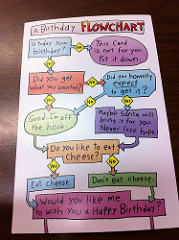
Flow Charts

8568887999_5562e7cc9e_m

Students are used to these in other subjects such as technology.  So use them to your advantage in structuring an argument.  Say for example you want the pupils to debate the environment, work experience etc.  Start with a variety of opinion phrases so that students make a point, explain it, add a contrasting view with “einige Leute denken, dass” and then add a further opinion and reason.  The exam boards say “express and explain a range of ideas and points of view.”  This is ideal for that very aim.

Lessons learnt teaching MFL to KS3 bottom sets. Part II

In my NQT year I had two hellish groups.  There were some good kids in there but the unmotivated and disruptive outweighed the good kids.  We had to deal with verbal and physical abuse of peers and staff (me), refusals to work, refusals to do anything or be sent anywhere and refusals to listen to you explaining anything.  They would throw things, swear, talk about all manner of unearthly thing and be loud and abrasive.  Some would storm out with a sense of drama befitting an RSC production.  Over the years I’ve got better with these groups.  If you’re a new teacher reading this.  I have three words for you: it gets easier.  The longer you are in a school; the more the kids begin to follow you.

I’ve learnt the following and I have a lot of colleagues to thank for this.

1) Relationship is the most important element of teaching these groups

If you are new to teaching then stick to the rules, follow policy and try to be understanding at the same time.  Most of the students in these groups see little point in languages and therefore you’re an obstacle between them and break/lunch/a more exciting lesson.  In the first few weeks, consider how you can make them want to be there and how they can feel succesful.  Learn their names in the first two lessons and learn things about them.  If the worst behaved kid in the school happens to do kickboxing outside of school, ask him about it.  You might be the first person that day to take an interest in them as a person.

2) Critical mass

Sometimes a few individuals can tip a group.  I remember being told on my PGCE that “the ideal group size is 3 smaller than you already have, and you know which three.”  It is a fair statement most teachers would identify with.  Look at the group.  Who influences behaviour?  Who follows?  Is there a way to get the influencing ones “on-side”?  This does not mean being their pal or mate, rather that you find a way to challenge them and get them involved.  If they are involved others will follow and you will have less to deal with.  Sticking to the rules and following up is crucial in this process.  I had a group where the critical mass was definitely not in my favour and it is really hard work.  The key to not getting into this situation is the first term and sticking to the rules.  Make them accountable to each other.  Explain how you want lessons to be and that it is their job as much as yours to make lessons enjoyable.  Bill Rogers suggests reviewing with a group how you feel lessons are going.  I would take the approach of getting pupils to write in the back of their books the following:

1) What skills or aspects of languages am I finding easy/difficult?  Why?

2) How am I getting better at languages?

3) Complete the sentence – my favourite lessons involve…

With these the students get a chance to “influence” your planning.  You can then say “‘you asked for this activity so that’s why we’re doing it”.  It shows them that 1) you listened  2) you acted on it  3) you want them to enjoy lessons.

3) Don’t pitch your lesson too high

Low ability sets are fighting weak literacy/numeracy, low self-esteem and being written off as a “bottom set”, “sink group” or “nurture group”.  In their minds, they have already lost.  You have to give them manageable challenges and praise them when they do it or when they don’t quite manage it but have tried really hard.  For some kids a sentence using a verb and an infinitive correctly is a huge challenge but if they can manage it, great.  Then stretch them further.  “You’ve done that, bet you can’t …” – some boys will really respond to this.  If they decide they can’t, then find a way to appeal to their competitive side or stretch them on that aspect next lesson.

4) Relentless positivity

Bottom sets are used to being bottom sets.  They are known as being the groups that no teacher looks forward to.  For one difficult girl I taught last year, all she needed to have a good lesson was the belief that I was happy to see her and wanted her there.  That meant finding something nice to say at the start of a lesson or asking how her day was.  It meant finding activities the group could do well early on and making things fun.  It also meant being honest when a less fun bit was coming.

5) ICT room

Every now and again I will take a group to the ICT room.  Kids enjoy ICT and websites such as www.linguascope.com or www.languagesonline.org.uk have excellent resources and cater well to all abilities.  Make sure they are clear on what needs to be done and don’t allow them to run out of activities.

6) Have a plethora of redirection phrases at your disposal.

Lower sets go off task quicker than most.  “Bradley, whilst your pet turtle’s mating habits are really interesting, can you get on with what you’re meant to be doing, thanks”  “That’s a really good question, ask me at the end.”  Praise the ones on task from the front, sometimes this will provoke the others around to action

7) Have a routine (Michaell Marland – Craft of the Classroom – massive help with ideas for this)

  • Date title and starter on board as they walk in.  Students get books out, write date and title and attempt starter.  First finishers can be helpful in giving out books etc.
  • Register while they do starter
  • Go through starter.
  • Explain objectives
  • Present something
  • Practise it in some way (L/S/R)
  • Check their understanding so far (mini-plenary)
  • Produce something – what can you do with it (S/W)?  What understanding needs to be practised (L/R)?
  • Plenary – an activity that shows you and them that they have managed to achieve the goal set at the start.

8) Reward effort (Carol Dweck – Mindset)

We spend a lot of time in our schools awarding achievement.  We celebrate who can run fastest, act best, sing well, play well and much more.  Effort is something that needs to be praised.  The end result may not be great but the effort that went in was.  If you show you value effort then you will eventually get attainment.  If you show you value only attainment then the rest that missed it will not try.  How could you deal with the situation below?

Teacher: “You put a lot of effort in there Tyler i’m really pleased”

Tyler: “But I didn’t finish it”

Teacher:

Teaching the present tense

I’ve had to do this with my German and Spanish groups recently.  Here is a selection of activities I have tried.  The main idea behind this blog is things that you can use easily without having to upload a powerpoint or extra resources.

Generally I will introduce the present tense from the whiteboard with colour coding for endings.  I have used powerpoints but students stare at powerpoints about 4 hours a day so sometimes the change is nice.

1) MM Paired Speaking (it’s called MM after the lady I learnt it from)

Students divide page into 3 columns with about 14 lines needed in their books.

  • In the first column students write either time phrases or days of week
  • In the second column they write activities (or could draw pictures to force more spontaneous language)
  • They leave the third column blank.  Eg:      Am Montag  |  spiele ich Fussball  |
  • Students then take it in turns to read out what they have written and their partner has to write down the sentences.

I find it practises speaking, listening and word order at the same time.  The year 10s seemed to enjoy it.  You can produce your own with clipart etc but that costs time and photocopying.  Get the students to do it for you in the lesson or prepare it as a homework.

2) http://www.languagesonline.org.uk  I cannot recommend this website enough.  It is excellent.

3) Cheat

Students get given 10 cards each and write sentences in the present tense on 8.  On the remaining two they write Schwindler.  They then get into groups of 4, shuffle the cards and play “cheat” (the card game)

  • Read out phrase on card and put into middle facedown
  • If they have a Schwindler card they have to make up a phrase similar to the ones they have been putting down.
  • If they are accused of being a cheat and the accuser is right, the cheater must pick up the cards.
  • If they are accused of being a cheat and were innocent, the accuser must pick up the cards.
  • Winner is the first to get rid of all their cards.

4) Translations / gap fills / correct the mistakes

All three of these are useful in fixing rules in learners heads and getting them to think through why they are putting particular endings on words.  They make great starters, mini-plenaries and plenary activities.  You can also differentiate them by having two sets of activities with different difficulty levels.