“Sir! When are we going to the computer room?”

Whilst not a pre-requisite to good teaching or good learning, some ICT room input is useful every now and again.  Students enjoy the occasional trip to the computer room.  I should use it more and my classes often remind me to do so!   Here are my regular ICT room lessons.  If you have a good idea drop one in the comments section below.

Sell your sibling (thanks to a former colleague for this one)

https://www.tes.co.uk/teaching-resource/Sell-your-brother-on-Ebay-6193621

Surprisingly, I have never got into trouble for this and the kids love it.  If they are an only child like the writer of this blog then suggest they sell their teacher.  Currently I am for sale on the wall of my own classroom.  In the event that your pursue the latter course, you may wish to correct any factual inaccuracies that ensue from the pupils description of you (which can often best be described as skewed, misinformed or just wrong).  If you’re wondering, I went for €1500.

WANTED

Great way to reinforce descriptions.  Give the pupils a helpsheet with phrases like “armed and dangerous”, “do not approach”, “reward” and then get them to find a celebrity and go for it.  A good plan is to tell them they are doing this lesson and have them think of someone beforehand, otherwise the normal battle of pictures vs content ensues and content loses out.  Ideally, they should probably avoid doing one of their teachers but if they’re learning and being creative with the language don’t stop them.  Display it in the corridor for maximum effect!

Gap Year

ANIMATEDGLOBE

Students plan a gap year using the future tense.  They need to explain where they are going to go, would like to go, intend to go etc and why.  If you have access to www.youtube.com then “where the hell is matt 2008” could provide some inspiration, although it might have more of an effect on your travel plans this summer.

Students could add more details and description.  The trick is to get them to focus on the language first and the pictures later.

Lebenslauf

Designing a CV.  Great way of teaching a range of vocabulary and revising a variety of topics.  Microsoft word has some good templates for this that can be customised.  You could set homework prior to this lesson so the pupils find the vocabulary they need and then produce the CV, or equally do it the other way around and teach them how to use http://www.wordreference.com properly.

Audio guide using audacity

Students produce a radio advert to encourage people to visit their town.  This can be done using the program audacity (free to download – or it used to be).  The difficulty is recording it.  Most students will happily do it but in an ICT room it does mean there is a lot of background noise.  Maybe suggest they do it at home or if your school allows then use http://www.spreaker.com/

Past listening exam papers

If you have a mixed ability group the ICT room is a great place for these.  Give the pupils the papers and put the listening tracks on the system or intranet where they can access them.  It also allows them to control volume and work through at their own pace.  This is good when you are developing exam technique.  Obviously some in-class or exam hall practice is good but this helps build confidence.  It allows you to cater to higher and foundation students if you have a mixed group.

Google Earth Directions

Why not create some directions that the pupils have to use google-earth to follow.  They could also create directions for their friends.  If they get to the right place then clearly they understood the directions – very easy way to evidence progress. There is a good resource on the TES for this but if you know where you are and where you are going then do your own.  I tried some with Madrid and got pupils going around the main square before being dropped elsewhere in the city and having to find the Bernabeu stadium.

Languagesonline.org.uk and samlearning.com

Both of these are superb websites and are improving all the time.  The former has recently been improved to facilitate use of tablet and smartphone.  The latter is gradually building up its stock of listening practice.  Languages online is free to use and has a lot of good exercises for practising grammar.  It also offers the explanations and hints to remind students of the rules they are practising and links well to Key Stage 3 schemes of work.

Little explorers picture dictionary

Great resource for early years or lower school.  My students have recently found this a great help on the house and home topic.  Whilst they see the title of “little explorers” as patronising, the website is very good.  Useful resource for weaker learners and perhaps getting students to make their own vocabulary lists.

Christmas Webquest 

Worksheets 1 and 2 are great for developing cultural knowledge.  I’ve only just discovered the rest of the site and there looks to be some really good material for French, German and Spanish.

Making writing more exciting

I personally feel there is too much of an emphasis on writing in GCSEs.  In spite of this it is a good means of checking understanding, encouraging creativity and developing literacy.

This is a short summary of 5 things that you can try and apply next week. You can judge my maths abilities at the end!

Writing Points.

Give students a grid of phrases with various points for various things.  It is similar to a writing frame but encourage them to use the more complicated material by giving it a higher points score:

5                              10                                                 20

me gusta              reason with porque   es     double reason with porque

me encanta         reason with porque son       use of “en mi opinion”

no me gusta        creo que                              use of connecting word not y/también/pero

odio                     pienso que                          use of negative in reasons given

This works really well with year 8-9 boys and a set time limit.  It also gets numeracy into your lesson.  It is really easy to differentiate by ability.  If you have a top set, stretch them, maybe 20 points should be for another tense.  The example above is for year 7s and links in with last week’s post.

Writing Bingo

Photo Credit: Leo Reynolds via Compfight cc

Photo Credit: Leo Reynolds via Compfight cc

Same as above but the mission is to use everything in the grid whilst still making sense.  Winner is first one to use them all.


Writing frames

These can be effective however they need to be tailored to the relationship you have with your group and material you have covered.  I have seen a number of excellent ones on the TES website but sometimes they need altering, correcting or rewriting for another topic as the layout is good but the material doesn’t help you!  If you know of particular interests within the group then consider playing to those.  For a more able group, the key to a good one is how much it forces adaptation and develops creativity.  For a lower ability group the question should be how it helps them to sequence their work and does it help to prevent the phrases such as “me lamo” “me prefiero” or “me juego” and the ubiquitous “me odio”?

Silly sentences

Photo Credit: Marcus E. Thomas via Compfight cc

Photo Credit: Marcus E. Thomas via Compfight cc

This works, my old German teacher used to practise grammatical concepts by increasing the difficulty of what we were expected to produce.  Emily’s horse said that it did not want to be eaten (passive, modal verbs and konjunktiv I – she had high expectations).

Pupils love it but it is about practising structure and aiming at automaticity with the structures.  Can students manipulate the language successfully?


Scenes we’d like to see

Borrowed from the popular jocular television show Mock the Week.  This is excellent for future tense or present tense writing.  “Things … will not do at Christmas” (insert name of celebrity or royalty).  “How Katniss Everdeen will spend her weekend.”  It really helps if you use mini-whiteboards as you can check that pupils have grasped the structures.  I made the mistake of allowing the kids to use me for the first one.  The results were interesting to say the least…

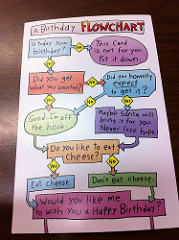
Flow Charts

8568887999_5562e7cc9e_m

Students are used to these in other subjects such as technology.  So use them to your advantage in structuring an argument.  Say for example you want the pupils to debate the environment, work experience etc.  Start with a variety of opinion phrases so that students make a point, explain it, add a contrasting view with “einige Leute denken, dass” and then add a further opinion and reason.  The exam boards say “express and explain a range of ideas and points of view.”  This is ideal for that very aim.

Stretching your best students

Whatever your view of G+T, it is clear that the brightest students in your class need pushing to achieve.  In a climate where languages takeup at GCSE is rising as a result of performance 8 or EBACC measures, A-level and university courses are experiencing decline.  A simple google search shows that in 2012,2013 and 2014 a major newspaper reported on the decline in A-level languages. Our best students should be the ones going on to study it yet most are not. There are blogs which explore and consider why.  Rather than do that, I thought I would share some of the things that I have tried, with varying successes.

Before looking at some ideas there are three questions you need to consider with extension work:

  1. Is the work I am giving them going to deepen their understanding?
  2. Is the work I am giving them going to consolidate their understanding?
  3. Is the work I am giving them suitably challenging and is there a suitable time frame in which to complete it?

Ideas for the classroom or outside of the classroom

Reading

  • Encourage regular independent reading in TL – encourage use of sites such as http://www.cuentosinfantiles.net
  • Authentic materials – what is there that they can go and get and work on if they finish early?  Can they spot the grammar point in a real-life context?
  • For boys encourage them to read www.juanmata8.com , the lethal mediocampista (midfielder) has a bilingual blog.

Writing

  • Picture response activities really allow for creativity. Show students a picture, they could then…
    • write the conversation that is taking place
    • write the events that are taking place  (present tense)
    • write what they think will happen next (future tense)
    • write what would happen if … (conditionals and hypothetical statements)
    • write what happened before (past tense)
    • do a mixture of the above (combining tenses)
    • write what the people should do (modal verbs)
  • Never settle for anything less than their best.  Insist on expanded answers in any plenaries/activities involving mini-whiteboards
  • Dictionary usage – encourage use of dictionary to improve and develop all written work.  Do you have a TL thesaurus?
  • French/Spanish penfriend scheme – get them involved if you can.

Listening

  • What else can they listen for?  Could they do a dictee from the listening recording if they get the answers first time around?
  • www.rtve.es/noticias/directo/canal-24h/    – Spanish news
  • www.france24.com/fr/  – French news     (opportunity to watch live on right hand side of page – pop up window opens
  • www.ard.de – same as the two above  Tagesschau is good short snappy news burst
  • Encourage listening to musicians: Manu Chao (FR/SP), Juanes (SP), Amaral (SP), El Tri (SP), MC SOLAR (FR), WISE GUYS (GER).
  • Encourage them to try a foreign film with subtitles in the TL and the audio in the TL.

Speaking

  • Interviews with TL speaking person are always good.
  • Insist on TL in the corridor, in class and if they have to use it then they will.  It will also develop habits and confidence.
  • Run a twilight session with a focus on improvisation and spontaneity.  They really do benefit from this.
  • Insist on elongated answers comparisons, contrasts, subordinate clauses, do not accept them lowering their standards to fit in.  If you have to then do the speaking test with them in the class but have everyone else working.
  • If playing the trampa game mentioned on this blog,  quietly challenge one to cheat on every go, or alternatively stack the deck.  I tried the former with one student and the intellectual challenge was something that they thrived on.  The morals are debateable but then the game is called cheat.

2 final salient points

1)  Encourage use of previously learnt language in all written and spoken assessments.  G&T students always want to do something new but the challenge should also be to include EVERYTHING they already know as a means of consolidation and a showcase of their abilities.

2) Check they are not sprinting before they can walk.  It goes against everything I have said above but they if they are playing around with subjunctives and still struggling with present tense forms, then you might want to sort the foundations out before building any more of the house.