It’s almost here. Regardless of the fact that 3 out of 4 exam boards are yet to have their specifications approved by OFQUAL, we have to begin teaching towards it in September. I’ve been thinking about how to prepare my year 9 learners for what is coming, in terms of topics and skills. Here are some things I have tried out:
Modalverben – regular drilling.
German teachers will be familiar with modal verbs. They are 6 most common verbs and are combined with an infinitive The same can be done in Spanish but there will just be more of them and they take different forms. I want my students to be completely proficient with these most common verbs so that they can use them spontaneously with infinitives. If you had 10 minutes to prepare for an exam, having a mental arsenal that contains
I have to / I like / I should / I want to / I can etc along with some infinitives, should be useful to them. We have been having regular sentence making drills on mini-whiteboards. Over time I have added in some opinion and reason phrases. If you are in doubt about whether drilling is effective then the video below is
Roleplays

I found the old roleplay cards and we will be using them in the coming weeks. If you don’t have them then there are some specimen papers on the exam-board websites. Those can be used and adapted. Rather than writing a section, I will refer you to a previous blog. A recent post on Frenchteacher also is worth a read. Do your students know enough multi-purpose transactional vocabulary?
Spontaneous Speech
Students are going to have to be a lot better at generating language spontaneously. Yes they can be drilled in rubric, roleplays and discussion but there is a greater emphasis on producing the language unaided. With TL rubrics in the speaking elements, this could be even harder. Rachel Hawkes has some worthwhile suggestions here. She also has a Phd so I will leave it in her capable hands.
Speaking from pictures.
Rachel Hawkes illustrated this brilliantly on a recent course I went on. It is about encouraging learners to use what they have learnt. It does not matter if they cannot say what they want to say. The question is what can they say?
What might a year 7/8/9 be able to do with the following picture?
- Es una fiesta. Hay un elefante. Me gustan las fiestas.
- Creo que es una celebración porque hay mucha gente.
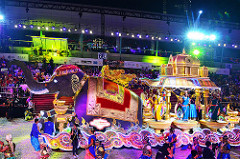
Photo Credit: chooyutshing via Compfight cc
Equally with this you can get the students to predict the questions that might be asked.
New Topics
I’m borrowing from AQA here.
- Marriage/partnerships
- Social media
- Mobile technology
- Customs and festivals in TL speaking countries
- Charity/voluntary work
- Poverty/homelessness
This looks more interesting than “self, family and friends”. The hard bit is working out how these might be examined. How can we teach them and make them accessible? See the table below:
| NEW GCSE | ||
|---|---|---|
| Topic from AQA | How it could be examined | Implications for teaching practice |
| Marriage/partnerships | Speaking – discussion or picture Listening Reading Writing – essay or translation question |
Students need to be able to give their opinions on this topic. Discuss with RE department to ascertain prior knowledge, stumbling blocks and stereotypes. |
| Social Media | Speaking – do you think it is a good thing? Listening – text about someone who uses Reading – text about social media Writing – essay or translation question |
Need to teach a variety of multipurpose vocabulary as the range is so wide. Students need to be able to give opinions on it, use frequency adverbs and explain why it is a good or bad thing. |
| Customs and Festivals | Speaking – is celebrating things important? Listening – report about an event Reading – text about an event Writing – less likely, possible translation |
Teach major festivals at various points of the year. Day of the dead, san fermin, la tomatina, las fallas. Students will need a cursory knowledge of the well- -known festivals |
| Charity/volunteer work | Speaking – should young people do it? Listening – account of someone’s job Reading – account of someone’s job, charity website? Writing – should young people do it? |
Teach students phrases to structure arguments and create extended responses. |
| Poverty/homelessness | Listening Reading – text on developing world |
Echo 3 and Mira 3 do a bit of this. Discuss with geography, is there a case-study or unit of work that you can link this too. |
 Everyday MFL