Since my PGCE, I’ve always thought that games have a place in MFL teaching and learning but they must have a purpose. That purpose could be: the practice of vocabulary or structures, practising spontaneity or revision of vocabulary.
Variations on Sentence Stealer
It always amazes me how Sentence stealer started in Kuala Lumpur and has made its way to classrooms across the UK and Australia and probably further afield. I’ve played it with a variety of classes in different schools and it always seems to go down well. I have come across one or two obstacles in playing with trickier classes
One student gives others their cards so that they win at the end
Students use a mixture of English and Spanish “do you have joo-ey-go al football?”
Some students don’t talk enough
Here are a few variations I have tried to counter this:
Pink writing – While the students make their cards. Write out four using a pink pen (or any colour they are not using). Slip them into a couple of students piles. Winners are now the ones that have the pink writing ones at the end or the ones with the most cards.
English = lose a card – While students are completing the activity, I walk around. If I hear English, I take a card from them.
Sudden death round – 1-2 minute timer (dependent on class size). Each student starts with one card. They continue to play as normal but as soon as they lose their card they return to their seat. Hint to students that the more they talk the less likely they are to be out quickly.
The 10 phrases game
Made this up after a game of 1 pen 1 dice earlier this week. Write ten phrases or chunks on the board. The more advanced the group, the longer the chunks can be. Colour the sentence complements in red (complement = word phrase or clause necessary to complete expression)
Juego al fútbol
Escucho musica
Student A: reads through the sentences trying to finish them in a different way.
Student B; counts how many they manage.
When finished they swap, but here’s the thing…
Student B cannot use any phrases student A has already used.
The game forces students to use what they know. The intention is to move them away from saying what they want to say and instead saying what they have learnt.
The Algo Game
Every now and again, you rediscover a game that works. The “algo” (something) game is one such example. You can find full instructions here (with pictures) and here (bit further down). This activity is great for reading aloud practice and practice of chunks. I can see it being particularly useful with the reading aloud element of the new GCSE. In the past, I have gone with a point per correct word. It motivates them to focus on listening and transcribing what they hear.
Points for sentences
This came from a lovely MFL teacher called Deborah who ran some training for us back in the days of controlled assessments. It works for both speaking and writing.
Verbs 5
Verbs 5
Time Phrases 5
Conjunctions 10
Showing off 20
You can imagine the kind of things that will fill the grid. You can also vary the requirements e.g. “weil” and “obwohl” might score more than “und” and “aber”. Students have a minute or two to make as many sentences as they can.
Student A: just talks and makes sentences
Student B: listens and notes down their points
Swap
Winner is the person with the highest points score. You can then also set it as an end of lesson writing task. The Nice Man Who Teaches Languages (whose blog is well worth a look) has written about getting students to write sticking to what they have learnt and they know from their repertoire. This activity helps with that as students stick to the phrases there as they score points.
Two truths and two lies
One of the easiest activities to do on the spot, likely inspired by the BBC programme “Would I lie to you?” Minimal Prep, maximum effectiveness. This came towards the end of a lesson on negatives in Spanish using the theme of sports and free time. It is easily adaptable to food, clothes, healthy living etc.
Students write two sentences that are true for them and two that are not. Most students do this in the order you say. Make sure they read them out loud to their partner in a different order!!! It’s then up to their partner to spot the fact from the fiction.
Other cultures have always fascinated me ever since learning about Norway in Year 5 or tasting a Stollen in German class in Year 7. My experience of teaching secondary languages suggests that this fascination is true for our students as well.
Was Norway where this fascination with other cultures started? Possibly! It’s still on the list to visit…
We teach culture to build enthusiasm interest and develop the cultural capital of our students. for those students who do not enjoy the language learning process so much, this can be a great way to hook them in.
There are four approaches to the teaching of culture that I have used in my career.
Unit based approach
The obvious benefit of a unit-based approach is that students can gain a deeper understanding of the target language culture full stop. I’ve seen units structured around the films “Innocent Voices” or Valentín. I have seen lessons centered around schools in Latin America or French speaking Africa. I have taught lessons about Cuba (thanks Listos 2), Dali, Goodbye Lenin and the Carnival de Oruro over time. There are schools who use artists such as Miro, Matisse and Picasso as the foundation for some of their early Spanish modules. Some textbooks base entire chapters around a target language festival, country or city. Indeed, one of my former colleagues convinced a class that Mira 2’s “Barcelona Te Quiero” song was once a successful Eurovision entry! The language gym has exercises on La Tomatina. There are plenty of ways to integrate culture into our lessons.
Just as there are benefits to this approach, there can be drawbacks. Culture can be relegated to an end of year project or sometimes a module around culture ends up with grammar or vocabulary “shoe-horned in” as they are good revision opportunities when actually other opportunities might have existed. The way to counter this is to ask the question: “Is this the best learning my students can do with the material that I am presenting them with?”
This might be a slightly extreme example but let’s take bullfighting:
It could be used as an opportunity to describe the colours of clothing worn by matadors, body parts or…
Do you use it as an opportunity to build opinions and justifications?
I think that
bullfighting
is can be
dangerous
as
animals are killed
however although yet
I believe that
barbaric
people risk their lives
In my opinion
unpleasant
the animals have no choice
In my view
cruel
The Pop-up approach
Do we simply just teach about the culture when it just pops up? Festivals in particular lend themselves to this approach. Events such as Las Fallas, Barilletes Gigantes, Dia de los Muertos, Christmas, Karneval and Bastille day are all opportunities to engage students with the target language country and its culture. Sometimes a textbook will have a single or double page spread on something. It does not take long to find a short appropriate video to show towards the end of a lesson.
The benefits of this approach are that it does not take up too much classroom time at the expense of learning the language. The drawbacks are that much can be missed if it is the only way culture is taught.
Displays
There are some wonderful displays out there. I have never quite had the artistic abilities to produce an amazing cultural display of the types one often sees on Facebook groups, X and BlueSky although I have done my best. I managed one on Germany with a lot of authentic materials after a trip to Berlin but our school then made the decision (against my protestations) to phase out German…
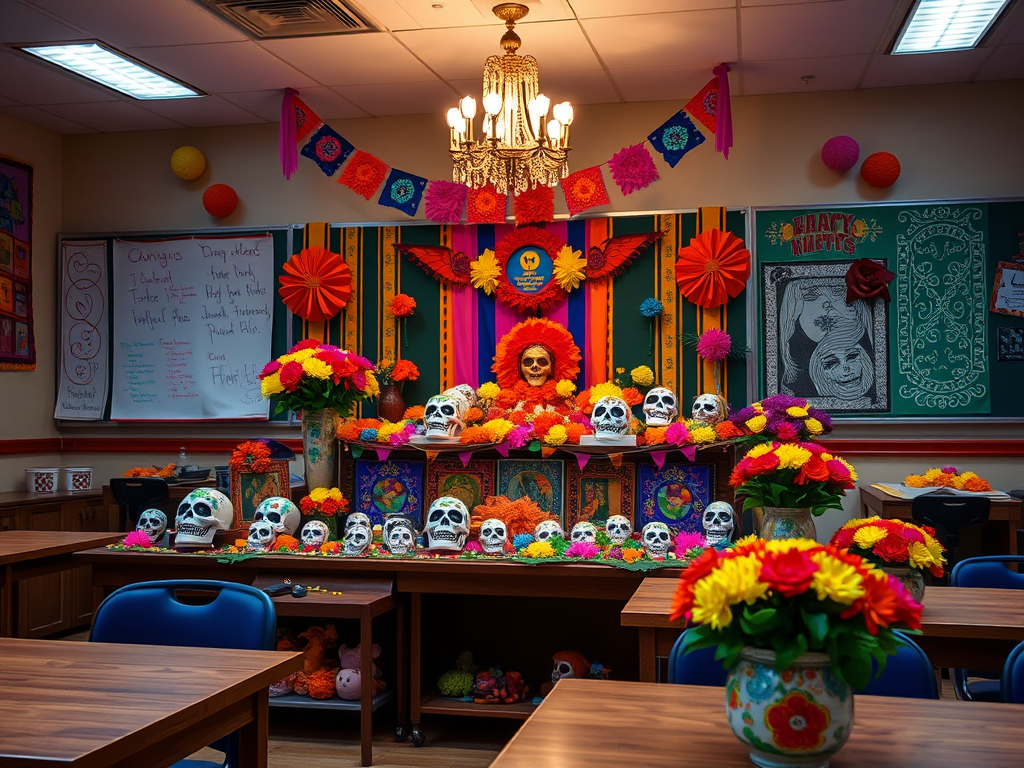
If you’re wanting inspiration, you can find some materials here with MFL Magic, Jose Garcia is has some of the most artistic cultural displays I have seen or you can go full mural as seen at this school on X. There are companies who can produce bespoke murals when given a set of criteria. If you are really stuck for inspiration regarding layout and how it could look then the picture below was created by giving an AI image generator a prompt “classroom dia de los muertos display.” Bear in mind these are highly predictive generating tools and will not be perfect but it might spark some ideas.
Like other approaches this does not detract from classroom time and it makes for a pleasant learning environment. The drawback is again that the display may need refreshing every so often and then you have to balance time invested against the return.
Culture slide approach
This is probably my most recent evolution in culture teaching and the one that I actually feel has done it best. Dedicating 2 minutes of a lesson to culture after answers to a starter/do now task and before the lesson fully starts. I prepare a single slide on a topic that includes some pictures and some fun facts. I talk through it for a minute or two and then we crack on with the lesson. The benefits of this approach are that there is largely something for everyone. The students who enjoy history enjoyed learning the history of Spain. The musicians enjoyed learning about singers/songwriters, bands and music. The students who go on holidays learn a bit more about the places they have been. The students – for whom a holiday abroad is unlikely – broaden their horizons. The students who don’t appear to enjoy language lessons often appear to enjoy this part.
Just to unpack what I mean a little bit more by “some pictures and fun facts”…
The Spanish island of El Hierro had a whistling language that was used to communicate between villagers. William Shakespeare was given a barrel of wine from Tenerife as part of his salary. Ibiza and Formentera were used as a base by pirates. Francesco Tarregas’s Gran Vals in A contains a tune known by millions around the world without realising its Spanish origins (seriously, look it up). The Menorcan city of Mahon is home to Salsa Mahonesa, or – thanks to the French – as we now know it: Mayonaise (an utterly disgusting substance with which people inexplicably ruin sandwiches).
I cannot reproduce the slides as they produced in the context of my work for an academy trust and therefore property of the trust, however, here is a rough guide to what you could do:
Year 7
Term 1
Term 2
Term 3
Term 4
Term 5
Term 6
Spanish Islands Mallorca Tenerife Ibiza
Major players in Spain. King, President, famous people
History of Spain Cavemen to present day in 10 lessons. *
Customs / Festivals Mealtimes Siestas Padel Tomatina San Juan
*Simon Barton’s History of Spain was quite useful for this for the division of eras into 10 lessons.
Year 8
Term 1
Term 2
Term 3
Term 4
Term 5
Term 6
Spanish artists.
Spanish musicians
Central American countries
Foods including Paella Mole Negro Pique Macho
Idioms from Spain
Quirky places to visit in Spain + South America Smurf village Water fights in Bolivia Colombian festival of Yipao
Culture can make great cover work
Feedback from the cover supervisors in my first school was that they hated covering Spanish/French/German as they didn’t know the answers, students would struggle with not knowing words and most people sending in cover are often too ill to provide much more than “do these grammar exercises.” Whilst a set of sentence builder activities goes a long way towards solving this, a cultural based lesson could work. A set of cultural based activities means students are still learning, they do not pick up or reinforce misconceptions with unchecked exercises and the cover teacher has a significantly easier job.
I have done this two ways in the past:
Spain Live – This was a great textbook teaching pupils about Spain. It works very like a geography textbook with articles and questions to answer. There are also France and Germany versions.
IT room/library – Write out a list of Spanish speaking countries, periods in Spanish history or famous Spanish people. Give each student a different one so that they have to do their own piece of work. Students have to create a poster / powerpoint / document of some description that explains everything they can find using the computers or the library (if your school has one). To avoid copying and pasting, make them write it in a horrible histories style where it has to be accessible for a child aged 8-10.
Conclusion
However you choose to teach it, there is no escaping the fact that culture can broaden horizons, enrich the mind and enthuse our students. The above are some ways I have done it over the past 15 years. You may have others in which case feel free to suggest them in the comments or underneath the social media posts.
I’ve been a teacher for nearly 15 years. Over the past seven or eight, due to timetable pressures and a variety of other factors, I’ve found myself teaching several different subjects. Often, as a languages teacher, I’ve sat in CPD sessions thinking, I’m not entirely sure how I can apply this to MFL.
In the last seven years, I’ve taught across five different subject areas: History, English, Religious Studies, Drama, and more recently, Computer Science. For those of a footballing persuasion, I guess i’ve ended up as a versatile super-sub*. A mix of Wayne Rooney and Ole Gunnar Solskjaer.
History
A few years ago, I was given a Year 9 top set history class, shared with another teacher. I like to think this was a mutually beneficial arrangement. They helped me deliver the lesson by explaining content and the activities; I fixed their German pronunciation. Two things particularly stood out from this time.
The first was that the starter tasks—or “do now” tasks —increased in difficulty from question one to question four. The idea was that every single student should be able to answer at least questions one and two. This meant every student in the room came in with an instant chance to be successful and get their lesson off to a good start. They followed the following pattern:
True / False
Multiple Choice
Short answer
Sentence / Multiple Sentence answer
There was a culture of “no excuses” for not answering or attempting question 1 and 2. I was encouraged to circulate and particularly demand extension to answers on question 4 and support those struggling with 3 or 4. I think a similar principle could work with MFL starters.
The second thing that really stood out was how each lesson was framed as a question to be answered. Now, in History, this is significantly easier than in MFL. Take, for example, the questions: What happened at Pearl Harbour? or What did the failure of the League of Nations mean for the future of Europe? Both of those questions immediately build interest, curiosity, and engagement.
In languages, this is obviously significantly trickier. The question: How do we form AR verbs? does not bring with it the same level of curiosity or interest (apart from for a select few of us who love our grammar). Could we possibly rephrase that question to: How can I master 88% of Spanish verbs?
There are, however, some areas of language teaching that naturally lend themselves to this “lesson as a question” approach. The teaching of ordering food in restaurants would lend itself well, for example: How can I order food and drink in Spain? Similarly: How can I describe people? or how can I say what is wrong with my hotel room? By phrasing the lesson as a question, students can walk out knowing they have learnt the start of the answer. How can I master 88% of Spanish verbs? I need to know the six endings; I need to remember to remove the AR and replace with the correct ending. For those wondering, the 88% is from a 2019 analysis of the Royal Spanish Academy Dictionary.
Religious Studies
In 2019, I taught Religious Studies due to timetabling issues. My main learning from this year of teaching would be the idea of spending entire half terms on one thing. For example, one half term was Christianity, one half term was Buddhism, and one half-term was Sikhism. These were Year 7 modules that were about six lessons each.
One popular Spanish textbook I used to use had the following five pages: ages, members of the family, pets, descriptions of hair and eyes, and descriptions of personality. The topics were well presented, the grammar chosen was sensible when linked with the topics, and the activities were, to an extent, useful. However, was this too much for two lessons a week in Year 7? The answer is probably yes.
At the end of each term in Religious Studies, we would assess what had been covered in the previous five lessons—and only that. I wonder if sometimes in languages we don’t teach sufficiently narrowly, and then we don’t assess that narrowly either. Gianfranco Conti recently wrote in a blog about the desire to correct everything that persists in many schools and trusts across the country. Perhaps we need to ensure that they can do fewer things well?
Drama
One year shortly before half term, I had a visit from a member of SLT suggesting that they needed someone to teach Drama for four weeks until the new Head of Drama arrived. To make matters worse, they said it was Key Stage 3 Drama.
I had the fortune to take on a good class comprised of pupils I had taught before. My biggest learning from the Drama department—and indeed from watching the new Head of Drama at work—was that projection was emphasised. Phrases such as “say it again but say it better”, “tell me, don’t ask me”, “say it like you’re really confident”, “say it like you believe it” were all used to develop their students’ ability to project, to sound confident, and to deliver lines with character, or as one of my English colleagues would say “with gusto!”
In MFL, sometimes I wonder if we neglect this in paired speaking activities. Recently, with my classes, when we’ve done short conversations, or short question-and-answer work in pairs, I’ve asked them to stop and then repeat it sounding like they are more confident. This might mean I ask them to sit up straighter, or I ask them to stand up.
If you think about it, most conversations in real life do not happen at a table where the person next to you is directly to your left or right. In a café, they are often opposite or slightly to the side. In passing, they are often stood up. It may be confirmation bias, but I tend to find that the second time students perform the activity, they sound better.
My version of the activity quiz quiz trade helps with this. Here’s how I run it. If you have read this blog for a while, then you will know my fondness for mini-whiteboards. They will help us here:
Students have a question on a mini-whiteboard and the start of the answer on the back. Whatever language you teach, you can apply the examples below:
Side facing student = question
Side facing away from student = help with answer
What do you do in your free time?
In my free time …
Do you play football
Yes/No ….. sometimes / never
Do you swim
Yes / no …… regularly / rarely
Students must 1) ask a question, 2) answer a question 3) swap their whiteboard. They can sit down after 5 ask/answer/swap cycles.
In our school, we have a policy that is known as SHAPE. Lots of schools have this, although I wonder sometimes if we focus on the S at the expense of the P. Languages, like Drama, are an opportunity for us to develop our pupils’ oracy—that is to say, their ability to speak confidently and fluently.
Computer Science
More recently, I have taught Computer Science. It may surprise you that both subjects can learn a lot from each other. As a languages teacher teaching Computer Science, I have found that my appreciation of mini whiteboard checks for understanding can continue. However, this post is about what we can learn from other subjects.
One of the things I’ve noticed in Computer Science is that flowcharts are extremely useful as a means for understanding. By this, I do not mean a bullet point list or a “1-2-3 steps for conjugating.” I mean a clearly laid-out visual flowchart. For example, this could be used for explaining when to use the subjunctive in Spanish:
Am I expressing a wish or desire? → If yes, use the subjunctive.
Am I expressing an impersonal reaction? → If yes, and if the sentence includes “it is + adjective,” then yes, I should use the subjunctive.
This could be a helpful way for students to visualise and decide whether the subjunctive is required using my favourite language teaching acronym: WEIRDO (Wishes, Emotions, Impersonal statements, Reactions, Doubts, and Ojalá).
I have also used these to help students build their opinions when talking about school. Word’s SmartArt can be quite helpful in this regard. An example in English is below:
Similarly, a flowchart might be useful in forming the passé composé in French. Students would then be able to decide easily between avoir and être and then progress onto Mrs Vandertramp (does anyone remember—or still use—the YouTube “Umbrella” version?) or however you choose to characterise the remaining verbs.
The second thing I’ve learnt from teaching Computer Science—and this is more aimed at GCSEs—is what we call the Moneyball approach. Moneyball is a film about baseball where a lower-league baseball club finds value in players that people didn’t rate very highly and their data-driven approach makes the club very successful. In the film, one of the main characters tells his club director that he needs to “buy runs,” not “buy players.”
To turn this into a modern-day football analogy: you are essentially buying goals, not buying a striker. Harry Kane scores you 30 goals a season. Other strikers, although highly thought of, may not reach those numbers but you could buy two players who will score 15 goals a season each such as Matheus Cunha and Bryan Mbeumo.
We can apply this Moneyball approach to exams. If the average needed at foundation level for most languages and exam boards (according to ChatGPT) is 60% for a grade 4, and the average for a grade 4 at higher tier is somewhere between 37% and 43%, then we need to consider: How are we going to put our students in the best place to get those marks? What are the things that we can control, that we can drill, and that we can best prepare them for, in order that they may achieve that?
I will leave you to think about those last couple of questions.
Conclusion
I hope this post has shown that, while not every strategy from other subjects will seamlessly translate to MFL, there is a wealth of insight to be gained from stepping outside our own discipline. Whether it’s the deliberate staging of questioning in History, the focus on oracy and projection in Drama, or logical and data-driven thinking in Computer Science, each subject offers something valuable.
By borrowing and adapting these approaches thoughtfully, we can enrich our language teaching and better support our students in becoming confident, capable communicators.
*James Milner was a consideration for comparison at this point but then I remembered his previous club history
This is a re-write of my most viewed post. Despite being written in 2016 and lessons no longer being graded, it has consistently topped my most-read posts every year. It was probably time for an update.
‘Hypothetical’ conversation overheard in staffroom:
Experienced teacher 1: “I delivered a number of outstanding lessons today”
Experienced teacher 2 “Ha! Your definition of an outstanding lesson is you putting your feet up while the kids are standing outside!”
Experienced teacher 1: “you saw them then!”
What makes an “outstanding lesson” is highly subjective and is based largely on the observations of the person watching. It is a positive thing that we have moved away from one word judgement of lessons or lesson snippets and there seems to be a similar move away from one word judgements of schools.
This is not a post on “how to play the OFSTED game” as the only OFSTED game to be played is simply high quality teaching and learning. It is a post about the key ingredients for an outstanding lesson and how we might apply those in MFL teaching everyday.
The big three: intent, implementation and impact.
OFSTED’s re-focusing on curriculum with the three I words is now well known. Intent, implementation and impact. The big question is the question every teacher should be asking of their classes “have they learnt it? And how I know they have learnt it?” Is my implementation achieving the intent? They (ofsted) will discuss this with a Head of Department or Lead Practitioner and then visit classes to see it in action. The idea is that what the Head of Department is saying should be visible in classrooms and students should be benefitting from it. Their evidence for forming their opinion will come from that discussion, watching lessons, talks with students, talks with staff and looking at any work in books.
My experience of being visited by OFSTED and our department going through a deep dive last September was that it followed the following pattern:
Part 1: A discussion about the intent, implementation and impact of the curriculum. My Head of Department did this bit so I cannot tell you exactly what was asked but if you want some typical practice questions then you can click here and this one from ilanguages gives some ideas of example answers too.
Part 2: Visits to lessons, talking to students in those lessons and looking at books. The inspector thought my teaching was “enthusiastic” and the lesson “well-delivered.” They expressed some disappointment that there was not any paragraph level writing in the Year 7 books. It was the first week back in September and their second lesson of Spanish. I’m not convinced their expectations there were reasonable but it also explains the levels of energy on display! They are essentially trying to answer a question around implementation. Is what the inspector has been told evident in classrooms?
Part 3: A discussion later with staff that began with some curriculum matters and then opened up to wider issues such as workload, how teachers are supported in school, safeguarding and recent training. To be honest, I thought this discussion would be much tougher but it was conducted in a fair and supportive manner.
Dealing with the drop in
Inevitably at some point a lesson is going to be watched. Personally, I feel a mixture of being short-changed and relived if not seen by an inspection team. Out of the four OFSTED visits, I have experienced, I have been visited on three. All of the below “ingredients” came from the previous post with some updates for 2025. They are not a recipe but definitely things to think about ahead of any lesson drop in.
Key Ingredient:
What it means for MFL teachers:
Consistency
This is a tricky one. In some schools and trusts, it appears to mean every teacher delivering the same slide decks (hopefully tailored to their groups). In others, it means a set of principles of delivery but teachers might be working on different lessons due to one group being ahead behind because a teacher deemed the group to be in need of re-teaching etc. There probably has to be some level of consistency across your team in delivery but again this needs to tie in with what you say in that deep-dive session.
Starting Points
Some knowledge of the students’ starting points is helpful. If most of your students arrive at Year 7 having had strong language teaching, how are you building on it? Are you able to build on it? Are your Year 8 and Year 9s building on prior knowledge? Would an inspector see more challenging vocabulary, grammar and writing in books if they compared between year groups?
Challenge
Is your work demanding enough? I don’t mean simply sticking an extension task on a starter or a reading activity. Are you sufficiently challenging that student who finishes the task seconds after you have explained it? Should they have finished that quickly? Are all students challenged and engaged? How could you reward risk-taking with the language?
Pupils views
ARGH?! What would they say about your lessons? If memory serves, my students were asked: – What they are learning? – Do they remember what they learnt last lesson? – How does it fit in with what they have been learning? – Do they enjoy learning languages?
Enthusiasm
You got into this job for one of two reasons (or possibly both). You love your subject or you love working with young people. Ignore the fact that someone is watching and teach like you do everyday.
Scrutiny of work
From this I understand the following: 1) Books will be looked at. 2) Can you demonstrate that students are improving? 3) Is there evidence of challenge or support and scaffolding? 4) OFSTED do not expect to see particular types of marking/feedback however they do expect to see departmental policies enacted so whatever you say you do, needs to be what you actually do.
Subject Knowledge
This will naturally come through as you teach. Remember you are the expert. Keep your explanations clear, don’t be nervous about the observer, just focus on doing what you normally do. If you are teaching your weaker language then there is some advice here: Keeping your languages up!
Effective Planning
No time wasted and all resources readily available and accessible. They will not want to see a lesson plan but it’s very easy to spot a well-planned lesson. This is probably the best thing I have read on planning an MFL lesson and still one of the best posts on the topic 8 years later.
Behaviour Management
Clear rules and consistently enforced. Again, keep to your school or department policies. I would argue that there is nothing wrong with removing a student whose behaviour is detrimental to the progress of the rest of the class, even in an observation. If there is a policy to be followed, follow it.
Adequate structured practice time
Pupils must be allowed enough time to practice and embed what they are learning. There must then be a definite increase in demand and evident progression in difficulty of the material covered in the lesson. Practice in MFL will obviously take place through different skills but it is worth considering: how do they link to your overall objectives in that lesson? Is the planned practice going to lead to some production?
Checks for understanding
Understanding must be checked and any misconceptions identified. You can probably tell who will struggle so maybe set the class a short activity that they can use to demonstrate their learning, while you go and help those who need it.
Challenging h/wk
Homework should consolidate, extend or prepare the students for future work or a mixture of the three. More on homework here
Literacy and Numeracy
Whilst numeracy is harder to shoehorn into MFL, literacy is very much the bedrock of what we do. Start using grammatical terms and do not shy away from them. You’re a language teacher and probably a fan of the odd reflexive verb, subordinating conjunction or relative clause. Own it.
Pupils know why they are learning what they are learning and how to improve
Pupils will likely be asked about what they are learning. They may be asked about work in their books, what lessons are like and how they feel about their progress in the subject. Do they know what they need to do to improve?
Challenging stereotypes
As MFL teachers we are in an ideal place to do this.
OFSTED’s descriptions miss out one major feature of teaching that I believe is key to delivering outstanding lessons and that is relationships. Admittedly you can produce an outstanding lesson that meets all of the above boxes but relationships go a long way to making all of the above much easier! Your relationships with your students will answer that. John Tomsett says: ‘Fundamentally students need to feel loved and I really don’t care what anyone might think of that, to be honest, because if I know anything about teaching, I know that is true.’
What could I do now? 5 things to try this term.
If you’re English then make a cup of tea before contemplating the following:
Build those relationships. Grab your seating plans or mark-book and find 3 students per class who you are going to develop your relationship with. How are you going to do that? Will you be teaching those kids next year? Who knows? Do it anyway.
Key Ingredients. Pick one of the key ingredients that you need to work on. In your planning for next week incorporate it into every lesson. Yep, that’s every single one. It’s all very well reading a blog post but you have to act on it. My old headteacher liked the phrase purposeful practice.
Revisit. Revisit your intent, implementation and impact. Are you doing what you say you are doing?
Gained time. Can you devote some of it to CPD? Who in your department is good at challenge, differentiation, target language use? Who could you learn from?
Power of praise. I used to do termly phone-calls or emails home to a parent to give some positive feedback on a student. I’ve slipped on this and may well do a few in the coming half-term. Shaun Allison writes about them here.
Consider September. Yep, right now! September is where we set the tone, set the patterns and culture in our departments, what would you like an observer to see if they entered your classroom? What needs to be part of your practice?
Iron sharpening iron. “As iron sharpens iron, so one person sharpens another” (biblical proverb). I love this proverb as it applies to most areas of life. Another person can always be guaranteed to sharpen you and smooth out the rough edges. Most NQTs have a mentor and most PGCE trainees do too. Once we exit that process, we are on our own. Who could you work with to improve your own teaching? Can you get them to pop in and watch? No notes, no agenda, no judgments and no threat, but just someone there simply to develop your practice.
Further Reading
Great Lessons – a series of blogs by Tom Sherrington (Headteacher) on what makes for great lessons and still good years on.
After recycling my yearly Christmas blogpost for the last few years, I decided it was time to make a new one. As a result you now have 18 ideas. Enjoy!
Idea 1: Lyrics Training, Christmas songs and mini-whiteboards
Create an account on Lyrics Training. Load up the website. Give out a set of mini-whiteboards. Pick a song, set your difficulty level. Decide on write mode and choice mode (write means writing full words and choice is a selection from four). Project the video on the screen and hit play. Students write the words when the music stops, show their answers and keep a points tally. Ones I have used in previous years.
Santa Claus llegó a la ciudad Enzo- Laura Pausini version
Feliz Navidad si tu quieres – Enzo
Mi burrito sabanero – Juanes – more on this one later.
You can find others just by typing in Navidad / Noel / Weihnachten or Christmas related words.
Idea 2: The Christmas Quiz is the vehicle for teaching about Christmas.
I’ve seen a lot of Christmas quizzes like this one by Alex Rose on TES. My personal favourite is this one although now it will cost you the wallet destroying sum of £1. It’s a bit shorter and cultural knowledge is dropped in with the answers.
Idea 3: Plan to reuse them every year.
I now have Christmas, Easter and day of the dead PPTs with all of the following in. Yes, it makes for a large file size but at least it is all in one place and easy to load up. It took me 8 years of teaching to think this up but it works now. The resources that go with the PPT are all in the same folder.
Idea 4: Mi burrito sabanero (or similar in German/French)
Most UK primary school kids have come across the song “little donkey”, and if they haven’t then they are missing out/lucky (delete as applicable). I like to think that “mi burrito sabanero” in Spanish is the equivalent!
Do now: 12 words on screen. 8 from the song, 4 not but similar sounding. Students work them out or look them up. Avoid “Belén” as to some teenagers, apparently it sounds quite rude…learnt that one the hard way.
Listen 1: Students listen to the song and identify which ones they hear in the song.
Listen 2: lines from the song mixed up on screen / on paper. Students number them in the order they hear them.
Listen 3: Gap fill
Listen 4: With video containing lyrics to check answer.
If i have heard the song too many times in that week then listen 1 moves straight to listen 3.
Idea 5: Class discussion sentence builder 1
Set up a single powerpoint slide with: “What is the best Christmas film?” in your target language.
Opinion phrases
Name of Film
Simple reasons
Agree/disagree phrases
I love
Home Alone
I like the story
I agree, it’s fantastic
I like
Muppet Christmas Carol
it makes me smile/laugh
I disagree it’s terrible
I enjoy
it makes me feel christmassy
I haven’t seen it
Consider it a sentence builder with reactions added at the end.
Students discuss in pairs and then pick a few to listen to.
Idea 6: Class Discussion Sentence Builder 2
I’ll be honest here, I got to 8 ideas when writing. So, take the idea above and change “best” to “worst” and alter opinion phrases and reasons.
Idea 7: Penguins(Spanish only)
Yep, you read that right.
One whole lesson ready to go. Neil Jones’ Madagascar Penguins is a great “off the shelf” lesson that is fun, enjoyable, Christmassy and goes down well with most groups i have done it with. If you are in the kind of school that doesn’t allow films then maybe try adding it to the scheme of work first.
AI generated madagascar penguins
Idea 8: Activity around a short film (French only)
Courtesy of Josiane Cullis on TES. Le Loup qui n’aimait pas Noel is a lesson based around a short film and with plenty of activities including pre and post listening tasks.
AI generated wolf
Idea 9: German Christmas Digital Escape Room
I wish I could make something like this but Ann-Kathrin Latter definitely has some skills. This German Christmas Digital Escape Room looks great fun, is beautifully presented and I can see it going down well with Years 7,8,9.
Quite why Mini-whiteboards tend to divide opinion is a bit of a mystery to me. A colleague once observed my lesson with a well-regarded speaker who often leads CPD around the country. My colleague informed me later that this speaker had said that the best way to improve my lesson would be to “bin” the mini-whiteboards. Had I not used them at that point then I wouldn’t have an accurate idea of what they learnt that lesson and indeed if they had mastered the verb conjugations I was trying to teach. Conversely, another senior leader (and now successful Headteacher) would not teach science without having them to hand.
Adam Boxer writes an excellent blog about Ratio (a concept from Lemov’s Teach like a Champion). I believe mini-whiteboards to be one of the best ways of increasing ratio in the classroom. I have a few principles when it comes to using them.
Principles:
– Everyone writes
– Everyone tries
– Everyone hides their answer until it is asked for
Logistics
I don’t have a classroom and teach in wide range of different rooms. I carry around a box with everything I need to teach. Here is how I manage:
Stock up on a box of 10 new pens at the start of – and halfway through – each half-term. No-one throws away a pen without my say so. “If I can read it from the front, it works.”
Hand out the whiteboards while students are doing the starter task. Do not hand out pens until you plan to use them.
Give out and/or get students to give out pens and rubbers. Rubbers are 1 between 2. It saves time and also means they are less likely to lose them as the other person needs it too! Some students prefer the blazer sleeve cleaning method.
Always insist on trying a pen that a student claims “is not working”. Often this is a misconception and what they are really trying to say is that it’s not a perfect jet black.
Always give a clear instruction of what you want to see on the board. Challenge any non-compliance such as doodling etc.
Always count down giving long enough for those students that need it. Sometimes it can help to have a particular student in mind as a guide and start the countdown when they are closer to finished.
No-one shows an answer until countdown is over and everyone shows their answer.
Whiteboard Activities
Obviously, you can use a whiteboard to translate both ways and practise verb conjugations. You can use them to draft sentences for work. I often like to have them on the desks so when students ask for words I can simply write them down. With the new new GCSE, you can use them to practise for the dictation activities. I would imagine these are regular occurrences for the pro mini-whiteboard MFL teacher.
Wikipedia Commons
Environmentally friendly time-saving battleships.
To save paper, printing and copying out time. Draw a 5×5 grid on the mini-whiteboard. Shade in the top row and first column. Have students add boats in a non-shaded area. Put your battleships game on PowerPoint slide. Explain that the top row and first column match the shaded ones. A quick model on the board where some students attempt to destroy the ships you have obviously put in there and they will be well away.
Noughts and Crosses translation practice.
Wikimedia Commons
Both students in a pair divide both their boards into a 3×3 grid. Have a corresponding grid on the screen with some translations. Students play noughts and crosses. They have to translate correctly to get the X or O. If there is any dispute then they look it up in vocab lists/knowledge organisers etc. The second board is for the inevitable rematch.
Starts and Ends
I tend to use this activity when teaching opinions with reasons. Students get the start or end of a sentence. They have to finish it however they can. It’s quite good for seeing what they can spontaneously produce, what has stuck and what they can do under pressure.
Me gusta ir al cine … (I like going to the cinema)
Me encantan las matemáticas (i love maths)
porque es mi asignatura favorita (because it’s my favourite subject)
aunque me da miedo (although it scares me)
Occasionally, with this activity, I tell students I will give them a score of 1,2,3 depending on how impressed I am with the sentence. This generally has the effect of them suddenly showing they know even more. If they get a score over 10 (keeping track on their boards) they may get a positive point.
Sharks + Icebergs
This is good for practising lots of small chunks. I’ll be honest, I came up with this activity at some point in the past 6-7 years. Soon after trying it with a class, I realised it owes a lot to Language Gym’s rather superb Rock Climbing. Where it differs is that you are not making one long sentence, merely practising short chunks and you don’t have the blood-curdling “aaaaaaaaaaaaaaaaargggghhh” when the man falls off the wall. You do however find some kids rather gleefully removing limbs from the stick man (should I be worried about them?)
Setup:
Students: The board needs to be portrait. Divide the board into a 7 x 3 grid. 7 rows, 3 columns. Students shade a map from one end to the other (see diagram). One shaded box per line. On the back of the board they draw a stick man.
Teacher: On your board/projector screen you will need a set of 21 short sentences using language the students have been learning.
Front of board(facing student):
/////////////////////////////////////////
/////////////////////////////////////////
/////////////////////////////////////////
/////////////////////////////////////////
/////////////////////////////////////////
/////////////////////////////////////////
/////////////////////////////////////////
Back of board (facing away from student):
Wikimedia commons
Students try to guess their partner’s path across the icebergs (shaded bit) avoiding the sharks (unshaded). Each time they guess wrong, their partner removes a limb from stick man. The winner comes when either someone has made it across the icebergs, or their partner has neither body or head. You can still win if you make it to the other side like the Black Knight in Monty Python. As long as something is left, you are in the game.
Wikimedia Commons. It is surely a crime that Dara never got to properly participate in “Scenes we’d like to see”
Future Tense Scenes We’d like to see.
Copied from the popular game show mock the week, this works best with the future tense. Pick carefully the class you use it with. Students tend to overcomplicate here, restrict them to the language they have been learning.
Things that Mr /Mrs … will never do..
Things that His Majesty will never do
Things I am not going to do at the weekend
Unexpected things that … is going to do this evening
Environmentally friendly strip bingo
Early in my MFL career I was introduced to strip bingo. I admit I tend not to use it too much however it is very simple to hold a whiteboard portrait, write down 5 phrases and rather than tearing off the strips, students simply cross off the phrase that is at the top or bottom of the list. Lots of paper and time saved. Mini-whiteboards can also work well for any form of bingo game to break up a lesson.