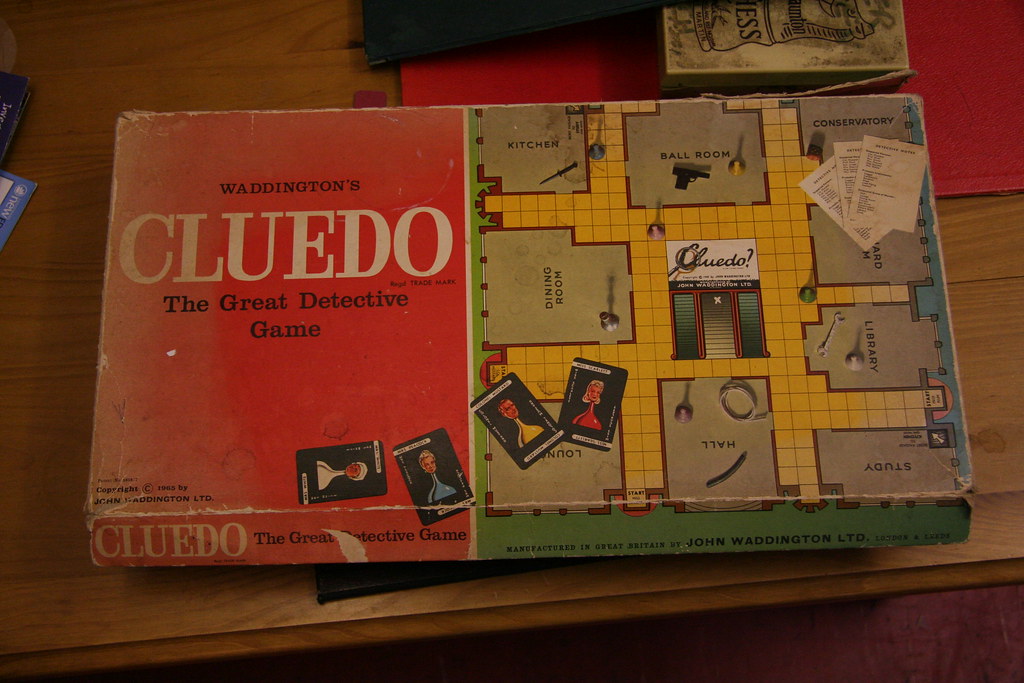
5 MFL Games I have been playing this week

Since my PGCE, I’ve always thought that games have a place in MFL teaching and learning but they must have a purpose. That purpose could be: the practice of vocabulary or structures, practising spontaneity or revision of vocabulary.

Variations on Sentence Stealer

It always amazes me how Sentence stealer started in Kuala Lumpur and has made its way to classrooms across the UK and Australia and probably further afield. I’ve played it with a variety of classes in different schools and it always seems to go down well. I have come across one or two obstacles in playing with trickier classes

  • One student gives others their cards so that they win at the end
  • Students use a mixture of English and Spanish “do you have joo-ey-go al football?”
  • Some students don’t talk enough

Here are a few variations I have tried to counter this:

Pink writing – While the students make their cards. Write out four using a pink pen (or any colour they are not using). Slip them into a couple of students piles. Winners are now the ones that have the pink writing ones at the end or the ones with the most cards.

English = lose a card – While students are completing the activity, I walk around. If I hear English, I take a card from them.

Sudden death round – 1-2 minute timer (dependent on class size). Each student starts with one card. They continue to play as normal but as soon as they lose their card they return to their seat. Hint to students that the more they talk the less likely they are to be out quickly.

The 10 phrases game

Made this up after a game of 1 pen 1 dice earlier this week. Write ten phrases or chunks on the board. The more advanced the group, the longer the chunks can be. Colour the sentence complements in red (complement = word phrase or clause necessary to complete expression)

Juego al fútbol

Escucho musica

Student A: reads through the sentences trying to finish them in a different way.

Student B; counts how many they manage.

When finished they swap, but here’s the thing…

Student B cannot use any phrases student A has already used.

The game forces students to use what they know. The intention is to move them away from saying what they want to say and instead saying what they have learnt.

The Algo Game

Every now and again, you rediscover a game that works. The “algo” (something) game is one such example. You can find full instructions here (with pictures) and here (bit further down). This activity is great for reading aloud practice and practice of chunks. I can see it being particularly useful with the reading aloud element of the new GCSE. In the past, I have gone with a point per correct word. It motivates them to focus on listening and transcribing what they hear.

Points for sentences

This came from a lovely MFL teacher called Deborah who ran some training for us back in the days of controlled assessments. It works for both speaking and writing.

Verbs
5
Verbs
5
Time Phrases
5
Conjunctions
10
Showing off
20


You can imagine the kind of things that will fill the grid. You can also vary the requirements e.g. “weil” and “obwohl” might score more than “und” and “aber”. Students have a minute or two to make as many sentences as they can.

Student A: just talks and makes sentences

Student B: listens and notes down their points

Swap

Winner is the person with the highest points score. You can then also set it as an end of lesson writing task. The Nice Man Who Teaches Languages (whose blog is well worth a look) has written about getting students to write sticking to what they have learnt and they know from their repertoire. This activity helps with that as students stick to the phrases there as they score points.

Two truths and two lies

One of the easiest activities to do on the spot, likely inspired by the BBC programme “Would I lie to you?” Minimal Prep, maximum effectiveness. This came towards the end of a lesson on negatives in Spanish using the theme of sports and free time. It is easily adaptable to food, clothes, healthy living etc.

Students write two sentences that are true for them and two that are not. Most students do this in the order you say. Make sure they read them out loud to their partner in a different order!!! It’s then up to their partner to spot the fact from the fiction.

Cultural Capital: Strategies for Language Classrooms

Other cultures have always fascinated me ever since learning about Norway in Year 5 or tasting a Stollen in German class in Year 7.     My experience of teaching secondary languages suggests that this fascination is true for our students as well.


Was Norway where this fascination with other cultures started? Possibly! It’s still on the list to visit…

We teach culture to build enthusiasm interest and develop the cultural capital of our students. for those students who do not enjoy the language learning process so much, this can be a great way to hook them in.

There are four approaches to the teaching of culture that I have used in my career.

Unit based approach

The obvious benefit of a unit-based approach is that students can gain a deeper understanding of the target language culture full stop.  I’ve seen units structured around the films “Innocent Voices” or Valentín.  I have seen lessons centered around schools in Latin America or French speaking Africa.  I have taught lessons about Cuba (thanks Listos 2), Dali, Goodbye Lenin and the Carnival de Oruro over time.  There are schools who use artists such as Miro, Matisse and Picasso as the foundation for some of their early Spanish modules.   Some textbooks base entire chapters around a target language festival, country or city.  Indeed, one of my former colleagues convinced a class that Mira 2’s “Barcelona Te Quiero” song was once a successful Eurovision entry!  The language gym has exercises on La Tomatina. There are plenty of ways to integrate culture into our lessons. 

Just as there are benefits to this approach, there can be drawbacks.  Culture can be relegated to an end of year project or sometimes a module around culture ends up with grammar or vocabulary “shoe-horned in” as they are good revision opportunities when actually other opportunities might have existed.  The way to counter this is to ask the question: “Is this the best learning my students can do with the material that I am presenting them with?”

This might be a slightly extreme example but let’s take bullfighting:

It could be used as an opportunity to describe the colours of clothing worn by matadors, body parts or…

Do you use it as an opportunity to build opinions and justifications?

I think thatbullfightingis
can be
dangerousasanimals are killedhowever although yet
I believe thatbarbaricpeople risk their lives
In my opinionunpleasantthe animals have no choice
In my viewcruel 

The Pop-up approach

Do we simply just teach about the culture when it just pops up?  Festivals in particular lend themselves to this approach.  Events such as Las Fallas, Barilletes Gigantes, Dia de los Muertos, Christmas, Karneval and Bastille day are all opportunities to engage students with the target language country and its culture.  Sometimes a textbook will have a single or double page spread on something.  It does not take long to find a short appropriate video to show towards the end of a lesson.

The benefits of this approach are that it does not take up too much classroom time at the expense of learning the language. The drawbacks are that much can be missed if it is the only way culture is taught.

Displays

There are some wonderful displays out there. I have never quite had the artistic abilities to produce an amazing cultural display of the types one often sees on Facebook groups, X and BlueSky although I have done my best. I managed one on Germany with a lot of authentic materials after a trip to Berlin but our school then made the decision (against my protestations) to phase out German…

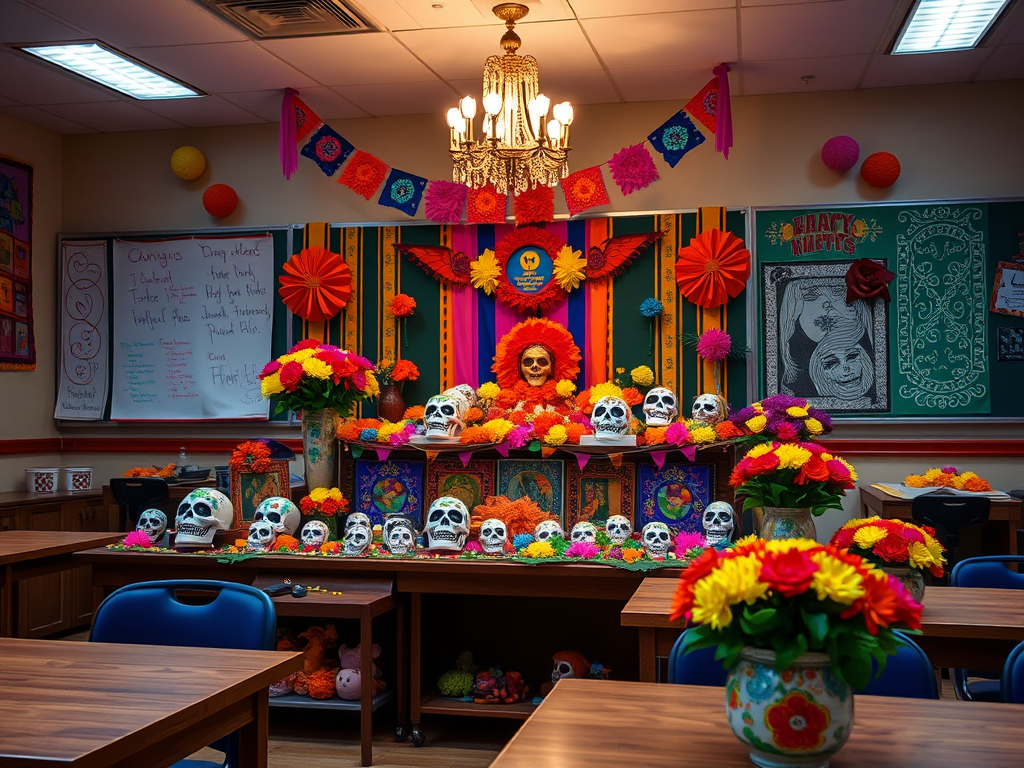
If you’re wanting inspiration, you can find some materials here with MFL Magic, Jose Garcia is has some of the most artistic cultural displays I have seen or you can go full mural as seen at this school on X. There are companies who can produce bespoke murals when given a set of criteria. If you are really stuck for inspiration regarding layout and how it could look then the picture below was created by giving an AI image generator a prompt “classroom dia de los muertos display.” Bear in mind these are highly predictive generating tools and will not be perfect but it might spark some ideas.

Like other approaches this does not detract from classroom time and it makes for a pleasant learning environment. The drawback is again that the display may need refreshing every so often and then you have to balance time invested against the return.

Culture slide approach

This is probably my most recent evolution in culture teaching and the one that I actually feel has done it best.  Dedicating 2 minutes of a lesson to culture after answers to a starter/do now task and before the lesson fully starts.  I prepare a single slide on a topic that includes some pictures and some fun facts.  I talk through it for a minute or two and then we crack on with the lesson.  The benefits of this approach are that there is largely something for everyone.  The students who enjoy history enjoyed learning the history of Spain. The musicians enjoyed learning about singers/songwriters, bands and music.  The students who go on holidays learn a bit more about the places they have been.  The students – for whom a holiday abroad is unlikely – broaden their horizons.  The students who don’t appear to enjoy language lessons often appear to enjoy this part.

Just to unpack what I mean a little bit more by “some pictures and fun facts”…

The Spanish island of El Hierro had a whistling language that was used to communicate between villagers.  William Shakespeare was given a barrel of wine from Tenerife as part of his salary.  Ibiza and Formentera were used as a base by pirates.  Francesco Tarregas’s Gran Vals in A contains a tune known by millions around the world without realising its Spanish origins (seriously, look it up).  The Menorcan city of Mahon is home to Salsa Mahonesa, or – thanks to the French – as we now know it: Mayonaise (an utterly disgusting substance with which people inexplicably ruin sandwiches).

I cannot reproduce the slides as they produced in the context of my work for an academy trust and therefore property of the trust, however, here is a rough guide to what you could do:

Year 7

Term 1Term 2Term 3Term 4Term 5Term 6
Spanish Islands Mallorca Tenerife IbizaMajor players in Spain. King, President, famous peopleSpanish cities Madrid, Valencia, Barcelona, SevillaSpanish speaking countries in South AmericaHistory of Spain Cavemen to present day in 10 lessons. *Customs / Festivals Mealtimes Siestas
Padel Tomatina
San Juan  

*Simon Barton’s History of Spain was quite useful for this for the division of eras into 10 lessons.

Year 8

Term 1Term 2Term 3Term 4Term 5Term 6
Spanish artists.Spanish musiciansCentral American countriesFoods including Paella
Mole Negro
Pique Macho
Idioms from SpainQuirky places to visit in Spain + South America Smurf village Water fights in Bolivia
Colombian festival of Yipao

Culture can make great cover work

Feedback from the cover supervisors in my first school was that they hated covering Spanish/French/German as they didn’t know the answers, students would struggle with not knowing words and most people sending in cover are often too ill to provide much more than “do these grammar exercises.” Whilst a set of sentence builder activities goes a long way towards solving this, a cultural based lesson could work. A set of cultural based activities means students are still learning, they do not pick up or reinforce misconceptions with unchecked exercises and the cover teacher has a significantly easier job.

I have done this two ways in the past:

Spain Live – This was a great textbook teaching pupils about Spain. It works very like a geography textbook with articles and questions to answer. There are also France and Germany versions.

IT room/library – Write out a list of Spanish speaking countries, periods in Spanish history or famous Spanish people. Give each student a different one so that they have to do their own piece of work. Students have to create a poster / powerpoint / document of some description that explains everything they can find using the computers or the library (if your school has one). To avoid copying and pasting, make them write it in a horrible histories style where it has to be accessible for a child aged 8-10.

Conclusion

However you choose to teach it, there is no escaping the fact that culture can broaden horizons, enrich the mind and enthuse our students. The above are some ways I have done it over the past 15 years. You may have others in which case feel free to suggest them in the comments or underneath the social media posts.

Transforming Language Teaching: Insights from Other Subjects

I’ve been a teacher for nearly 15 years. Over the past seven or eight, due to timetable pressures and a variety of other factors, I’ve found myself teaching several different subjects. Often, as a languages teacher, I’ve sat in CPD sessions thinking, I’m not entirely sure how I can apply this to MFL.

In the last seven years, I’ve taught across five different subject areas: History, English, Religious Studies, Drama, and more recently, Computer Science. For those of a footballing persuasion, I guess i’ve ended up as a versatile super-sub*. A mix of Wayne Rooney and Ole Gunnar Solskjaer.


History


A few years ago, I was given a Year 9 top set history class, shared with another teacher. I like to think this was a mutually beneficial arrangement.  They helped me deliver the lesson by explaining content and the activities; I fixed their German pronunciation.  Two things particularly stood out from this time. 

The first was that the starter tasks—or “do now” tasks —increased in difficulty from question one to question four. The idea was that every single student should be able to answer at least questions one and two. This meant every student in the room came in with an instant chance to be successful and get their lesson off to a good start.  They followed the following pattern:

  1. True / False
  2. Multiple Choice
  3. Short answer
  4. Sentence / Multiple Sentence answer

There was a culture of “no excuses” for not answering or attempting question 1 and 2.  I was encouraged to circulate and particularly demand extension to answers on question 4 and support those struggling with 3 or 4.  I think a similar principle could work with MFL starters.

The second thing that really stood out was how each lesson was framed as a question to be answered. Now, in History, this is significantly easier than in MFL. Take, for example, the questions: What happened at Pearl Harbour? or What did the failure of the League of Nations mean for the future of Europe? Both of those questions immediately build interest, curiosity, and engagement.

In languages, this is obviously significantly trickier. The question: How do we form AR verbs? does not bring with it the same level of curiosity or interest (apart from for a select few of us who love our grammar). Could we possibly rephrase that question to: How can I master 88% of Spanish verbs?

There are, however, some areas of language teaching that naturally lend themselves to this “lesson as a question” approach. The teaching of ordering food in restaurants would lend itself well, for example: How can I order food and drink in Spain? Similarly: How can I describe people? or how can I say what is wrong with my hotel room?  By phrasing the lesson as a question, students can walk out knowing they have learnt the start of the answer.  How can I master 88% of Spanish verbs?  I need to know the six endings; I need to remember to remove the AR and replace with the correct ending.  For those wondering, the 88% is from a 2019 analysis of the Royal Spanish Academy Dictionary. 

Religious Studies


In 2019, I taught Religious Studies due to timetabling issues. My main learning from this year of teaching would be the idea of spending entire half terms on one thing. For example, one half term was Christianity, one half term was Buddhism, and one half-term was Sikhism. These were Year 7 modules that were about six lessons each.

One popular Spanish textbook I used to use had the following five pages: ages, members of the family, pets, descriptions of hair and eyes, and descriptions of personality. The topics were well presented, the grammar chosen was sensible when linked with the topics, and the activities were, to an extent, useful. However, was this too much for two lessons a week in Year 7? The answer is probably yes.

At the end of each term in Religious Studies, we would assess what had been covered in the previous five lessons—and only that. I wonder if sometimes in languages we don’t teach sufficiently narrowly, and then we don’t assess that narrowly either.  Gianfranco Conti recently wrote in a blog about the desire to correct everything that persists in many schools and trusts across the country.  Perhaps we need to ensure that they can do fewer things well? 

Drama

One year shortly before half term, I had a visit from a member of SLT suggesting that they needed someone to teach Drama for four weeks until the new Head of Drama arrived. To make matters worse, they said it was Key Stage 3 Drama.

I had the fortune to take on a good class comprised of pupils I had taught before. My biggest learning from the Drama department—and indeed from watching the new Head of Drama at work—was that projection was emphasised. Phrases such as “say it again but say it better”, “tell me, don’t ask me”, “say it like you’re really confident”, “say it like you believe it” were all used to develop their students’ ability to project, to sound confident, and to deliver lines with character, or as one of my English colleagues would say “with gusto!”

In MFL, sometimes I wonder if we neglect this in paired speaking activities. Recently, with my classes, when we’ve done short conversations, or short question-and-answer work in pairs, I’ve asked them to stop and then repeat it sounding like they are more confident. This might mean I ask them to sit up straighter, or I ask them to stand up. 

If you think about it, most conversations in real life do not happen at a table where the person next to you is directly to your left or right. In a café, they are often opposite or slightly to the side. In passing, they are often stood up. It may be confirmation bias, but I tend to find that the second time students perform the activity, they sound better.

My version of the activity quiz quiz trade helps with this.  Here’s how I run it.  If you have read this blog for a while, then you will know my fondness for mini-whiteboards.  They will help us here:

Students have a question on a mini-whiteboard and the start of the answer on the back.  Whatever language you teach, you can apply the examples below:

Side facing student = questionSide facing away from student = help with answer
What do you do in your free time?In my free time …
Do you play footballYes/No ….. sometimes / never
Do you swimYes / no …… regularly / rarely

Students must 1) ask a question, 2) answer a question 3) swap their whiteboard.  They can sit down after 5 ask/answer/swap cycles. 

In our school, we have a policy that is known as SHAPE. Lots of schools have this, although I wonder sometimes if we focus on the S at the expense of the P. Languages, like Drama, are an opportunity for us to develop our pupils’ oracy—that is to say, their ability to speak confidently and fluently.

Computer Science

More recently, I have taught Computer Science. It may surprise you that both subjects can learn a lot from each other. As a languages teacher teaching Computer Science, I have found that my appreciation of mini whiteboard checks for understanding can continue. However, this post is about what we can learn from other subjects.

One of the things I’ve noticed in Computer Science is that flowcharts are extremely useful as a means for understanding. By this, I do not mean a bullet point list or a “1-2-3 steps for conjugating.” I mean a clearly laid-out visual flowchart. For example, this could be used for explaining when to use the subjunctive in Spanish:

  • Am I expressing a wish or desire?
    → If yes, use the subjunctive.
  • Am I expressing an impersonal reaction?
    → If yes, and if the sentence includes “it is + adjective,” then yes, I should use the subjunctive.

This could be a helpful way for students to visualise and decide whether the subjunctive is required using my favourite language teaching acronym: WEIRDO (Wishes, Emotions, Impersonal statements, Reactions, Doubts, and Ojalá).

I have also used these to help students build their opinions when talking about school.  Word’s SmartArt can be quite helpful in this regard.  An example in English is below:

Similarly, a flowchart might be useful in forming the passé composé in French. Students would then be able to decide easily between avoir and être and then progress onto Mrs Vandertramp (does anyone remember—or still use—the YouTube “Umbrella” version?) or however you choose to characterise the remaining verbs.

The second thing I’ve learnt from teaching Computer Science—and this is more aimed at GCSEs—is what we call the Moneyball approach. Moneyball is a film about baseball where a lower-league baseball club finds value in players that people didn’t rate very highly and their data-driven approach makes the club very successful. In the film, one of the main characters tells his club director that he needs to “buy runs,” not “buy players.”

To turn this into a modern-day football analogy: you are essentially buying goals, not buying a striker. Harry Kane scores you 30 goals a season. Other strikers, although highly thought of, may not reach those numbers but you could buy two players who will score 15 goals a season each such as Matheus Cunha and Bryan Mbeumo.

We can apply this Moneyball approach to exams. If the average needed at foundation level for most languages and exam boards (according to ChatGPT) is 60% for a grade 4, and the average for a grade 4 at higher tier is somewhere between 37% and 43%, then we need to consider: How are we going to put our students in the best place to get those marks? What are the things that we can control, that we can drill, and that we can best prepare them for, in order that they may achieve that?

I will leave you to think about those last couple of questions.

Conclusion

I hope this post has shown that, while not every strategy from other subjects will seamlessly translate to MFL, there is a wealth of insight to be gained from stepping outside our own discipline. Whether it’s the deliberate staging of questioning in History, the focus on oracy and projection in Drama, or logical and data-driven thinking in Computer Science, each subject offers something valuable.

By borrowing and adapting these approaches thoughtfully, we can enrich our language teaching and better support our students in becoming confident, capable communicators.

*James Milner was a consideration for comparison at this point but then I remembered his previous club history

Can you mark whole class set of reading/listenings in 1 PPA? Definitely!

End of year assessments or mock listening/reading exams need marking. I used to do them all one by one and it took me aaaaages.

7 years into my career I learnt that you can manage a whole class in one PPA with some question level analysis thrown in for good measure!

This method is suited to the listening and reading papers. It also works for the 4 sentences about a photo and the translations of the outgoing GCSE. It does not work for writing sadly.

Here’s how…

You ideally need a classroom with rows. If not, borrow a colleague’s classroom and watch them stare at you in a slightly odd way while you enact the following process:

  • Put the mark scheme on the interactive whiteboard
  • Lay the papers out with the same page showing along the rows (closer together than the AI generated picture). Ideally open them at the first page the first time through.
  • Walk along the rows, marking the same question over and over. After a while you start looking for D C A B as the answers, P N N P or “salchichas” “sandillas” “treinta” etc
  • Walk back turning to the next page
  • Repeat

Considerations:

If you have a large class it may be easier to do 10 or so at a time.

Having the exam papers open anonymises the process and ensures you are objective. You can look at the end if there is a paper that is striking you as “they didn’t revise”. Or stick a post-it note if you spot something you really need to address.

Every time you go to the laptop to move the mark scheme on a page is an opportunity to note down any areas or vocabulary students struggled with.

Give it a try

GCSE: Teaching the Celebrity Culture topic

For a topic like this, it makes sense to start with three very simple questions:

  • How is this going to be assessed?
  • What vocabulary will they need to do well?
  • What obstacles might I encounter in teaching this?
Exam TypeWays it could appear
ListeningSomeone talking about a celebrity they admire
Interview with a celebrity
SpeakingQuestions about a celebrity you admire
Roleplay discussing a celebrity
Photocard where questions are about a celebrity or opinions on celebrity culture
Reading aloud task about someone famous
ReadingText about a celebrity
Short texts with people giving opinions on celebrity
WritingWrite about a celebrity you like or admire and explain why

Vocabulary

Looking at the exam board vocabulary list, the following words jumped out at me:

well knownbrandfollowborntrick/deceive
alivefashionintroducemarriedcry
deadinfluencerpresentdivorcepromote
behaviourvoteadvertseparaterelate to
interviewrecordmediaestablish/set upto direct/manage

Many of the words on the vocabulary list will naturally come up during the teaching of the module. The ones above were a mixture of “that’s slightly unusual so will need teaching” or “that’s definitely teachable but could be taught equally in another topic and transferred.”

There will also be significant overlap with free time activities particularly if your free time lessons include music, dance, films, TV and the internet.

Obstacles

Potential obstacles in this topic include the following:

  • Your resources could date very very quickly as celebrities fall in and out of public eye.
  • Celebrities can suddenly be “cancelled” or information emerges about them that might be a distraction from the lesson.
  • Exams are less likely to use well-known celebrities so you may need to create or find some resources using people with whom the students are less familiar.

Don’t re-invent the wheel

I have written before about using what we already have for aspects of this new new gcse. Plenty of textbooks have covered celebrities in various guises so far. Those resources (while they may not teach every word on the new spec) will serve you well. For example, our recent AQA Spanish GCSE textbooks had a page on “modelos a seguir” (you can find related resources on TES such as this one). Mira 3 had short biographies on celebrities as a means of revising the preterite. If you have copies of these books lying around and/or gathering dust then use them for this topic. I imagine French and German textbooks will have similar texts that are of use.

Don’t assume students have the vocabulary to talk about these things

You might be thinking that they are surrounded by influencers and instagram/snapchat etc, how would they not know how to talk about it?! Students will be aware of people who are famous, online influencers with thousands of followers but some might not understand the concept of “celebrity culture” itself or have the vocabulary to talk about it in English. For example, discussing the pros and cons of being famous might be a stretch for some. They might not be able to articulate why in a foreign language they do or do not like a particular celebrity beyond “he/she is …” They equally might struggle to articulate this under pressure.

I think a sentence builders approach could work very well here especially for talking about people you admire and also for where famous people have not been good role models. Gianfranco Conti’s post here gives some salient pointers about how to craft a good sentence builder

What opportunities this topic presents (teaching)?

Firstly, opinions and reasons are unavoidable on this topic. A question such as “tell me about someone you admire and why” gives an able student the potential to give a variety of opinion and justification phrases. Secondly, there is a great opportunity for the past tense with some examples “he/she was”, “he/she won”, “he/she recorded/sold/has gone on tour.” Lastly, there is a opportunity to drop in a reference to the future with a simple “I want to meet him/her.” Vincent Everett’s post here gives you an excellent idea of how this could be taught in the classroom.

What opportunities this topic present (cultural capital and making the case for languages)?

Firstly, there is an opportunity to build our students understanding of the target language culture. You may need to do a little bit of research if you are not up-to-date with your Spanish/German/French influencers. The majority of our students are online, on TikTok and Instagram. Give them some good role models to follow from the target language country. Lots of videos are subtitled so students can read the language as well as listening to it.

Secondly, this topic is a good opportunity to remind students that a lot of famous people are bilingual or multilingual and that they learnt it like the students did: in school. Kylian Mbappe – in one interview – mentions he “wasn’t the best in school at Spanish” but he kept learning. In another (the one below) he mentions that sometimes people “still speak too fast”. A good reminder that mastering a language takes time!

This topic would tie in quite well with options too.

Key Ingredients for Outstanding MFL Lessons

This is a re-write of my most viewed post. Despite being written in 2016 and lessons no longer being graded, it has consistently topped my most-read posts every year. It was probably time for an update.

‘Hypothetical’ conversation overheard in staffroom:

Experienced teacher 1: “I delivered a number of outstanding lessons today”

Experienced teacher 2 “Ha! Your definition of an outstanding lesson is you putting your feet up while the kids are standing outside!”

Experienced teacher 1: “you saw them then!”

What makes an “outstanding lesson” is highly subjective and is based largely on the observations of the person watching.  It is a positive thing that we have moved away from one word judgement of lessons or lesson snippets and there seems to be a similar move away from one word judgements of schools.

This is not a post on “how to play the OFSTED game” as the only OFSTED game to be played is simply high quality teaching and learning. It is a post about the key ingredients for an outstanding lesson and how we might apply those in MFL teaching everyday.

The big three: intent, implementation and impact.

OFSTED’s re-focusing on curriculum with the three I words is now well known. Intent, implementation and impact. The big question is the question every teacher should be asking of their classes “have they learnt it? And how I know they have learnt it?” Is my implementation achieving the intent? They (ofsted) will discuss this with a Head of Department or Lead Practitioner and then visit classes to see it in action. The idea is that what the Head of Department is saying should be visible in classrooms and students should be benefitting from it. Their evidence for forming their opinion will come from that discussion, watching lessons, talks with students, talks with staff and looking at any work in books.

My experience of being visited by OFSTED and our department going through a deep dive last September was that it followed the following pattern:

Part 1: A discussion about the intent, implementation and impact of the curriculum. My Head of Department did this bit so I cannot tell you exactly what was asked but if you want some typical practice questions then you can click here and this one from ilanguages gives some ideas of example answers too.

Part 2: Visits to lessons, talking to students in those lessons and looking at books. The inspector thought my teaching was “enthusiastic” and the lesson “well-delivered.” They expressed some disappointment that there was not any paragraph level writing in the Year 7 books. It was the first week back in September and their second lesson of Spanish. I’m not convinced their expectations there were reasonable but it also explains the levels of energy on display! They are essentially trying to answer a question around implementation. Is what the inspector has been told evident in classrooms?

Part 3: A discussion later with staff that began with some curriculum matters and then opened up to wider issues such as workload, how teachers are supported in school, safeguarding and recent training. To be honest, I thought this discussion would be much tougher but it was conducted in a fair and supportive manner.

Dealing with the drop in

Inevitably at some point a lesson is going to be watched. Personally, I feel a mixture of being short-changed and relived if not seen by an inspection team. Out of the four OFSTED visits, I have experienced, I have been visited on three. All of the below “ingredients” came from the previous post with some updates for 2025. They are not a recipe but definitely things to think about ahead of any lesson drop in.

Key Ingredient:What it means for MFL teachers:
ConsistencyThis is a tricky one. In some schools and trusts, it appears to mean every teacher delivering the same slide decks (hopefully tailored to their groups). In others, it means a set of principles of delivery but teachers might be working on different lessons due to one group being ahead behind because a teacher deemed the group to be in need of re-teaching etc.
There probably has to be some level of consistency across your team in delivery but again this needs to tie in with what you say in that deep-dive session.
Starting PointsSome knowledge of the students’ starting points is helpful. If most of your students arrive at Year 7 having had strong language teaching, how are you building on it? Are you able to build on it?
Are your Year 8 and Year 9s building on prior knowledge?
Would an inspector see more challenging vocabulary, grammar and writing in books if they compared between year groups?
ChallengeIs your work demanding enough?  I don’t mean simply sticking an extension task on a starter or a reading activity.  Are you sufficiently challenging that student who finishes the task seconds after you have explained it?  Should they have finished that quickly?  Are all students challenged and engaged?  How could you reward risk-taking with the language?
Pupils viewsARGH?!   What would they say about your lessons? If memory serves, my students were asked:
– What they are learning?
– Do they remember what they learnt last lesson?
– How does it fit in with what they have been learning?
– Do they enjoy learning languages?
EnthusiasmYou got into this job for one of two reasons (or possibly both). You love your subject or you love working with young people. Ignore the fact that someone is watching and teach like you do everyday.
Scrutiny of workFrom this I understand the following:
1) Books will be looked at.
2) Can you demonstrate that students are improving?
3) Is there evidence of challenge or support and scaffolding?
4)  OFSTED do not expect to see particular types of marking/feedback however they do expect to see departmental policies enacted so whatever you say you do, needs to be what you actually do.
Subject KnowledgeThis will naturally come through as you teach. Remember you are the expert. Keep your explanations clear, don’t be nervous about the observer, just focus on doing what you normally do. If you are teaching your weaker language then there is some advice here:  Keeping your languages up!
Effective PlanningNo time wasted and all resources readily available and accessible.  They will not want to see a lesson plan but it’s very easy to spot a well-planned lesson.  This is probably the best thing I have read on planning an MFL lesson and still one of the best posts on the topic 8 years later.
Behaviour ManagementClear rules and consistently enforced. Again, keep to your school or department policies.  I would argue that there is nothing wrong with removing a student whose behaviour is detrimental to the progress of the rest of the class, even in an observation. If there is a policy to be followed, follow it.

Adequate structured practice timePupils must be allowed enough time to practice and embed what they are learning.  There must then be a definite increase in demand and evident progression in difficulty of the material covered in the lesson.  Practice in MFL will obviously take place through different skills but it is worth considering: how do they link to your overall objectives in that lesson? Is the planned practice going to lead to some production?
Checks for understandingUnderstanding must be checked and any misconceptions identified.  You can probably tell who will struggle so maybe set the class a short activity that they can use to demonstrate their learning, while you go and help those who need it.

Challenging h/wkHomework should consolidate, extend or prepare the students for future work or a mixture of the three.  More on homework here

Literacy and NumeracyWhilst numeracy is harder to shoehorn into MFL, literacy is very much the bedrock of what we do.  Start using grammatical terms and do not shy away from them.  You’re a language teacher and probably a fan of the odd reflexive verb, subordinating conjunction or relative clause. Own it.
Pupils know why they are learning what they are learning and how to improvePupils will likely be asked about what they are learning. They may be asked about work in their books, what lessons are like and how they feel about their progress in the subject. Do they know what they need to do to improve?
Challenging stereotypesAs MFL teachers we are in an ideal place to do this.

OFSTED’s descriptions miss out one major feature of teaching that I believe is key to delivering outstanding lessons and that is relationships.  Admittedly you can produce an outstanding lesson that meets all of the above boxes but relationships go a long way to making all of the above much easier! Your relationships with your students will answer that.  John Tomsett says: ‘Fundamentally students need to feel loved and I really don’t care what anyone might think of that, to be honest, because if I know anything about teaching, I know that is true.’

What could I do now? 5 things to try this term.

If you’re English then make a cup of tea before contemplating the following:

  1. Build those relationships.  Grab your seating plans or mark-book and find 3 students per class who you are going to develop your relationship with.  How are you going to do that?  Will you be teaching those kids next year?  Who knows?  Do it anyway.
  2. Key Ingredients.  Pick one of the key ingredients that you need to work on.  In your planning for next week incorporate it into every lesson.  Yep, that’s every single one.  It’s all very well reading a blog post but you have to act on it.  My old headteacher liked the phrase purposeful practice.
  3. Revisit.  Revisit your intent, implementation and impact. Are you doing what you say you are doing?
  4. Gained time.  Can you devote some of it to CPD?  Who in your department is good at challenge, differentiation, target language use?  Who could you learn from?
  5. Power of praise.  I used to do termly phone-calls or emails home to a parent to give some positive feedback on a student.  I’ve slipped on this and may well do a few in the coming half-term.  Shaun Allison writes about them here.  
  6. Consider September.  Yep, right now!  September is where we set the tone, set the patterns and culture in our departments, what would you like an observer to see if they entered your classroom?  What needs to be part of your practice?
  7. Iron sharpening iron.  “As iron sharpens iron, so one person sharpens another” (biblical proverb).  I love this proverb as it applies to most areas of life. Another person can always be guaranteed to sharpen you and smooth out the rough edges.  Most NQTs have a mentor and most PGCE trainees do too.  Once we exit that process, we are on our own.  Who could you work with to improve your own teaching?  Can you get them to pop in and watch?  No notes, no agenda, no judgments and no threat, but just someone there simply to develop your practice.

Further Reading

Great Lessons – a series of blogs by Tom Sherrington (Headteacher) on what makes for great lessons and still good years on.

An Outstanding Teacher – short blog post by Shaun Allison – still good

5 Things to Try Tomorrow

The whole idea behind these posts is five simple things you can do in your classroom with minimal preparation tomorrow.

Adam Boxer’s Tick Trick (adapted to MFL)

This arose from a post on X by Adam Boxer (you can find his website here). I started using this with my classes for translation tasks. It’s devastatingly simple to add into a lesson: “If you have that bit on your answer, give it a tick on your board.“ You can even convert it into TL with more simplistic language “If you have A, correct. If you have B, correct.” I used it to break sentence translations down into chunks of languages so that students were being rewarded for the bits that they were getting right. The current AQA GCSE does a similar thing where 2/3 chunks correct might equal a mark.

Photo by Photo By: Kaboompics.com on Pexels.com

The power of underlining.

Recently, our department has begun experimenting with sentence builders. I currently share some groups and wanted to check how much of the sentence builder my class actually knew and could reproduce because when you see them every other lesson, it is inevitably harder to track their progress. Being a fully-signed up fan of mini-whiteboards, I chose 5 sentences from the sentence builder for my class to reproduce in Spanish. In this case, the sentence builders described a house. Each sentence was different, used adjectives with the highest surrender value (that is to say applicable across multiple contexts) and students could attempt an extra sentence from the previous sentence builder if they finished quickly. I asked students to turn their sentence builders over and try to produce the sentences from memory. If they peeked, looked up a word or phrase then I asked them to underline that phrase on the sentence builder. It gave me quick intel as to how much each student could remember.

AI seedling image

Seed-planting for GCSE

One of my Year 9 class this week asked a question about GCSE. It was one of those “let’s slow the lesson down by getting the teacher to talk about something” moments. I quickly weighed up the pros and cons and thought let’s take the opportunity to sell GCSE MFL to this mixed ability group. We have not begun our options process yet but they had some thoughts that needed unpacking.

Do I have to take it?

What is foundation / higher?

My sister says it’s ****** hard?

Do i really have to talk for 12 minutes?

What if i don’t want to teach / translate? Is it worth it?

It’s always worth reminding students that they have been preparing for their language GCSE since Y7. The words that they learn then are equally likely to make an appearance and the topics in Key Stage 3 often map to the GCSE ones. When the foundation reading text says “does Ximena enjoy her history lessons?”, they learnt that in Year 7. I sometimes think we are not so different from maths in that our GCSE is the culmination of everything learnt so far.

Photo by Yan Krukau on Pexels.com Grumpy Smurf picture was copyrighted

Grumpy Time

Not my idea at all and full credit goes to Gianfranco Conti for this one. Having seen that my class had used the sentence builder mentioned above to write about where they live (more ideas for this topic here), I asked them to produce me an answer that was entirely grumpy. Having not done this for a few years, none of my students had written a grumpy answer before so we had a brief moment about adding in adverbs of degree (sometimes MFL teachers and resources refer to these as quantifiers). We noted down a few to add in to sound significantly more grumpy. Students then produced some extremely grumpy sentences and seemed to enjoy it rather than the generic “write about where you live.”

Photo by Binyamin Mellish on Pexels.com

Spot the difference with AI

You might notice we have been teaching a fair bit of “in my house” stuff recently from the post above. This idea continues that theme I asked ChatGPT to produce me an image containing two houses and specified what rooms i wanted in each (after a disastrous first go where we had staircases to nowhere). In the end, I ended up using both images! One for a simple writing activity where students wrote “In house A there is but in house B there is not…” The disaster house came in useful as an extension where with a few adjectives given students could write “there is a useless staircase”, “there is a garage upstairs which is stupid.”

A cautionary note on this one. ChatGPT only allows you a certain amount of images per day also since then I have also learnt that AI image generation has a significant water footprint.

Lastly, if you are starting to look for Christmas MFL ideas then…

Here’s 9 ideas

Here’s 9 more ideas

Also a relatively new blog from Beth M is well worth a look. I remember Steve Smith being kind enough to mention mine in the early days which raised my viewing numbers. I hope this will do the same.

9 New ideas for Navidad, Noel & Weihnachten

After recycling my yearly Christmas blogpost for the last few years, I decided it was time to make a new one. As a result you now have 18 ideas. Enjoy!

Idea 1: Lyrics Training, Christmas songs and mini-whiteboards

Create an account on Lyrics Training. Load up the website. Give out a set of mini-whiteboards. Pick a song, set your difficulty level. Decide on write mode and choice mode (write means writing full words and choice is a selection from four). Project the video on the screen and hit play. Students write the words when the music stops, show their answers and keep a points tally. Ones I have used in previous years.

Santa Claus llegó a la ciudad Enzo- Laura Pausini version

Feliz Navidad si tu quieres – Enzo

Mi burrito sabanero – Juanes – more on this one later.

You can find others just by typing in Navidad / Noel / Weihnachten or Christmas related words.

Idea 2: The Christmas Quiz is the vehicle for teaching about Christmas.

I’ve seen a lot of Christmas quizzes like this one by Alex Rose on TES. My personal favourite is this one although now it will cost you the wallet destroying sum of £1. It’s a bit shorter and cultural knowledge is dropped in with the answers.

Idea 3: Plan to reuse them every year.

I now have Christmas, Easter and day of the dead PPTs with all of the following in. Yes, it makes for a large file size but at least it is all in one place and easy to load up. It took me 8 years of teaching to think this up but it works now. The resources that go with the PPT are all in the same folder.

Year 7Lesson 1: Cultural talk, Christmas Quiz + Worksheet.
Lesson 2: Burrito Sabanero.
Year 8Lesson 1: Navidad Mexicana.
Lesson 2: Lyrics Training lesson (see above).
Year 9Lesson 1: Lyrics training lesson (see above) or Todo lo que quiero eres tu
Lesson 2: El Gordo
ExtrasChristmas Calligrams
Writing a letter to santa
Spanish Christmas info

Idea 4: Mi burrito sabanero (or similar in German/French)

Most UK primary school kids have come across the song “little donkey”, and if they haven’t then they are missing out/lucky (delete as applicable). I like to think that “mi burrito sabanero” in Spanish is the equivalent!

Do now: 12 words on screen. 8 from the song, 4 not but similar sounding. Students work them out or look them up. Avoid “Belén” as to some teenagers, apparently it sounds quite rude…learnt that one the hard way.

Listen 1: Students listen to the song and identify which ones they hear in the song.

Listen 2: lines from the song mixed up on screen / on paper. Students number them in the order they hear them.

Listen 3: Gap fill

Listen 4: With video containing lyrics to check answer.

If i have heard the song too many times in that week then listen 1 moves straight to listen 3.

Idea 5: Class discussion sentence builder 1

Set up a single powerpoint slide with: “What is the best Christmas film?” in your target language.

Opinion phrasesName of FilmSimple reasonsAgree/disagree phrases
I loveHome AloneI like the storyI agree, it’s fantastic
I likeMuppet Christmas Carolit makes me smile/laughI disagree it’s terrible
I enjoyit makes me feel christmassyI haven’t seen it

Consider it a sentence builder with reactions added at the end.

Students discuss in pairs and then pick a few to listen to.

Idea 6: Class Discussion Sentence Builder 2

I’ll be honest here, I got to 8 ideas when writing. So, take the idea above and change “best” to “worst” and alter opinion phrases and reasons.

Idea 7: Penguins (Spanish only)

Yep, you read that right.

One whole lesson ready to go. Neil Jones’ Madagascar Penguins is a great “off the shelf” lesson that is fun, enjoyable, Christmassy and goes down well with most groups i have done it with. If you are in the kind of school that doesn’t allow films then maybe try adding it to the scheme of work first.

AI generated madagascar penguins

Idea 8: Activity around a short film (French only)

Courtesy of Josiane Cullis on TES. Le Loup qui n’aimait pas Noel is a lesson based around a short film and with plenty of activities including pre and post listening tasks.

AI generated wolf

Idea 9: German Christmas Digital Escape Room

I wish I could make something like this but Ann-Kathrin Latter definitely has some skills. This German Christmas Digital Escape Room looks great fun, is beautifully presented and I can see it going down well with Years 7,8,9.

picture of the escape room resource from above

Turning Around Challenging Classes: Strategies for Success

My current school uses mixed ability groups so the scenarios below are from previous years in teaching groups largely set by ability but I thought this might give some hope to those teachers that are struggling.

8×6 – Year 8 Set 6

SOURCE: YARN

I had battled with this class up until Christmas and January needed something new, something different to avoid seven months more of students not learning as much as they could. This class was extremely boy heavy and whilst more recently books such as “Boys don’t try” have advocated avoiding competition, we leaned into it. Bill Rogers “Cracking the Hard Class” played a major part in this one and much of what follows is based on the advice found therein.

My classroom at this point was set up with square tables much like a primary school with four students to a table. The overly rectangular shape of the room suited it and lent itself to this. Rows ended up very long and a horseshoe wasn’t possible with student lockers and cupboards etc. This did however mean that whiteboards and rubbers could be left in a tray in the middle of the desk and all that needed to be given out was pens.

Students were in teams of four. Students had a say in the teams. They could nominate one person they thought they would work well with and 2 people they would rather avoid. This meant that certain combinations did not end up together. Ultimately, I didn’t satisfy everyone but the buy-in increased slightly. The rules and what they could score points for was clearly explained.

Our teams were Bolivia, Paraguay, Peru, Chile, Argentina and Panama. Points were awarded for completion of work, good work, using the target language in class, positive behaviours such as helping others and completion of homeworks. I occasionally had a TA in this group and they were allowed to award points too. Points were counted in two places a small whiteboard on the wall (which normally held learning objectives) and on a mini-whiteboard when I was mobile so they didn’t get forgotten. We would finish lessons ever so slightly earlier to give time to add up the points for each team. These would be displayed on a PowerPoint slide before students left the room, as well as at the start of lessons. As I taught this class Friday period 6 then this was declared the double points lesson. This meant that friday period 6 was actually quite a nice end to the week. At the end of each half-term we rewarded the top two teams and reset the scores to zero. Certain behaviours would mean points being wiped off. We limited this to rudeness and anything you might deem physically aggressive. The school policy remained in place for other infractions.

The mix of positive reinforcement, short term rewards combined with the team accountability that grew turned this class around. The TA and I actually ended up quite enjoying this class and were both disappointed when they got restructured for Year 9.

8×5 – Year 8 Set 5

Tenor Gifs

I hesitate to include this one but I’m going to and the reasons will become clear later on. This class looked great on paper. There was only 12 of them. How difficult could it be? Our first lesson went actually well, expectations were set, books were neat and students did what they were asked. I went home thinking “job well done lad.” Then came the second lesson. One student decides to run over the tables throwing various items at other students. Another hides under the table refusing to come out. One claims they don’t have a pen. The pen magically appeared flying through the air towards me when i asked them to leave after they had delivered a number of x-rated outbursts at other students. Three others refused to work as they didn’t believe there was anything wrong with the verbal outbursts from the other one. One walked out because they didn’t want to do the work “it was too hard” and that was just copying the date and title. Their book showed they did it perfectly the previous lesson. Another walked out because I asked them to open their book and make a start.

I said the reasons for including this would become clear later on. Being completely honest, I don’t think I ever fully turned around this class but some of their lessons did get better. There is a model of bringing change to organisations that i think works with classrooms and is relevant here. I have paraphrased it below:

  • Stage 1: “Early Adopters” – Approx 10-20% of a group – Some people will just join in straight from the off. They will go with you.
  • Stage 2: “Ok, i’ll join” – Approx 20-30% of a group – Some people will join with you after a short while when they have had time to size you up.
  • Stage 3: “Don’t want to get left behind” – Approx 40-50% of a group – Some people will realise the tide is turning and join you.
  • Stage 4: “Critical mass” – Approx 55-70% of a group – At this point more people are with you than against you. Some people will not join you as they have decided they don’t like you, or your ideas.

It was clear with this class that we needed to get to critical mass. Here are some of the steps we took:

  • Removing 1 key player from the group and moving them to another group with a teacher they had had the previous year. They were more comfortable with her.
  • Getting SEN department involved to assist students under their remit. One was extracted for extra literacy as with a reading age equivalent to that of approximately 5 years old, accessing Spanish was extremely hard.
  • Getting our behaviour specialist to work with another key player or two. One particularly tricky student was removed for a period of 2 weeks while they worked with him. They then accompanied him to his next two lessons as a means of re-integrating him. The three of us had a conversation prior to his return. It allowed the class to settle a bit and then we carried on. The other we met with in a PPA to try and sort out some of the issues they were having. They highlighted some issues that we could deal with. There was a mixture of the content and the nature of the group.
  • Having a talk with one of the more challenging students outside the room that went something along the lines of “I’m never going to stop believing that you can do well in my lessons”. After that chat, I had to live up to this every single lesson. Some lessons they did well, some they didn’t but there was a definite increase where we had more good days than bad.
  • Once it was realised that this group were an issue, someone from SLT would drop in occasionally to see how the class were working and positively reinforce any good behaviours. Simultaneously, they would also look out for, and be quicker to any calls made to remove pupils. It took time and following rules and policies for at least a term or two to get to this point. Once the data of the time out room started showing that these students were an issue across the school and that MFL was over-represented in its two lessons a week (compared to the subejcts with one lesson) then the question became “what needs to happen for the students in that room to be successful?” rather than “what on earth is happening to the students in that room and why aren’t they being successful?”
  • Talking to their tutors and asking what information they had beyond the stuff that was available from SEN that could help me understand them or use to build a better relationship with them.
  • Having a starter task on paper, on the desk on arrival and making sure it could not be failed. It could be argued this was a massive lowering of expectations and to an extent it was. Once we had good behaviour and a good start to the lesson, we could get on with the learning.
  • Listening activities were largely done by me rather than the recordings. It was about giving the students confidence. Some struggled with processing so I would take the transcripts and slow them down or amend the language in them slightly, removing distractors and increasing the cognates.
  • Battleships and other games became a common feature of lessons and were always done with a model first so that students could “defeat Sir” and practise the language before doing it with their partners.
  • Writing was very much “write a short bit from memory to answer this question and then look up something to add.” Students had vocab lists. I had stamps where I could praise or give simple feedback. Stamp stacks from this supplier worked quite well.
  • We sought support from parents via phone-calls and posted occasional reward postcards home. Some parents were more supportive than others but again it helped in reaching that critical mass.
  • One teacher who was on a PPA would occasionally come and do their work in the classroom and help out here and there. They didn’t have to, they realised it was a battle and just wanted to help out.

I did wonder about posting the above and indeed writing this whole post as it doesn’t make me look like the world’s greatest teacher. I was my own worst critic in that I would go home thinking: “you’ve done this for 7-8 years now, how is this group of 10 giving you such a hard time.” I didn’t realise at the time but I wasn’t alone; other teachers struggled with these students but the timetable didn’t put all 10 together in one room apart from in MFL and ICT!

If you are that teacher going through that class at the moment or looking at taking on a new class that makes you think “aaaaaaahhhh” then know that there are steps you can take. Don’t be afraid to talk to line managers, SENCOs, pastoral staff and SLT. If things are really really bad, then there is support out there: https://www.educationsupport.org.uk/ is one such source. Union reps can also help. I would also recommend subject Facebook groups. You can post anonymously if you are just out of ideas and don’t want to be identified.

If you love teaching, love your subject, are passionate about your pupils and want them to do well then don’t let that one class change that.

9x Something – We’re not doing this next year

This next one is an amalgamation of a couple of classes. What do you do when they are not taking it next year?

Class 1 had very much decided this from about September 3rd. I used the setup from 8×6 above, as it had worked well the previous year and went for it. The group contained mostly different kids and in the end, a few were convinced to take Spanish.

Class 2 were a re-structured group post-option confirmation. They had had the options lesson and even despite our best efforts as a department, they had all opted for other things. All those that were studying it were moved into another group: my group. Continuing with the textbook chapter was a non-starter. So we went practical with the idea: If you were dropped in Spain, what would you need? These lessons were all resourced via old textbooks, bbc clips, resources online or lessons from TES.

The rough order was as follows:

Lesson 1: Shop names including this classic

Lesson 2: Directions (how to get to shop)

Lesson 3: Buying things (in the shop you just got to) recap of larger numbers and prices

Lesson 4: Buying ice-cream (if you can ask for ice-creams you can pretty much buy anything)

Lesson 5: Ordering food in restaurants

Lesson 6: Complaining about food

Lesson 7: Hotel vocab

Lesson 8: Checking in and out

Lesson 9: Transport by train/bus

Lesson 10-11: Body parts, illness and injury

Lesson 12: Getting what you need in the chemist

Most students will buy in to the fact that you are teaching them something useful and that in itself can be a big help. Inevitably, there are some who will not but more ideas can be found in this post

Ultimately, my hope in writing this is to give some hope and pathways forward to the teacher who is dreading “that class” tomorrow. If this post achieves that, then it’s worth it. Don’t stay silent and do lean on the support that is out there.

Everyday Mini-whiteboards

Quite why Mini-whiteboards tend to divide opinion is a bit of a mystery to me. A colleague once observed my lesson with a well-regarded speaker who often leads CPD around the country. My colleague informed me later that this speaker had said that the best way to improve my lesson would be to “bin” the mini-whiteboards. Had I not used them at that point then I wouldn’t have an accurate idea of what they learnt that lesson and indeed if they had mastered the verb conjugations I was trying to teach. Conversely, another senior leader (and now successful Headteacher) would not teach science without having them to hand.

Adam Boxer writes an excellent blog about Ratio (a concept from Lemov’s Teach like a Champion). I believe mini-whiteboards to be one of the best ways of increasing ratio in the classroom. I have a few principles when it comes to using them.

Principles:

– Everyone writes

– Everyone tries

– Everyone hides their answer until it is asked for

Logistics

I don’t have a classroom and teach in wide range of different rooms. I carry around a box with everything I need to teach. Here is how I manage:

  • Stock up on a box of 10 new pens at the start of – and halfway through – each half-term. No-one throws away a pen without my say so. “If I can read it from the front, it works.”
  • Hand out the whiteboards while students are doing the starter task. Do not hand out pens until you plan to use them.
  • Give out and/or get students to give out pens and rubbers. Rubbers are 1 between 2. It saves time and also means they are less likely to lose them as the other person needs it too! Some students prefer the blazer sleeve cleaning method.
  • Always insist on trying a pen that a student claims “is not working”. Often this is a misconception and what they are really trying to say is that it’s not a perfect jet black.
  • Always give a clear instruction of what you want to see on the board. Challenge any non-compliance such as doodling etc.
  • Always count down giving long enough for those students that need it. Sometimes it can help to have a particular student in mind as a guide and start the countdown when they are closer to finished.
  • No-one shows an answer until countdown is over and everyone shows their answer.

Whiteboard Activities

Obviously, you can use a whiteboard to translate both ways and practise verb conjugations. You can use them to draft sentences for work. I often like to have them on the desks so when students ask for words I can simply write them down. With the new new GCSE, you can use them to practise for the dictation activities. I would imagine these are regular occurrences for the pro mini-whiteboard MFL teacher.

Wikipedia Commons

Environmentally friendly time-saving battleships.

To save paper, printing and copying out time. Draw a 5×5 grid on the mini-whiteboard. Shade in the top row and first column. Have students add boats in a non-shaded area. Put your battleships game on PowerPoint slide. Explain that the top row and first column match the shaded ones. A quick model on the board where some students attempt to destroy the ships you have obviously put in there and they will be well away.

Noughts and Crosses translation practice.

Wikimedia Commons

Both students in a pair divide both their boards into a 3×3 grid. Have a corresponding grid on the screen with some translations. Students play noughts and crosses. They have to translate correctly to get the X or O. If there is any dispute then they look it up in vocab lists/knowledge organisers etc. The second board is for the inevitable rematch.

Starts and Ends

I tend to use this activity when teaching opinions with reasons. Students get the start or end of a sentence. They have to finish it however they can. It’s quite good for seeing what they can spontaneously produce, what has stuck and what they can do under pressure.

  • Me gusta ir al cine … (I like going to the cinema)
  • Me encantan las matemáticas (i love maths)
  • porque es mi asignatura favorita (because it’s my favourite subject)
  • aunque me da miedo (although it scares me)

Occasionally, with this activity, I tell students I will give them a score of 1,2,3 depending on how impressed I am with the sentence. This generally has the effect of them suddenly showing they know even more. If they get a score over 10 (keeping track on their boards) they may get a positive point.

Sharks + Icebergs

This is good for practising lots of small chunks. I’ll be honest, I came up with this activity at some point in the past 6-7 years. Soon after trying it with a class, I realised it owes a lot to Language Gym’s rather superb Rock Climbing. Where it differs is that you are not making one long sentence, merely practising short chunks and you don’t have the blood-curdling “aaaaaaaaaaaaaaaaargggghhh” when the man falls off the wall. You do however find some kids rather gleefully removing limbs from the stick man (should I be worried about them?)

Setup:

Students: The board needs to be portrait. Divide the board into a 7 x 3 grid. 7 rows, 3 columns. Students shade a map from one end to the other (see diagram). One shaded box per line. On the back of the board they draw a stick man.

Teacher: On your board/projector screen you will need a set of 21 short sentences using language the students have been learning.

Front of board (facing student):

  ///////////////////////////////////////// 
 /////////////////////////////////////////  
  ///////////////////////////////////////// 
   /////////////////////////////////////////
  ///////////////////////////////////////// 
   /////////////////////////////////////////
  ///////////////////////////////////////// 

Back of board (facing away from student):

Wikimedia commons

Students try to guess their partner’s path across the icebergs (shaded bit) avoiding the sharks (unshaded). Each time they guess wrong, their partner removes a limb from stick man. The winner comes when either someone has made it across the icebergs, or their partner has neither body or head. You can still win if you make it to the other side like the Black Knight in Monty Python. As long as something is left, you are in the game.

Wikimedia Commons. It is surely a crime that Dara never got to properly participate in “Scenes we’d like to see”

Future Tense Scenes We’d like to see.

Copied from the popular game show mock the week, this works best with the future tense. Pick carefully the class you use it with. Students tend to overcomplicate here, restrict them to the language they have been learning.

Things that Mr /Mrs … will never do..

Things that His Majesty will never do

Things I am not going to do at the weekend

Unexpected things that … is going to do this evening

Environmentally friendly strip bingo

Early in my MFL career I was introduced to strip bingo. I admit I tend not to use it too much however it is very simple to hold a whiteboard portrait, write down 5 phrases and rather than tearing off the strips, students simply cross off the phrase that is at the top or bottom of the list. Lots of paper and time saved. Mini-whiteboards can also work well for any form of bingo game to break up a lesson.

5 things to try tomorrow

You may have been wondering about the lack of posts over the past year and a half. Teaching another subject (I can add Python to my Spanish, German and KS3 French), some health issues and raising a toddler (who is awesome) has meant that the blog has had to take a backseat. Fortunately, there are plenty of good blogs out there. If you haven’t come across MFL Craft, Frenchteacher, the nice man who teaches languages or many of the MFL Facebook groups, Threads communities etc then definitely open up some of those in a new tab.


5 things to try tomorrow.


In the early days of my MFL there were forums on the TES website (anyone remember those??). One contained “minimal preparation, highly effective” activities. It probably had a role in inspiring some of this blog and the number of posts titled “5 things to do tomorrow.” I think edu-language over time has changed a bit so I will characterise these five as “low effort, high impact” and the first one counts as two 😉

Clipboard / mini-whiteboard

best free whiteboard pic out there, obviously yours will be smaller

Recently on Twitter/X, a simple clipboard shook the education world (or the small subset thereof that exists on Twitter/X). The writer of the post suggested walking around with a clipboard and making notes during class. This ground-breaking practice is something I had been doing for the past 2-3 years and maybe longer; I can’t quite remember when it started. I humbly suggest you do it with a mini-whiteboard/mini-board (the chipboard type as they are easier to write on). By doing so you have just probably saved a tree and also you nearly always have a whiteboard pen on you. So what could you possibly be noting down?

1) Mispronunciations
2) Misconceptions
3) Random name generation
4) Rewards
5) Sanctions

Ultimately, it is up to you. If you don’t currently do it then give it a go. Today, walking around I picked up that my year 7s couldn’t manage “hermoso” (they all pronounced the “h”) or “increíble” (they almost all added a non-existent “d”). Was my modelling poor? I don’t think so but it gave me useful intel to correct them. In addition to picking up things like this, I can note pupils to reward and/or sanction. To save time I sometimes use little codes; you will develop your own. What it might look like is crudely drawn below:

=====================

| + Jack Kate James John Charlie |
|+ Desmond Michael Walt |
| hermoso incredible |
| |
| W JulietteT, Bernard DF |

=====================

===========

| 1 4 6 7 2 3 8 5 |
| 2 4 6 8 1 3 5 7 |
| 8 7 6 5 4 3 2 1 |

===========

I occasionally use something like the above for random name generation. I teach 6-7 different rooms so it doesn’t take much to adapt the layout. On the board at the front of the room, I will write “front, middle 1, middle 2 , back” (in target language). I will then quickly write out the numbers 1-6 or 1-8 depending on how many students there are in a row on my board in a random order. After cold-calling one student, they will then select (in TL) “front number 3” or “back number 2” to pick the next person. As much as I love a wheel of names (Vincent Everett has a completely different use of wheel of names which is well worth a look – not sure if it is him doing the voiceover but his idea), it does save some time. Maybe you already do this and I’m aware a good percentage of Twitter keep it in their heads. I prefer to have something to refer to.


Live-marking – underline, question, double tick and bad English.

Live-marking seems to be one of those newer buzzwords. We have finally moved away from triple marking, deep marking etc or hopefully are in the process of moving away from some of the more heavy duty marking practices that have dominated the 2010s. While students are writing answers to questions, I will circulate and do one of the following:


• underline/highlight something that needs sorting that I think they can sort
• circle something and ask the student question out loud that forces them to think
• double tick any particularly nice Spanish that no-one else is using

It isn’t rocket science and you’re probably already doing it. If not, give it a whirl. It is quick, simple, effective feedback.

Live marking however does not just need to be for writing. I will circulate while students are speaking and if needed borrow their exercise book. I will write the word they are struggling to say with a “bad English” version next to it or immediately underneath. For example: “increíble” = “in cray ee blay” or “divertido” =” dee v-air tee doh.” It allows the pupil to be successful and serves as a very simple aide-memoire. I find very few students relapse with pronunciation after this little intervention.

Positive Post-Parents evening email

Occasionally on parents evening you do not see the students you want to see. Often those students are the trickier ones. However, sometimes you do not see a student who is performing well and deserves recognition. It might be that they were involved in something extra-curricular. It does not take long to write a quick email like the one below and from experience the vast majority of parents welcome it. It can be quickly done in a PPA the next day or day after.

Dear Parent
I’m sorry I didn’t get the opportunity to see you at parents evening. I just wanted to drop you a quick email to say how impressed/pleased/encouraged I have been by …’s effort/progress/attainment in Spanish this year. Their participation / effort / speaking / written work is of a really high standard / excellent / showing some promise. Please pass on how pleased I am with them and they are a credit to you.
Kind regards
Teacher

If you’re not a fast typist, then most modern versions of Word have a dictate mode that is decent. Like all dictation software it will inevitably struggle with some pronunciation so do check before sending.

If you’re considering this approach for the trickier students then I would suggest a phone-call is an infinitely better approach. If you’re relatively new in your career and need to do this then seek out a supportive Head of Department or Head of Year for advice on how they might approach this kind of phone-call.

3x TL Phrase to use

We almost all play a game in our language lessons at some point. Whether it is the classic battleships, sentence stealer a la Conti, Steve Smith’s Alibi or some from EverydayMFL.

I propose pre-teaching three target language phrases before the game. These could fall into different categories. The table below gives you a few ideas. You can convert them into TL.

Game phrasesHorror PhrasesGloating phrasesMoving along phrasesDelaying
Your turnI can’t believe you just did thatI winCome onWait a sec
You firstYou’ve got to be kidding meI win againHurry upWait a moment
My goWhat are you doing?I’m the best/championIt is my turn yetSo…. Errrm…

Some games might lend themselves to specific vocabulary. For example, in battleships your three might be “hit”, “miss”, “sunk”.

You might have a hard to motivate set so if you feel your class are less likely to engage with this then get their partner to tick every time they hear one used. If their partner doesn’t hear any of them, then they don’t win.

The Obligatory World Cup Post.

File:Qatar Airways (FIFA World Cup 2022 Livery).jpg - Wikimedia Commons

If you’re looking forward to enjoying the World Cup (2 weeks to go) then you’re probably a football fan or  have Brazil, Spain, England (yep, I said it) or France in the staff sweep-stake. If you’re not enjoying the World Cup then chances are you’re not a fan of football, or the staff sweep-stake left you with Morocco or Qatar.

The World Cup does lend itself to a variety of activities to revise material you have likely covered this year…

Recapping clothes and colours

This is one of my favourite ways to teach adjective endings. Football kits lend themselves to this task as the link explains. This could also be achieved with the flags of the countries.

Developing opinions and reasons

crystal-ball-14785249855CZ

CCO Public Domain

Why not get each member of your class to write a prediction? You could even involve yourself in this, particularly if you’re still bitter about the sweep-stake.

I think that <insert country here> is going to win

I believe that <team that is not England> is going to win

In my opinion <probably Spain> is going to win

You could change this depending on the ability of the students. Students could add a reason for their opinion “because they have better players”.  You could use the “will” future in French and Spanish instead of going to. They could add superlatives “because Ronaldo is the best”. More advanced students could use a subjunctive: “I hope that”.  There is an opportunity to revise descriptions and opinions “I like … because he/she is talented.”  You could also teach some colloquial language.

Never ending debate

The opinions above can be turned into a never-ending debate (at least that’s the name I’m giving it for now).  This is based on something I hazily recall from a video I saw by Greg Horton a number of years ago where students did something similar with school subjects (apologies to Greg if I have in anyway misrepresented what was going on in the video- happy to amend if needed). It requires some structuring from the teacher.  Your slide/lesson resources will require the following:

  1. A sentence builder with opinions similar to the ones above about who is going to win.
  2. Some questions such as “do you think … have a chance?”
  3. Some positive, negative, neutral opinions in your sentence builder.
  4. Some colloquial phrases “no way”, “not in a million years”

Put students into 3s or 4s. 

Student A (to student B): Who do you think will win?

Student B: “I think … is going to win because…”  “What do you think student C?”

Student C: “No way!  I think … is going to win because”

Student A: “not in a million years, … is going to win because”

There are 36 teams in the world cup, you should be fine to keep going for a while!

Ways I have found to make this more effective is to do the following:

  1. Firstly, this one only works first time!  Secondly, choose well.  Get one student from each group and tell them that if the group is still talking French/German/Spanish after 2mins to silently raise their hand.  You reward any groups with hands raised.
  2. Tell students you are walking around and will reward anyone speaking really good French/Spanish/German.  Write the names silently on a whiteboard and tell them afterwards.  It’s a handy reminder to the rest that had they been doing it too, they would have had the reward.
  3. Tell one student in the group to be deliberately controversial.  “Yes Morocco are going to win the world cup because…”
  4. Gradually remove/disappear parts of the sentence builder.
  5. Put a timer on the screen.  If students are still talking in TL when timer hits zero then there is a reward.

How are you going to watch the final – future tense revision.

Students produce their plans for the day of the final. There is an opportunity here for a short piece of writing involving time phrases, opinions, reasons and the future tense. If they are not planning to watch it at all then it is still good future tense practice.  This is a great opportunity to teach some more complex structures such as “after having done…” or “before watching…”

Consequences Activity

Students write their name at the bottom of a piece of paper. They write a sentence at the top, fold it towards themselves and pass it on. They keep going until all the sentences have been written. It can produce something amusing. Watch the kids closely (you know the ones I mean).

In the morning I’m going to…

For lunch, I’m going to…

In the afternoon, I’m going to

For dinner, I’m going to..

After having eaten, I’m going to…

… and … are going to be in the final.

Phonics Practice

Image result for seleccion de peru

This is one I have used a number of times. I always wonder why students can pronounce any footballer but then get every other word with the same sound patterns wrong!

For Spanish teams, pick one of the South American sides. Far harder. Most of the Spanish team will be well known to your kids whereas Costa Rica or Honduras’ first elevens will not be well known.

Recap target sounds with students. For Spanish this may be G, J, CE, CI, LL among others. For French this might be silent endings or other sounds. For Germany this could be sounds with umlauts, “ch” endings or double vowels.

Option 1: students announce the team to their partner as if they were on TV reading out the lineup.

Option 2: students race through the team trying to beat their partner to the end.

Option 3: teacher goes through lineup and students have to spot the mistakes made and correct them.  You could do this as a Conti style “faulty echo”.  With faulty echo I tend to have students write “la primera” and “la segunda” on each side of a whiteboard.  They show me after hearing both versions of the word and keep a points count going on their board.

Song Activities

I think England could have stopped at that John Barnes rap or Footballs Coming Home

Sergio Ramos was involved in this beauty…

How to exploit it…?

Well, I had some ideas but then found this superb guide on Frenchteacher.net Anything I write would simply be repeating the list.

Or use their Euro 2016 effort…

If you are a bit sick of the football, or your class is, then do the same with the song “Así Soy” It worked wonders with my Year 10 class.

Comparatives/Superlatives Revision

Image result for greater than

The world cup is an opportunity to revise comparatives and superlatives. Who is better, worse, faster, slower, uglier, less talented, more talented? Who is the best, worst, most irritating? There is a TES worksheet from a previous tournament that just needs a little bit of updating, based on who didn’t make it this year.

Player Biography / Description

Image result for david de gea spain save

Mira 3 has a section on biographies of famous people.  Viva 2 does a similar page on musicians. Why not do the same with footballers. There is an opportunity here to practise the past tense with “he played for”, “he signed for”, “he was born in”. There is an opportunity for the present tense “she plays for”, “she is a defender”. I’m sure you can come up with even more ideas.

Georgia Stanway completes move from Manchester City to Bayern Munich | The  Mail

Whilst this post is predominantly about the World Cup, England quarter final hero and goalscorer Georgia Stanway has just joined Bayern Munich.  A quick proofreading of this post shows that there has been a lot of French/Spanish emphasis so far so this is for the German teachers.

  • You could put together a reading text covering past career, present situation and future hopes.
  • You could use this text from FCBFrauen with an emphasis on cognates.
  • You could use it as a listening text.  There is a “Text Vorlesen” option.  It is a little stilted.  Whilst I would normally advocate slowing listening texts with beginners, I’m not sure you would want to in this case.

Read some tweets

Image result for twitter

The vast majority of international teams are on Twitter, as are their players. You could screenshot a few and use them as a translation task. Example below:

Listening Bingo

Image result for barry davis commentator

Give students a selection of football related terms. You could record yourself commentating over a video clip, you could mute the clip and improvise on the spot, or use the original commentary (with advanced level)

Option 1: students select 5 terms and you play bingo. First person to hear all 5 wins.

Option 2: students have a list and tick off as many as they hear. People who get the correct number win.

Developing Target Language Teaching II

There are many superb teachers of languages out there and if you are teaching your lessons perfectly in the target language then this post really is not for you. I wrote about this first in Developing Target Language Teaching however it has been an ongoing journey of improvement since.  In 10 years, I’ve had to teach 3 different languages and am at varying levels with each.  In a previous school, this meant all three in the same day on most days and hourly switching. If you are less confident with a language then this post is for you. If you are following NCELP schemes of work or similar then this is for you. If your department is more EPI influenced then a substantial amount of your target language input is probably coming from the LAM (listening as modelling) activities in the modelling, awareness-raising and receptive practice phases, however there may be something for you to take from it.

Routines

In my previous post, I wrote about how scripting was helpful. Lockdowns really helped with this. I began each lesson with the exact same language and it has stuck since. In my department, we moved from using command forms to “we’re going to”. This was partly due to the higher surrender value of “we’re going to” and it has worked a treat as students know a higher proportion of infinitives and are familiar with read/write/translate/speak etc. It also saves working out command forms in a variety of languages where they don’t come as naturally.

How do you start/finish a lesson?

It is well worth considering what are the first and last things that your classes hear from you? Is it target language? Is it comprehensible target language? Do you vary what you say depending on the level of the group?

Working it out Step by Step. This is how I set up a …

If you are teaching a language in which you are not particularly strong then it is a worthwhile use of a PPA to sit down and script out how you would set up a speaking / listening / reading / writing / translation task in that language and then check it by a more confident colleague. For example, let’s take a listening task. I’ll put the script in English below with “stage directions” in brackets.

  • We are going to listen (check understanding of listen, use gestures)
  • In your books, the information that you write is numbers / letters / positive / negative (check understanding, use gestures)
  • We are going to listen two times (gesture, make sure fingers correct way round, check understanding)
  • If it is dificult, possibly third time (gesture, check understanding).
  • Number 1 (let it play as per recording)
  • We are going to check
  • Number 1 = A
  • Who has number 1 correct? Hand up (gestures).
  • We are going to continue with 2,3,4,5 etc.
  • Afterwards we are going to correct it.

Get pupils to translate as you go.

My one caveat with setting up activities is that certain things are best done in English. I would argue these are (but not limited to):

  • Some games with high value (no snakes no ladders) are sometimes best explained in English the first time as ultimately the game is forcing the students to produce the language and you might arive at that quicker.
  • Grammar explanations.  I find these are best done in English however practice activities after can normally be explained in TL.
  • Negative discipline with consequences.  Best done in English so complete clarity exists.

Icons

Doug Lemov’s Teach like a Champion refers to “Means of Participation.”  Essentially, Lemov’s premise is that students should know exactly how to join in with each phase of a lesson.  Ben Newmark (whose blogs are well worth a read) writes: “Clarity and predictability around Means of Participation results in better lessons; better behaviour, clearer teaching and children who learn more. It results in pupils who accept the rules around lesson contributions as non-personal organisational routines that create a fair and purposeful environment.“  There are two ways to ensure that the means of participation in our lessons are clear.  Firstly, we can frontload instructions as we mentioned above (in bold).  Secondly, we can add simple icons to our PowerPoints.  It could be argued that this is taking away the need to listen. On the contrary, I’ve found the icons tend to help weaker learners and the stronger ones will focus on my instructions anyway. I would also add that the icon is often accompanied by the infinitive underneath.

Praise Praise Praise

As language teachers we’re pretty good at praise. We know every word for good, amazing, brilliant, fantastic, splendid and we encourage the students to use them in their writing. I have friends who still know tres bien from their French lessons back in the late 90s but I’m not sure the feedback was that helpful. I’ve tried altering some of the praise I give to pupils in the target language. This was partly with an aim to making it more specific (yet still comprehensible) and also helping them to hear a greater diet of words. In bold below are some phrases I will often use in target language.

Your pronunciation was perfect (this one really builds confidence “I said it right”)

98% correct. One small problem. (highlight problem) Can you repeat? (pupil repeats) Perfect

Incredible. Applause for … Very long, lots of details (with actions and occasional writing of cognates on board, detalles = details).

Great answer, one more time, more confidence please.

I don’t agree (pause) but your Spanish was perfect (often used when student has expressed a view that I disagree with such as mushrooms are tasty, Manchester United aren’t as good as …)

“Again, more passion” or “Again, stronger” Our school is currently using SHAPE to help pupils formulate better responses. This relates to the P for projection.

Displays

I have been through many displays in my time but my target language phrases one is probably the most used in class. I cannot remember where I got the phrases from but having them at the front of the room is quite useful for pointing. The blog link above will give you a flavour of the ones on the wall.

Coaching & hits/misses

It takes time in a language you are less familiar with to develop target language teaching. I suggest you have a friendly colleague who can pop in as a coach. They can praise you when you are getting it right and persevering, which helps to reinforce the routines. They can also log your hits/misses. Were there moments when you used English but simple French/German/Spanish was possible? There is not always time to reflect in a school day and this can be really helpful as long as the process is developmental and not judgmental.

What to do when it slips

Let’s be honest, it slips when we’re tired, stressed, sleep-deprived, not had tea/coffee or when we’re lacking confidence because it’s language number 3 and not your best one or you’re battling teaching 8×6 on a friday period 5. At this point, it is simply a case of get back on track as soon as you can. Don’t beat yourself up. Things that I have done in the past are:

  1. Stick TL phrases in weakest language to my desk.
  2. Stick TL phrases inside front cover of planner.
  3. Write a TL phrase at the top of my planner everyday for a week and try to get it into any lesson.
  4. Leave your door open and use TL whenever someone walks past.
  5. Tell yourself that someone is listening next door to see how much you’re using. Or actually have someone next door.
  6. Spanish minute. No-one is allowed to talk unless what they are saying is in Spanish (including the teacher), set a student to monitor it.
  7. Sometimes you just need to hit reset with a class. “I know we haven’t used as much … as I would like lately. I’ve done that too. We’re going to step it up a bit from Monday, be ready. I will be listening to hear you using …, there will be rewards if I hear lots of it from you. Likewise if you hear me using a bit too much English then you have to call me out on it.” This works better with more co-operative classes. The phrasing will need changing with less co-operative classes.

Language teaching can be exhausting. I have taught 5 new subjects to fill timetable gaps and languages seems to demand more energy than many of the others. It can be easy to slip into english, hopefully this post will help you Deutsch zu erhalten, maintenir votre français or mantener su espanol.

Evolution of Starters

Over the time I have taught, the role and types of starter activity have varied massively. When I first started teaching, a starter was a quick activity to get the lesson off to a speedy start, ensure that every pupil was “doing something” and allow the teacher to deal with any admin (forgotten books, registers etc). The best starters were differentiated or had challenge tasks (with added chillis. If you don’t know what I mean by chillis, you’re probably better for it). This post is charting the journey of where I started to where I am now. As I researched for this post, I stumbled across MFLClassroomMagic who has a list of principles we should consider when planning starter tasks. I wish I had this list in the early days.

The Early Years

Match ups, gap fills, anagrams, spot the errors and two way translations were the name of the game in these days.

The Pros:

  • Quick to produce.
  • Environmentally friendly (no paper needed).
  • Accessible for most learners.
  • Easy to differentiate

The Cons

  • Were these cognitively demanding enough.
  • Would these have been better after introduction of vocabulary.
  • Students had to recall single words not chunks.

The Paper Based Ones

I went through a phase of paper based starters. I got to a point where I was quite quick at condensing them on to a page of 4 to a page (without needing a class set of magnifying glasses. These involved simple puzzles, gap fills or occasional Tarsia puzzles. For those unfamiliar with Tarsia, a tarsia puzzle is a shape divided into smaller shapes with clues along the inside lines that match. If you match them perfectly, you will create the shape.

Example from Mrbartonmaths.com. Whilst not language-specific, you will see the principle.

The Pros:

  • Quick to produce is using websites such as Discovery Education Puzzlemaker
  • Every student has something in front of them with little excuse for not doing it.
  • Students do enjoy puzzles or working things out.
  • Fallen phrase, double puzzles and letter tiles were my go-to puzzles.  Never wordsearches.

The Cons

  • Were these cognitively demanding enough?
  • Have enough glue-sticks to glue in the tarsia puzzles. Avoid tarsia puzzles during pollen season.
  • Sometimes took too long for some students and you would find them completing it in the lesson when they were meant to be on other things.
  • Again single words more likely so lost opportunity for longer chunks of transferable language.

The Vocabulary Test

I went through a phase in one school of vocabulary test starters based on learning homeworks. All students had vocabulary booklets and were allocated a section each week. 5 were Tl to English and 5 were English to TL.

The Pros:

  • Students had the resources, they just had to learn the phrases.
  • Rewards the diligent.
  • Workload light in terms of administering the test.  Tests could be marked by partner.
  • Easy to differentiate to ability groups

The Cons

  • Working out what to do with those who don’t revise or process things slowly.
  • Regular repeated failure for students can be quite demoralising.
  • Harder to make work in mixed groups. 
  • Some kids with dyslexic tendencies admitted they did not enjoy this part of the lesson.

I moved schools in 2018 and learning resources cannot be shared outside of the Trust so examples of the following cannot be given, even on request, sorry. As the Steve Smith style starters and “return of the vocabulary test” are no longer departmental or trust current practice (at least as starters, some of the activities may inevitably feature at other points in a lesson), then I will share them. The final one titled “The Hybrid” (sounds like a sci-fi film) is still in development and refinement. It may make an appearance on this blog one day.

The Steve Smith Style starters

I would characterise the next phase of my evolution as the “Steve Smith style starter.” This is not because they are solely Steve Smith creations (although they may indeed be) but mainly because they (and variations thereof) all appear in this nifty list on his website! One starter task that I cannot locate the author of (wondered if it might have been Kayleigh Merrick via Twitter. If you are reading this and it is you, and you’re not Kayleigh, then please let me know and I will happily link to your blog/Twitter feed), was “Find 4”. This could have been 4 ways to start a sentence, 4 items of vocabulary on a particular theme, 4 connecting words. One would assume that with such an activity marks would be awarded for creativity and originality.

The Pros:

  • Start/End the sentences.  I always referred to it as “starts and ends.”  Students enjoyed the freedom with this activity to finish the sentence.  Your most creative students will enjoy finishing some of these, particularly anything that involves their classmates.  Sentences such as “at the weekend … is going to” or this weekend (insert past tense activity here) said The Prime Minister (or any celeb, other teacher etc)
  • Activities like “change one thing” work really well.  You can also colour some words so that half of the room change one thing and half of the room change another thing. 
  • Convert the sentence from present to future was always challenging but I found worked better if an infinitive was given in brackets 

The Cons

  • Keeping the creativity going with these is ever so slightly trickier.
  • Odd one out was a good activity and students would enjoy it but it helps to have some phrases so students can explain their decision in TL otherwise you risk going into English for too long.  Phrases such as the ones below, allow for a bit more TL use.
    • I think the odd one out is … because of the spelling / length /meaning / type of word
    • I’ll be honest, it was a guess

Return of the Vocabulary Test

Our school moved to silent starts of lessons for the first 10minutes for all subjects and all lessons. This meant we had to be creative in what we did with our first 10mins that did not involve talking. In that time, students would have 10 phrases to change from English to TL. They were tested on the same phrases for 3-4 lessons in a row so that they got better at them.

The Pros:

  • Allowed testing of chunks and single words chosen by the teacher.
  • A positive marking scheme of “2 points for perfect 1 for close” rewarded effort.
  • Questions could get progressively tougher.
  • Students repeatedly tested on the same chunks.
  • Worked well in remote learning.

The Cons

  • Bit repetitive.
  • Hard to stop students checking previous page in book for answers.
  • Always had to go through answers, some students would copy down during this and maybe not think enough during the test.

The Hybrid

Where we are now, is a place I’m quite happy about. It takes some of the better elements of all the above. It ticks most of the boxes on MFL Classroom Magic’s list. It is not perfect (few things in education are perfect) but the direction of travel seems right There are two tasks to complete in our first ten minutes, with the suggestion they apportion their time appropriately. Elaborating on this will have to wait for another day.

Final Words

Hopefully this post stirs you to thought. Maybe that thought is “I’m really glad my school does … and not what I have just read.” Sometimes it’s quite nice to be reminded we are doing the right thing. Maybe that thought is “I can’t believe Everydaymfl is not doing this awesome thing which we do, he absolutely should know about this awesome thing!” If that is your thought then please drop it straight in the comments.

However, that thought might be “I should really look at our department starters ahead of the new term.” If the ideas above have not hit the spot then I would whole-heartedly recommend this list from MFLClassroom Magic for 25+ more ideas (with added templates). If you’re stuck after that then ask your team, they might just have a brilliant idea.

Everyday Displays

Over the past 9-10 years, I have had a number of classroom displays. I’ll be the first to admit, I’m not very artistic. I look at some of the displays I see on Twitter and think “that looks incredible”, shortly followed by “I could never do that.” If you search MFL displays on Twitter you will soon see what I mean, along with a wonderfully deadpan nativity one! Here is what I can do with my limited artistic abilities and have done. Hopefuly ahead of the new term, it inspires some ideas.

When it comes to displays, I think there two types of display:

  1. Learning
  2. Inspiring

The kind of questions we need to be asking are:

  1. How does this display help my students learning, or help me while teaching?
  2. Is this display doing the thinking for them or making them do some thinking?
  3. Is this helping to inspire a love of languages, an understanding of their value or an appreciation of culture?

I have 4 display boards in my classroom.

Display Board 1 (front) – TL phrases I want students to use in lessons

Display Board 2 (side) – Phonics board – this is an experiment from September

Display Board 3 (back) – Why study langauges

Display Board 4 back) – Map of Spain

My Current Displays

I’m aware that some people out there argue in favour of a “less is more” approach from a perspective of aiming to reduce visual stimulus in a classroom. I can completely see their point of view and definitely lean more towards this now than I did when I first started teaching.

Display Board 1: TL Phrases

File:WA 80 cm archery target.svg - Wikimedia Commons

I cannot find the original online so it is entirely possible my Head of Department made this. The phrases on this board are largely similar to this one on TES: https://www.tes.com/teaching-resource/spanish-classroom-language-mat-12359711 The overriding aim in any display like this is that it has to be stuff that students are actually going to use. We have quite a strict equipment policy in our school so any “I have forgotten a pen/book” phrase is out. The rationale for having this at the front of the room is that I can just tap the board if a pupil asks me something in English that could easily be done in Spanish. Phrases it includes are:

“te toca a ti” (your turn) “espera un momento” (wait a second) “lo he dicho bien?” (did I say it right?)

he puesto (I’ve put…) “creo que es” (i think it’s…) “no es justo” (it’s not fair)

Display Board 2: Phonics

Credit: https://www.flickr.com/photos/jeffdjevdet/20611280311
Owner requests  speedpropertybuyers.co.uk/ be credited

This is an experiment for this year. I wanted pupils to be a bit more conscious of how words are formed in Spanish and essentially take a bit more responsibility in working out how they are said. That way if someone says “I don’t know how to say it”, they can break the word down and reconstruct it. This uses some enlarged slides from Rachel Hawkes’ phonics powerpoints here.

Display Board 3: Why study languages

Question Mark Response - Free image on Pixabay

This one is at the back of the room so chances are students are only going to see it when they are a) walking in and b) turning around to look at the clock (how dare they!). It could be more prominently placed if my classroom allowed for it but the material on there is large enough to read even with a cursory glance. Again, I am not the most artistic of people so my first trip was to Instant Displays for some lettering and then to use these resources from NST.

Display Board 4: Map of Spain

File:CCAA of Spain (Blank map).PNG - Wikimedia Commons

If I’m honest this is the one I am most proud of. It took a while to make so here is how:

You will need:

  • yellow and blue display paper
  • A marker pen
  • a projector that projects on to a whiteboard

Here is how to do it:

  1. Find this map of Spain.
  2. Fix yellow display paper to your whiteboard.
  3. Project map on to the yellow paper.
  4. Draw around the outline map adding dots for places.
  5. Remove yellow paper from whiteboard.
  6. Cut it out.
  7. Cover display board in blue paper (sea).
  8. Fix your map of Spain in the middle.
  9. Write on the places.
  10. Don’t forget the Canary Islands and the Balearic Islands.

This tends to be used quite regularly in lessons particularly when a place is mentioned in a text. It can be quite helpful to say: “This place is here. If you have been to … then you were not very far way from it.”

One year we also put some stars on places where students and staff in the school had been to Spain and where.

With apologies to Portugal.

Other things on the walls

The Weather: Students in our lessons write the date, learning aim (post on learning aims and objectives in the works) and weather.

Numbers 1-20: This is quite useful for lower ability classes when getting feedback on tasks. “How many people scored …?” Or for randomly selecting the next person. “Charlie, pick a number between 1-20.” you count along the rows for the next person. This is of course when you are not using Wheel of Names.

Both of these can be found at Instant Displays.

Spanish Speaking countries: This is quite a nice poster set by Twinkl. You can check it out here.

My Past Displays

The Sentence Builder

In the past I have turned a display into a giant sentence builder. The sentence builder was modelled on one in this video from Vincent Everett (the sentence builder appears at the 3min 20), which uses modal verbs and infinitives. It was extremely helpful to students, however I quickly learnt I needed to cover it up during tests!!! He also has an excellent blog, which you should check out. His Toblerone idea will be making it into a lesson in September.

Origami Houses

You can find out how to make these here

I set up a display board as above and then populated it with the origami houses that the students had made. I asked a few students to print off some useful vocabulary that could float in clouds in the sky, which they duly did….only with a few additions such as the house from Up! and the Death Star from Star Wars.

The Three Tenses Board

This was quite a simple idea from my previous Head of Department but effective. It contained 30 phrases all students had to know. His original looked something like the table below. I will let you decide what verbs should make it into the 30.

PastPresentFuture
J’ai mangéJe mangeJe vais manger
J’ai buJe boisJe vais boire

Teaching Spanish at the time I simply adapted the phrases. Again, this was a “cover up during assessments” board.

Hopefully, this has inspired you with a few ideas. I have probably done others that I cannot remember but these are the ones that I feel answered the three questions best.

GCSE: Marriage/Partnership/Relationships

46716767621_6a166a6735_m

Photo Credit: The Quiet One Harumi Flickr via Compfight cc

I doubt the above picture will ever be the subject of a “qué hay en la foto?”, however it’s copyright free so feel free to use it in your lessons!

It is definitely time for another post on GCSE topics, which is another way of saying it’s half-term and I have some time to write.  Having covered GCSE topics such as school, the environment, technology, customs and festivals and social issues charity and volunteering, it was time to look at the marriage and relationships topic.

AQA calls it marriage/partnership.  Edexcel calls it “relationships”, as does Eduqas.  This topic is one that I believe requires a degree of sensitivity when teaching.  I have always found it useful to pre-warn students when there are upcoming lessons on this topic.  For some, family relationships, divorce and arguments are the last thing they want to talk about because they are living through it.  The last thing you want is to dredge up unpleasant memories or experiences.

I’ve tried a variety of activities to make this topic more enjoyable for students and will share a few below.  Before starting this topic, it is really worth considering what you want your students to be able to say at the end and how it might be assessed.  You might think “well I do that all the time”.  However, are we thinking in terms of grammar, chunks of language or set phrases?  From a brief look at AQA’s speaking sample assessment materials.  Students should be able to…

  • give their opinion on marriage and appropriate age to marry
  • to explain a cause of divorce
  • talk about their ideal partner
  • state whether you believe marriage is important

You could also imagine how the topic is likely to appear in writing, listening and reading.

Here are some activities I have tried with groups on this topic.

Word Family Matchups.

Give students a list of nouns, verbs and adjectives.  They should all have very similar meanings eg: “love”, “to love”, “loved”  or  “girlfriend/boyfriend”, “to go out with”, “dating”.  Students have to match all three.  I found this was a good start to the topic as most students started picking up the spelling and meaning links between the phrases and gave them a good base of vocabulary for future lessons.

Synonyms match up around the room.

Give students a list of words.  Around the room you will have synonyms with a TL definition.  Students have to work out which synonyms go together.  This is best done with higher level groups after pre-teaching some basic vocabulary around the topic.

Ideal partner modal verbs

This topic is ideal for revising modal verbs (most common verbs).  If you are a fan of Sentence Builders à la Conti, there is plenty of potential here.  I’ve put two examples below.  Feel free to adapt them to French/German/Spanish/Italian etc.

I want                              to meet          a man              who         is                     adjective

I would like                                            a woman                         can be           adjective

I hope

Or

My ideal partner          should be                    adjectives

would be                     more adjectives

would have                 nouns

You can then do various games and mini-whiteboard activities based on these.

Consequences ideal partner.

I have used the above phrases in a consequences style activity.  Give out A4 paper, one between two.  Fold in half lengthways and chop.  Students put their name at the bottom of the paper.  Give them a sentence to create.  They write it at the top, fold towards themselves and pass it on.  Give them another sentence.  Repeat until most of the paper has been used and then return to original owner.  The original owner now has two jobs.  Job 1: translate what has been produced.  Job 2: write out a version correcting  anything they deem not to suit them.  For example, if their piece of paper says “my ideal partner would have brown hair” and they would prefer otherwise then they need to change it.

This vocabulary would also lend itself to a trapdoor activity!

Starts and Ends

I have always found this a good pre-writing activity to see how much students can produce independently.  Give them the start of a sentence that they must finish or the end of a sentence that they need to start.  It goes some way to mitigating the tension that arises when a student is asked to produce 40-90 words on this topic.

Mi novio ideal ______________________________

_____________________________________________ me hace reír

Semi-authentic Texts

I have a love/hate relationship with authentic texts.  With some topics I love them (food, restaurants etc) and find them helpful.  With some topics I cannot seem to find any that would better what is in the textbook.  This is where you can create your own (highly patterned and flooded with language you want them to learn, naturally).  I recently had some success with Fake Whatsapp.  Rather than an authentic text where you cannot select the language, here you can, in a way that looks authentic.  Add in some French textspeak, German textpspeak, or Spanish textspeak if you dare.

How can you turn this into something about relationships?  Let’s return to our earlier bullet points:

  • Your opinion on marriage: Produce a short conversation between two people discussing it.
  • What is the right age for marriage?  Produce a conversation between two people about a friend getting married.

Do every roleplay and photocard on this topic you can find

My experience of the new GCSE so far shows me that when students are confronted with a roleplay or photo card on school, free time, holidays or healthy living then they are largely fine.  When confronted with one on marriage or family relationships.  They panic.  In class I would make sure we have a go at these topics and trust them to be ok with holidays and school.  As there is only one of you and potentially 20-34 students in your room.  I have found some success using the following process for doing roleplays and photocards in class.  I have copied it verbatim from another blogpost on marking here.

  • Teacher shows students mark scheme and script for roleplay.
  • One student is selected to conduct the roleplay.  Teacher plays role of student
  • Roleplay is then performed by teacher and student (in reversed roles).
    • Teacher (as student) produces a roleplay that can be described as a omnishambles full of mistakes, hesitation, use of English, use of Spanglish, use of French, adding O to any English word to make it sound Spanish.
    • Teacher (as student) produces a half-decent roleplay that ticks some boxes but not all.
    • Teacher (as student) produces a roleplay that would knock the socks off the most examiners.
  • After each the students are asked to give numerical scores.  The AQA mark-scheme is extremely helpful in this as for each element of the roleplay there is a score of 0, 1 or 2.  Their language says “message conveyed without ambiguity” or “message partially conveyed or conveyed with some ambiguity”.  In short:  2 = job done   1 = partly done  0 = was it done?   Students are then asked to give a score out of 5 for quality of language.  The teacher can guide them towards this one a bit more.
  • Students then have silent prep time for a roleplay on the same theme but with different bullet points.  10-12mins.
  • Students conduct the roleplay in pairs with script on projector screen.  After which, they assess their partner’s performance.  When they switch over, you need to switch the unpredictable question to something else!  Or generate a new task for the other.
  • They need to repeat this so that they have two sets of scores.  They can then calculate an average.  By doing so, hopefully any overly generous or overly harsh marking is minimised.

Example:

Joe gives Martina   2+2+1+1+1   /10   +3   /5     = 10/15

Kelsey gives Martina 1+2+1+2+2  / 10      4/5     =12/15

Average = 11/15

5 Things to try tomorrow 2019 Edition!

pay-634910_960_720

A very Happy belated New Year to you.  If you’re reading for the first time then you are very welcome!  Over 10,000 busy teachers visited last year from countries all over the world.  Hopefully, you found something useful.  Anyway, to kick off this year, here are 5 things you can try tomorrow.

31338932574_c13f32c0de_m

Photo Credit: Ekspresevim Flickr via Compfight cc

Vocab Sheet/Knowledge Organiser Dice Quiz

Some schools have vocabulary sheets, some have knowledge organisers.  Get some 12 sided dice and set 12 chunks/items for students to test each other.  They need to produce the Spanish for this activity to be most effective.  Students test each other on 5 things.  My year 8s are working through a foods topic so the phrases they were testing each other on primarily concerned restaurants.

  • 3pts – perfect recall without help.
  • 2pts – needed sheet to prompt
  • 1pts – needed sheet but not correct
  • 0pts – silent response

Quick run-through:

Harvey rolls dice, rolling a 9.  He looks at the screen.  His partner  Lewis has to do  task 9.  Lewis reads task 9.  “Order a dessert”.  Lewis consults his vocabulary sheet and says “quiero un helado de chocolate”.  Lewis has achieved 2 points.  He then rolls the dice for Harvey.

bingo-159974_1280

Double chance to win bingo

Students divide a mini-whiteboard into 6.  They put three adjectives and three nouns into the spaces.  This worked best with school subjects and opinions.  Bingo was one of the go-to games for my German teacher in year 7.  I find doing it this way forces learners to listen to more of what you say.  I guess you could do it with 9 squares and alter the verb too.  The Year 7s loved it this week.

me gusta la geografia porque es útil

bomb

Bomb Defusal

Using a writing frame, put a sentence from it on a mini-whiteboard.  Learners have 10 opportunities to defuse the bomb or a set time limit using this website.  Very simple guessing game but actually allows you to check their pronunciation of the target structures.  Make it more interesting by having the first person pick the next person, who picks the next person.  Or use a random name generator.

Image result for marking teacher

Live Marking

This was sold to me a year or so ago as a way to “dramatically reduce your marking load”.  This idea from a history teacher was that you went around the class adding comments to kids work such as “how could you develop this point further?”.  The kid then had to respond instantly.  In humanities subjects I can see it being effective.  I came up with a variation recently designed to help a class that are not particularly confident speakers..  Here’s how it works:

  • Find a text in TL (textbooks are great for this).
  • Work student by student having them read out the text – no prior preparation.
  • With each student write a quick note in their book on their speaking.  Here are a few examples:
    • 15/1  Speaking: “superb today – no issues.”
    • 15/1  Speaking: “check words with LL otherwise fine.”
    • 15/1  Speaking: “check words with “CE.”
    • 15/1  Speaking: “pronunciation fine, now try to sound more confident.”
  • If you feel that they need to respond in some way, write out a series of words containing the target sound and work through them with the student.  Or get them to redo the line.

Students seemed motivated by it and seem more confident as a result.  As a teacher, it is quick simple feedback and if a response is needed then you can do one very quickly!  It takes very little time to do a whole class.

Sense/Nonsense Listening

This is a really simple warm-up activity prior to a recorded listening on a similar topic.  Recently year 8 working through the food topic and have arrived at restaurant situations.   This one was a bit of a “off the cuff” thing.  Read out a sentence.  Students have to listen carefully and decide if it is “sense” or “nonsense” based on vocabulary they have covered recently.

  1. De primer plato quiero una tortilla española con helado de chocolate.
  2. De segundo plato quiero una sopa de manzana.
  3. De segundo plato quiero un filete con patatas fritas.
  4. Por la mañana juego al fútbol con mis amigos
  5. A las dos de la noche juego al baloncesto
  6. me gusta el inglés porque es interesante
  7. No me gusta el teatro porque es divertido

The possibilities are endless.


GCSE: Current and future study

After a far longer break than planned, EverydayMFL is back.  Prior to this hiatus, I had worked my way through a number of the less desirable GCSE topics to teach.  After going through  global issues, customs and festivals and charity and volunteering.  I decided school and study should be next.  Kids have mixed feelings about the topic.  Teachers might also have mixed feelings.  It comes with some nice easy grammar in Year 7 but then it is less fun to talk about in Year 11.

Here are a few ways to make the school topic fun.

Who’s the greatest?

2312158825_139a87e4a2_m

Photo Credit: jtfmulder Flickr via Compfight cc

Flowcharts are used heavily in other subjects but rarely in languages.  I’ve often used one set out as follows to allow students to give their opinions on the best teacher.  It is also great CPD as you can find out the one they genuinely believe to be the best and then learn from them.  Quite often the one described as a “legend” is different from the one they feel they learn best from.

                                             Opinion phrase

Teacher

is the most …

because (positive reasons)                 because (negative reasons)

although he/she can be

positive adjectives                                 negative adjectives

You could achieve a similar effect with a writing frame but I think the flowchart gives a slightly different feeling of progression.

At the end you could get them to apply it to a different topic.  Whilst the phrasing is slightly artificial, it should show the students that the same structure can be applied across topics.

I think that <insert sport here> is the most … because … although it can be …

Hogwarts Conditional

hogwarts-2404482_1920.jpg

The majority of students still appreciate the Harry Potter books.  This allows you to teach conditional clauses: “if I went to Hogwarts, I would study …”  “If I were at Hogwarts, my favourite teacher would be…”

List of subjects here if you need them.

Alternatively …

If I were the boss

boss

Again teaching conditional clauses, you would be surprised how many students want to talk when they are given a writing frame on school improvement.

“If I were the head, I would…”

“If I had the choice, I would…”

“If I could, I would…”

Clause structures & Descriptions

Early in year 7 students are likely to have learnt how to describe people. It is often worth revisiting in year 10-11 but I have tried to do it with more advanced clause structures:

  • Not only…but also
  • Both … and …
  • Neither … nor
  • Regardless of whether … is …, I think that …
  • He/she can be … but can also be …
  • In spite of being … , he/she is also …

Germanists can have a field day here with “weder…noch…”, “egal, ob…”,  “zwar…aber…” and “sowohl…als auch”.  I’m sure French and Spanish teachers can come up with a few.

Describing your school

Image result for school floor plan

This has got to be one of the most tedious bits to teach.  I cannot imagine many students enjoy relating the facts that their school has classrooms, modern science labs and a small playground.  Here is an activity to make it ever so slightly more interesting:

Teacher gives half of the class mini-whiteboards.  The other half are given cards containing a description of a school (parallel text in both languages).  Starting in the top corner students draw in the rooms as they are told where they are.  The whiteboard is then passed to the other person to check.  They then rub out any wrong rooms and read those parts again.

You will need two sets of descriptions so that both people can have a go.

This could also be done as a whole class listening task.  You could even do the school you are in and get students to spot the mistakes you make.

After School Clubs

Image result for fencing

Again, another topic to enthuse…

Essentially from this you want students to come away with a structure such as: “después del instituto”, “después de haber terminado mis clases”, “après avoir fini mes cours”, “am Ende des Tages” combined with the preterite/passé composé or perfekt tense

Have students look up some slightly more interesting activities in advance of this lesson.  Fencing, bungee jumping, quidditch, gaming.  They can then practice the structure you want them to learn.  I can imagine some quite creative efforts once you add in TMP (Germanists only).

Future plans Cluedo

Image result for cluedo

ah…the good old days

I was introduced to “who killed Santa” cluedo in my NQT year by two super language teachers I worked with.  The structure can largely be applied to anything.  Another popular language teaching website calls it mind-reading.

Give students the following table on a slide.

They pick three phrases and write them on a mini-whiteboard or in books.  The student guessing needs to read out the verbs at the top and the infinitives.  The person with the three answers can only tell them how many they are getting right.

I want to… I’m going to… I would like to
infinitive chunk
infinitive chunk
infinitive chunk
infinitive chunk
infinitive chunk
infinitive chunk
infinitive chunk
infinitive chunk
infi YOU nitive
infi GET nitive
infi THE nitive
infi IDEA nitive

This is great as you can recycle quite a lot of language and also three ways of talking about the future at once.


5 Things to try tomorrow

These may already form part of your everyday teaching repertoire but here are five activities to try tomorrow.  Each has a differentiation and challenge added.

Quiz Quiz Trade

Everyone I know seems to understand this one differently.  I have seen it used in MFL and English in different ways.  It can probably be applied to other subjects too.  Here’s how I make it work in my classroom.

  1. Get the mini-whiteboards ready
  2. Project on screen 3 questions students have been learning.
  3. Students pick one of the questions and write it on their board.
  4. Students go around the room.  They must ask a question, answer a question and then swap whiteboards.
  5. They must perform 5,6,7,8 swaps before heading back to their seat.

Differentiation: You can differentiate this by getting students to write the start of an answer on the other side of the whiteboard.

Front of whiteboard:   ¿Qué llevas normalmente?

Back of whiteboard:    Llevo…

Challenge: You could have students put a word on the back of the whiteboard that has to be incorporated into the answer.   You could increase the variety of questions used or vary tenses used by questions.

Rewards: whilst the students are doing this, go around, listen and note down the ones who are going for it.  Reward them at some point in a manner of your choosing.

MM Paired Speaking

MM are the initials of the excellent teacher who showed me this.  It is an information gap activity but I like it as it practises speaking, listening, reading and writing.

  1. Students divide page into 3 columns
  2. Column 1 – write days of week in TL leaving 2-3 lines in between each
  3. Column 2 – pupils draw picture that represents vocab they have been learning such as places in town.
  4. Column 3 – leave blank.
  5. Project on board a question such as ¿Adónde vas el lunes? (where do you go on Monday?).  You could also project a model answer “el lunes voy al cine” (Mondays I go to the cinema).
  6. Model the activity with a keen student.  This stage is crucial for the activity to work well.
  7. Fiona asks Shrek where he goes on each day of the week.  When Shrek answers, Fiona uses her final column to write down exactly what he says.
  8. Shrek and Fiona swap roles.

Differentiation: Weaker students might need this printing out on paper.

Challenge:  You could increase the complexity of the sentence demanded by insisting pupils add an opinion.  This could be done by adding a column in between 2 and 3.

Car Race Quiz

I resurrected this little gem this week.  I cannot find the original car race powerpoint but you will find similar powerpoints here by the same author.  Car race, horse race or (at Christmas) race to Bethlehem should work.  For those of you big on knowledge organisers, this could be a different way to test them.

  1. Have a list of questions ready to test everything in a unit from key vocabulary to how to form various tenses or structures covered.
  2. Divide class into teams
  3. Teams take it in turns to answer.
  4. If they are right then click the car/horse/wise man (whichever you choose to download) and they will gradually move towards the finish line.  If a team is unable to answer, pass it to another team.
  5. Winners are first to the finish line.

Differentiation:  This can come through the questions you ask and how you tailor the activity to the students in front of you.

Challenge: you could turn this activity into a translation challenge.  First group to produce correct translation of a particular phrase gets to move their car forward.

Song gap fills

I don’t do these too often but a colleague of mine did one with a class recently.  Find a song and take out a variety of vocabulary.  You could look for words with a particular phoneme that you want students to practice or remove some verbs you have learnt recently. They listen twice or three times trying to put in the missing words and then you show them the lyric video for them to check their answers.

It is best done last lesson of the day or you will be hearing it all day.  Whilst my colleague suggested Kevin y Karla (check their Youtube channel out),  This one was a hit with my year 9s:

Differentiation: depends on the quantity words you take out.

Challenge: have two versions with words removed.  Remove significantly more from one version, or equally put the wrong words in and students correct them.

12 sided dice topic revision

If you have a set of these then great.  If not then tell students to roll a six sided die twice and add the numbers.

Set 12 tasks on the screen that link to the topic you have been studying. Give each task a points score according to complexity.

1 Simple vocabulary recall task

2 Explain grammar structure

3 Translate something

4 Make a sentence including …

etc

Differentiation: you could pair up students who are at a similar level.  You could turn it into a rally-coach task (the more advanced student does their own task but coaches a weaker individual to help them achieve).

Challenge: depends on the complexity of tasks set

GCSE: Customs & Festivals

800px-Santiago_Sacatepequez_Kite_Festival

Picture of Santiago Sacatepequez by gringologue [CC BY-SA 2.0 (https://creativecommons.org/licenses/by-sa/2.0)%5D, via Wikimedia Commons

The Spanish speaking world is full of a variety of festivals.  From the perilous San Fermín to the picturesque Fiesta de los Patios en Córdoba or contemplative Semana Santa.  If you look further afield you will find El Día de Los Muertos/El Día de La Muerte,  and El Yipao in Colombia.

AQA refers to this topic as “customs and festivals in Spanish speaking countries/communities”.

Pearson/Edexcel refer to it as “celebrations and festivals”.

WJEC refer to it as: “festivals and celebrations”.

The ideas discussed in this blog and inevitably the language used will unavoidably favour the exam board I’m currently preparing my students for.  Nevertheless the ideas themselves should be applicable to any exam board and adaptable to languages other than Spanish.

It is worth considering how a module like this one might be examined.  It could be tested by all four skills

  • Speaking: any of the three elements could include something related to this topic.  Your sample assessment materials should give you an idea.
  • Writing: write about a festival/celebration you went to or would like to go to
  • Listening: listen to an account of Carnival and answer questions (AQA SAMS)
  • Reading: same as above but text on page

Here are some activities I have tried over the course of teaching this module.

The VLOG

This was an idea from a colleague of mine and one of the best MFL teachers I know.  The ultimate aim is that students produce a VLOG (video-blog) in which they describe a Spanish festival.  A growing number of the students I teach want to be “Youtubers” so they welcomed this idea.  Students were told they can appear in the VLOG if they choose or they could do something similar to Tio Spanish.  The main rule was that it was them doing the talking.  The structures I wanted the students to be using included the following:

it celebrates, it takes place in, it is, there is/are, you can see, you can, it starts, it finishes, it lasts, it is one of the most … , it has, it involves, it includes, I would like to go, because it looks, i would recommend it because it is.

Part 1: 2-3 lessons of controlled listening, reading, speaking and writing practice ensued trying to recycle these structures as much as possible.  I had been reading quite a bit over half-term and wanted to try out some new ideas.  One source of ideas was The Language Teacher ToolkitThe Language Teacher Toolkit.  Another was the Language Gym Blog.   A number of these formed part of the lesson and I wrote a number of texts that recycled the target structures above.

Part 2: I took the students to the ICT room.  They researched key details about a festival from a selection I had produced.  No-one did La Tomatina because that was on the scheme of work for subsequent weeks.  After that students produced a script using as many of the target structures as possible.

Part 3: They handed in their scripts, which I marked.  They then corrected and improved it based on feedback they were given so that their VLOG recording is grammatically sound.  As part of this, they also had to underline any words that they felt were tricky to pronounce.   Those that finished this redrafting process worked with me on how to pronounce the words.  Others were directed to Voki.  Whilst not perfect, it will do the job.

Part 4: Students are currently recording their vlogs.


Festivals that match interests.

Sometimes it is worth investigating a little more to find out some more festivals out there.  UK textbooks tend to emphasise la tomatina or navidad.  I think the former because it captures the imagination and the later because students can relate to it.  One student was quite motivated by the fería de caballos in Jerez.  Another really enjoyed looking into la mistura peruana (Peru’s food festival).  Día de amistad (South America) was perceived to be a great idea by another student and they wondered why we don’t have it here.

PaseoPrincipal-FeriaJerez-MIN-DSC04582

Android Game

This was a way of practising the key vocabulary around festivals.  Here’s how it works:  Frodo draws 9 dots on a whiteboard in a 3×3 pattern.  Frodo then joins up 4-5 of the dots consecutively like an Android phone password.

6917000655_ac16a092e0_b

On the screen have 9 squares with phrases in.  These correspond to the 9 dots.

Sam’s job is to crack Frodo’s password.  Sam says the phrases on the screen trying to guess where Frodo’s password starts.  Frodo can only respond “si” when Sam has guessed the first one.  Even if he has said other parts of the pattern up to this point, he must get the first one.

The main aim here is repetition of vocabulary and familiarisation with the target structures.  You should advise students beforehand not to use their actual phone password.  You would think it might not need saying, but it does.

Trapdoor with lives

Trapdoor seems to be a staple of MFL teacher PowerPoints on TES.

trapdoor

Danielle was kind enough to let me use this example of trapdoor. You should visit her site: Morganmfl

The prevailing methodology seems to be that students restart when they get it wrong and go back to the beginning.  A slight twist I have tried recently is giving students a number of lives.  They then have to reach the end alive.  This means that they have a greater chance to use all of the vocabulary on the activity.  I tend to base the number of lives on 1-2 guesses per section.

For festivals I used the idea of a past tense account of the festival including the following vocabulary:

I went to, we went to, my friends and I went to, we participated in, we threw, a lot of, we ate, we drank, it was, we are going to go again, because it is, we are never going to go again,

Mastermind with lives

Image result for mastermind board gameAgain using the same principal as the trapdoor activity above.  Students have to guess what their partner is thinking.  They can only tell their partner how many they get right.  Place a table on the board with 3-4 columns.  The original game to the left uses four.  Personally, I prefer three for MFL lessons.  One student writes the target phrases in their book.  The other tries to guess the phrases that they have written.  This can be made quicker by giving students a number of lives.  It also means both students are likely to get a go.  Students seem to enjoy this one.

TL Questions and TL answers

La_Tomatina_2014

By Carlesboveserral [CC BY-SA 4.0 (https://creativecommons.org/licenses/by-sa/4.0)%5D, from Wikimedia Commons

This module has been great for training students to respond to target language questions with target language answers.  Using the AQA book, we covered la tomatina.  I wrote text about la tomatina from the point of view of “Marcos” who attended la tomatina.  There were then 8 TL questions with relatively simple answers in the text.  Part of the activity was to train pupils to look for language that is similar to the verbs in the question.

If this is the answer, what is the question

In the subsequent lesson, I jumbled up the TL questions and TL answers and asked students to match them.  The answers were on the left of the slide and questions on the right.  To increase the level of challenge in this activity, you could have students create the questions themselves.

Four Phrases One festival

Have four boxes of text on the screen.  Three of the boxes all partly describe a festival.  The final box should have some details that do not correlate with the others.  Students need to work out the festival as well as which box does not help them.  The idea behind this was to give them practice of filtering out the distractors when looking at higher level reading texts.  Depending on the level of your class you can make this as subtle as you feel is right.

Dice

I’m not quite sure where I would be without a set of 6 sided and 12 sided dice in lessons.  Aside from the rather popular “one pen one die” activity, you can do a variety of things.

Improvisation – students make a sentence based on prompt.  You could add a minimum word count to stretch them.

  1. Where was the festival?
  2. What was it about?
  3. What did you see?
  4. How was it?
  5. Who did you go with?
  6. What did you like most?

Roll, say, translate – Hugh rolls the dice and says the sentence.  Zac translates into English.

  1. se celebra en abril
  2. tiene lugar en Sevilla
  3. hay muchas casetas
  4. empieza dos semanas después de la Semana Santa
  5. la gente baila sevillanas, bebe manzanilla y come tapas
  6. Quiero visitarla porque parece bonita

etc

Extreme Snakes and Ladders

File:Snakes and ladders1.JPG

By Druyts.t [CC BY-SA 3.0 (https://creativecommons.org/licenses/by-sa/3.0)%5D, from Wikimedia Commons

I’ll be honest with you; it is not extreme but the name seems to have an effect on classes.  Find a snakes and ladders board.  Set sentence-making challenges for anyone who lands on a number ending in 1,3,5,7,9.  You could also add a snake stopper and ladder allower.  These should be tricky tasks.

1  Where was the festival?

3  What was it about?

5  What did you see?

7  How was it?

9  Who did you go with?

Snake Stopper: make three sentences about a festival that includes the words … , … and …

Ladder Allower: Describe a festival you wouldn’t go to and why

If you have managed to read this far then well done!  Feel free to tweet any ideas to @everydaymfl or leave a comment below.