Everyday Homework

Leading headteacher Tom Sherington writes on his blog “great teachers set great homework”.  In fact, he dedicates an entire blogpost to it.  I thought I would do the same but with an MFL slant.  I’m sure I have set some good homeworks and some bad ones in my time.  Below is a buffet of homeworks.  It will allow you to add to your plate the ideas you like, whilst avoiding those that you don’t.

One of the best bits of the blog mentioned above is this:

“The research by Hattie et al shows that homes make more difference to learning than schools. So, take away homework and what do we have? Essentially, homes with the greatest cultural capital, typically more affluent and middle class, will just fill the gap with their own family-education as they always have. They’ll be fine. Meanwhile, children from families where home-learning is scarce or simply doesn’t happen are left without structure or resources to fall back on. The same inequalities that give children such different learning orientations from pre-school persist. I’d argue that homework for all is a basic element of an educational entitlement; it is a leveller – provided that schools offer support for ‘homework’ to be done anytime, any place.” – Tom Sherrington September 2nd 2012

So, how can Everyday MFL teachers such as you and I make sure that learning continues outside the classroom?  Just as feedback and marking should drive learning forward; homework should do the same!

Vocabulary learning

Photo Credit: <a href="https://www.flickr.com/photos/10332960@N03/24239940353/">sardinista</a> via <a href="http://compfight.com">Compfight</a> <a href="https://creativecommons.org/licenses/by-nc-nd/2.0/">cc</a>

Photo Credit: sardinista via Compfight cc

Well that was obvious wasn’t it!  As MFL teachers, we know the value of vocabulary learning but how can you ensure that they have actually learnt it.  One method I have used in the past particularly with lower ability learners or year 7s is the look, cover, write, check sheet.  You can find an example on the TES here.  There is also one that I would recommend with your weakest students at this link.

Sites such as Languages Online, The Language Gym, Linguascope, Memrise, Duolingo, Pons Vocabulary Trainer all have their place and role to play.  The Language Gym focuses quite heavily on conjugation.  This excellent with the advent of the new GCSE and the greater focus on being able to manipulate language.  Memrise I  like as it forces the students to type the vocabulary and produce it, rather than simply reading.  I’m a big fan of the phrase “reading is not revision” so this site is right up my street!  Languagesonline is also excellent.  The only issue I have with these sites is you cannot see which students have done the work!  I believe Vocabulary Express does allow such things but have yet to try it.

Rachel Hawkes suggests that students should achieve a certain amount of points from a selection of activities to prove they have done their homework, using a variety of different techniques.  Too many students will simply stare at the words and assume that some osmosis will occur unless they are given specific tasks to do.

I tend to teach the students as much as possible about how to learn vocabulary early on.  Look, cover, say, write, check can be very effective.  Flashcards and mindmaps equally so.  By testing it, you will give it value.  By sanctioning unacceptable performance, you will find students are more likely to do it.  I’m not going to give a minimum acceptable level as sometimes that can vary depending on the student.

A couple of colleagues in another department have recently experimented setting the same vocabulary for 2-3 weeks with lower ability classes.  They have tested them each week but only taken in the marks on the third time.  Looking at the books, they have found that the students improved and their confidence was boosted by this process.  I would argue the amount of reinforcement also helped.  You could do this with some high-frequency language for your weaker groups.  It is an experiment I would certainly like to repeat.

The multi-skill homework.

Currently my favourite!  Why set homeworks that test only one skill??!  This epiphany came to me at some point in the middle of a lesson!  It has only taken 5 years to have it.

Slow German, Audio Lingua, Conjuguemos and the websites previously mentioned might allow you to set a variety of different tasks.  My current year 10 were set the following last week:

  1. Listen to this podcast on audio-lingua
  2. Complete following exercises on languagesonline and samlearning
  3. Produce dialogue for … situation

I’m allowed to set up to 50 minutes worth of work so I might as well go for it!  I was not exactly popular when I did this.  Once the rationale was explained, most students went for it.

Exam boards also have past papers on their websites, that would easily allow multiple skills.  Again the specimen papers for the new GCSE could be used in this way.  Admittedly speaking would be out of the question but listening, reading and writing would all be possible.

The worksheet

Photo Credit: <a href="https://www.flickr.com/photos/28629285@N02/7076490675/">t2ll2t</a> via <a href="http://compfight.com">Compfight</a> <a href="https://creativecommons.org/licenses/by-nc/2.0/">cc</a>

Photo Credit: t2ll2t via Compfight cc

There are some brilliant worksheets out there on websites such as TES and the excellent Frenchteacher.  Having said that, you might have a low photocopying budget so I would encourage you to create your own or borrow bits from other people and condense it on to a single page.  The big question with the sheet is: does it make the students work hard?  Does it take them from a level where they might follow a model to get the answer to being able to apply the grammar rule?  With the appearance of translation in the new GCSE, this could be a place to include it?


The paragraph

Produce a paragraph on … Produce two paragraphs on …  These can often be effective as it gives the student time to work on something using what they have learnt.  However, beware the evils of googletranslate.  This website, long the bane of the Everydaymfl teacher, is getting.  Students shouldn’t need to recourse to it if they have been taught how to use wordreference.com correctly, or if they have sufficient resources on your VLE, in their book or on paper.

Have you considered a point scoring paragraph?  Higher point scores generally indicate better work…

5 10 20 25
Simple connecting words More complex connecting words More complex structures
um…zu
ohne..zu
ausser…zu
ni…ni
bien que…
The amazing mindblowing structures
to really impress examinersKonjunktiv II
Konjunktiv I
Si hubiera pensado…
French subjunctive
Simple time phrases More complex opinion phrases More of the above More of the above
Simple adverbs Less common adverbs Less common adverbs More of the above

Another idea would be to ask students for an ASL calcuation.  Average Sentence Length.  They need to divide the amount of words by the amount of sentences.  Scores of 7+ indicate they are probably using opinions.  Scores of 12+ indicate they are justifying those opinions.  Scores of anything higher and they might need to consider the occasional full stop!

Have you considered banning certain words from their paragraphs?  Some of the below would be top of my list!

French German Spanish
ennuyeux langweilig aburrido
interessant interesant interesante
amusant lustig divertido

The example sentences

Regularly I will set my learners a task to produce some examples using a grammar point we have worked on.  This is mainly because I want to see if they can do it outside the classroom without me and also to reinforce the material at a later date.  The Ebbinghaus Forgetting Curve suggests they will have lost some of it after the lesson so this is my attempt to fight the curve!  Perhaps suggest a theme for their example sentences:

Future tense: “what Homer Simpson will do at the weekend”

Past Tense: what”insert celebrity” did last week


The Culture Homework

Photo Credit: Arttesano via Compfight cc

Photo Credit: Arttesano via Compfight cc

I tend to set one of these once a half-term (homework is weekly).  Students are naturally curious and like to learn about the country.  I remember, when I was in school years ago, a couple of homeworks from my language teacher: “find out what you can about who won the election in Germany?”  Gerhard Schröder was the answer, which seems like a long time ago now, probably because it was!  Students  like to know about the place, not just the language.  However, we are language teachers and so the homework should be proportional to what we do.  I would also counsel that you tell them to avoid the blindingly obvious and go for a more horrible histories style in their research.  “Madrid is a city in Spain” is the kind of thing you can open yourself up for if not careful!

I have highlighted my favourite one in orange.  Google it, you will see why it is such a cool festival!

French German Spanish
What is “la marseillaise” actually about? What is Karnival? What happens at “la tomatina”?
Find out 10 facts about the French Revolution Find 10 facts about the fall of the Berlin wall Produce a poster showing what happens at “las fallas”
What is Bastille day? Who is Angela Merkel? What is Yipao and why is it celebrated in Colombia?
What is Mardi Gras? Produce a timeline of major events in
German history starting from 1800
What is día de los muertos all about?
How do the French celebrate Christmas? 10 Facts about any German city Produce a short biography of Franco or another famous  figure from Spanish history
Who was Marie Curie? Who was Hans Riegel from Bonn? Who is the current King of Spain?
Find out 10 facts about a city that is not Paris. Find out 10 facts about a city that is not
Berlin or Munich
Find out 10 facts about a city that is not
Madrid or Barcelona

Flipped Learning

I’m a bit of a skeptic at the moment when it comes to this.  John Hattie claims that along with effective feedback; clarity of explanation is crucial in our teaching.  Most youtube videos teach a grammar rule and then explain EVERY exception known to man.  If you are not confused by the end then it is because you got up to make a cuppa 2-3minutes in.  I think there is a place for it, but video selection needs to be carefully done.  Then the students need to do something with the knowledge to reinforce it, otherwise it is just another video.  The questions the teacher needs to ask are as follows:

  • Is this better than explaining the concept in class with worked examples?
  • Is the person on the video easy to listen to?
  • What will I do about students who do not watch the video?
  • Should I use the video to introduce or consolidate?
  • Is the video clear, too fast, too slow?


If you have read this far then well done but don’t forget it’s half-term.  Enjoy yourself, rest, have some fun, have some more fun and be ready to go again on Monday.


9 ideas para Noel/Navidad/Weihnachten

Christmas is approaching. I’m fairly certain most MFL teachers have done the following over the past few years:

  1. Make a Christmas card
  2. Christmas Wordsearch
  3. Christmas crossword/sudoku etc
  4. Break out the DVDs…if SLT are reading, I didn’t suggest this…

Here’s some ideas that go beyond the minimal with years in brackets as a guide.

Cluedo: who killed Santa? (yr 7,8,9,10,11)

Prepare three columns of phrases on whiteboard.

  • People (Santa, Herod etc)
  • Places (santa’s workshop, lapland)
  • Murder weapons (tinsel, christmas trees, presents, satsumas). You will need to pick one of each in your head. Students then give you their opinion on who killed Santa, where, and what weapon. You tell them only how many they get right or wrong. Brilliant game for teaching deduction and reinforcing opinion phrases such as “a mon avis” or “pienso que”.

Euroclub schools (yr7,8,9)

Take them to an ICT room and complete any of the pdf quiz worksheets on http://www.euroclubschools.org.uk/page2.htm. French, Spanish and Italian are on offer here. Whilst not huge on the TL; it is brilliant for their knowledge of culture. Some exam boards are looking at increasing the cultural side of the new GCSE so it cannot hurt.

La pesadilla antes de la navidad

Video here

Lyrics are in the description, exploit to your hearts content

Gap fills, multiple choice, missing sounds or letters, translate bits. Over to you… Lamentably, months on, all your students will remember are the words ¿qué es? ∏ë

Letter to Santa (Yr 7,8,9,10,11)

The new GCSEs have writing tasks that involve “write a letter to” (at least one of the sample assessments does). Why not introduce this with a letter to Santa. It is also a great opportunity to revise tenses.

El año pasado recibí … aunque quería …

Este año quiero/me gustaría …

Lots of potential and easily transferable between year groups.

Food-tasting

5829330676_ea38ec69d0_m

Some students will never get to try turrón or stollen, why not bring some in? If finances are stretc
hed then you could ask for a voluntary contribution…or hand the receipts to your HoD to claim back under “vital lesson resources”. Serious point: check for nut allergies otherwise a great lesson and experience for the children will end up in the headteacher’s office, putting a downer on any festive season cheer.

Real Christmas (yr 9,10,11)

Animated cartoon telling the story of the nativity.

Madagascar Penguins (7,8,9,10,11)

3025125260_20ae058f42_m

This has been my stock Christmas lesson for a couple of years created by sanferminuk on the TES website who has a number of excellent resources

Link to Madagascar Penguins

I know, I know, I made a comment about DVDs but this is an entire lesson planned around understanding a 20 min video in the target language. Surely that’s a different thing, right?! The video clip can be found on Youtube.

Origami santa (Yr 7,8,9,10,11)

For the grammar-lovers out there some revision of imperatives might be in order…

There are plenty of others out there but this might help get you started. Practice makes perfect so get practising!

The Great British sing off (yr7,8)

With names like that I should clearly get a job naming things… Anyway, team up with a couple of colleagues who teach at the same time as you. Each group learns a song and then a sing off is had with an impartial judge. Plenty of carols and songs can be found on youtube.

5 things to try this week

Half-term – where did that go?!

Anyway, here are 5 simple things to try this week…

Mini-whiteboard Vocab Scrabble

c1e648cf1e7507505599af8fc9c88d48

You need some large tables, mini-whiteboards and pens.  Start by writing a word across the middle (a long one).  Students score points for the following:

  • Point per letter
  • Point per letter of word they create and the word it bisects
  • Double points if the word links to the topic from the previous half term (another way of making it stick).

Alternatively you can use paper but mini-whiteboards are more environmentally friendly 🙂  If you’re feeling nostalgic you can do it with a whole class and an OHP.


Odd-one-out remix.

Photo Credit: david.nikonvscanon via Compfight cc

Photo Credit: david.nikonvscanon via Compfight cc

Give students a line of 4 vocabulary items on the same topic and a big capital letter at the end.  They have to invent the odd one out.  Again you could demand that they recycle knowledge from a previous topic.


livre    cahier   professeur  etudiant           M


Find 5

Great way to build vocabulary.  If you have access to dictionaries, picture dictionaries or Usborne’s first thousand words.  Get students to find 5 of something so they broaden their vocabulary.  Try to avoid them getting hung up on finding the duck!

Taboo

Talk or write about a topic without using certain words.  In the cases of one or two students, I’m going to declare war on the next individual who uses interesante, aburrido, bueno, malo, emocionante.    

Mark – Plan – Teach

I’ve been reading a little too much on the Teacher Toolkit website but I like this one.  It should be the way we approach marking.  I have just marked a set of year 8 assessments and whilst most did what was asked of them, there are a number of errors that I want to sort out.

  • It would appear most of them have great command of possessive apostrophes in English but these do not exist in Spanish yet nowhere in Mira 1,2, or 3 does it cover this.
  • Me gusta + Me encanta are often followed by conjugated verbs so that needs sorting.
  • ie and ei keep getting confused so some phonics drilling is probably in order.

Making writing more exciting

I personally feel there is too much of an emphasis on writing in GCSEs.  In spite of this it is a good means of checking understanding, encouraging creativity and developing literacy.

This is a short summary of 5 things that you can try and apply next week. You can judge my maths abilities at the end!

Writing Points.

Give students a grid of phrases with various points for various things.  It is similar to a writing frame but encourage them to use the more complicated material by giving it a higher points score:

5                              10                                                 20

me gusta              reason with porque   es     double reason with porque

me encanta         reason with porque son       use of “en mi opinion”

no me gusta        creo que                              use of connecting word not y/también/pero

odio                     pienso que                          use of negative in reasons given

This works really well with year 8-9 boys and a set time limit.  It also gets numeracy into your lesson.  It is really easy to differentiate by ability.  If you have a top set, stretch them, maybe 20 points should be for another tense.  The example above is for year 7s and links in with last week’s post.

Writing Bingo

Photo Credit: Leo Reynolds via Compfight cc

Photo Credit: Leo Reynolds via Compfight cc

Same as above but the mission is to use everything in the grid whilst still making sense.  Winner is first one to use them all.


Writing frames

These can be effective however they need to be tailored to the relationship you have with your group and material you have covered.  I have seen a number of excellent ones on the TES website but sometimes they need altering, correcting or rewriting for another topic as the layout is good but the material doesn’t help you!  If you know of particular interests within the group then consider playing to those.  For a more able group, the key to a good one is how much it forces adaptation and develops creativity.  For a lower ability group the question should be how it helps them to sequence their work and does it help to prevent the phrases such as “me lamo” “me prefiero” or “me juego” and the ubiquitous “me odio”?

Silly sentences

Photo Credit: Marcus E. Thomas via Compfight cc

Photo Credit: Marcus E. Thomas via Compfight cc

This works, my old German teacher used to practise grammatical concepts by increasing the difficulty of what we were expected to produce.  Emily’s horse said that it did not want to be eaten (passive, modal verbs and konjunktiv I – she had high expectations).

Pupils love it but it is about practising structure and aiming at automaticity with the structures.  Can students manipulate the language successfully?


Scenes we’d like to see

Borrowed from the popular jocular television show Mock the Week.  This is excellent for future tense or present tense writing.  “Things … will not do at Christmas” (insert name of celebrity or royalty).  “How Katniss Everdeen will spend her weekend.”  It really helps if you use mini-whiteboards as you can check that pupils have grasped the structures.  I made the mistake of allowing the kids to use me for the first one.  The results were interesting to say the least…

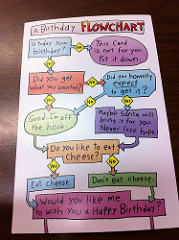
Flow Charts

8568887999_5562e7cc9e_m

Students are used to these in other subjects such as technology.  So use them to your advantage in structuring an argument.  Say for example you want the pupils to debate the environment, work experience etc.  Start with a variety of opinion phrases so that students make a point, explain it, add a contrasting view with “einige Leute denken, dass” and then add a further opinion and reason.  The exam boards say “express and explain a range of ideas and points of view.”  This is ideal for that very aim.

Stretching your best students

Whatever your view of G+T, it is clear that the brightest students in your class need pushing to achieve.  In a climate where languages takeup at GCSE is rising as a result of performance 8 or EBACC measures, A-level and university courses are experiencing decline.  A simple google search shows that in 2012,2013 and 2014 a major newspaper reported on the decline in A-level languages. Our best students should be the ones going on to study it yet most are not. There are blogs which explore and consider why.  Rather than do that, I thought I would share some of the things that I have tried, with varying successes.

Before looking at some ideas there are three questions you need to consider with extension work:

  1. Is the work I am giving them going to deepen their understanding?
  2. Is the work I am giving them going to consolidate their understanding?
  3. Is the work I am giving them suitably challenging and is there a suitable time frame in which to complete it?

Ideas for the classroom or outside of the classroom

Reading

  • Encourage regular independent reading in TL – encourage use of sites such as http://www.cuentosinfantiles.net
  • Authentic materials – what is there that they can go and get and work on if they finish early?  Can they spot the grammar point in a real-life context?
  • For boys encourage them to read www.juanmata8.com , the lethal mediocampista (midfielder) has a bilingual blog.

Writing

  • Picture response activities really allow for creativity. Show students a picture, they could then…
    • write the conversation that is taking place
    • write the events that are taking place  (present tense)
    • write what they think will happen next (future tense)
    • write what would happen if … (conditionals and hypothetical statements)
    • write what happened before (past tense)
    • do a mixture of the above (combining tenses)
    • write what the people should do (modal verbs)
  • Never settle for anything less than their best.  Insist on expanded answers in any plenaries/activities involving mini-whiteboards
  • Dictionary usage – encourage use of dictionary to improve and develop all written work.  Do you have a TL thesaurus?
  • French/Spanish penfriend scheme – get them involved if you can.

Listening

  • What else can they listen for?  Could they do a dictee from the listening recording if they get the answers first time around?
  • www.rtve.es/noticias/directo/canal-24h/    – Spanish news
  • www.france24.com/fr/  – French news     (opportunity to watch live on right hand side of page – pop up window opens
  • www.ard.de – same as the two above  Tagesschau is good short snappy news burst
  • Encourage listening to musicians: Manu Chao (FR/SP), Juanes (SP), Amaral (SP), El Tri (SP), MC SOLAR (FR), WISE GUYS (GER).
  • Encourage them to try a foreign film with subtitles in the TL and the audio in the TL.

Speaking

  • Interviews with TL speaking person are always good.
  • Insist on TL in the corridor, in class and if they have to use it then they will.  It will also develop habits and confidence.
  • Run a twilight session with a focus on improvisation and spontaneity.  They really do benefit from this.
  • Insist on elongated answers comparisons, contrasts, subordinate clauses, do not accept them lowering their standards to fit in.  If you have to then do the speaking test with them in the class but have everyone else working.
  • If playing the trampa game mentioned on this blog,  quietly challenge one to cheat on every go, or alternatively stack the deck.  I tried the former with one student and the intellectual challenge was something that they thrived on.  The morals are debateable but then the game is called cheat.

2 final salient points

1)  Encourage use of previously learnt language in all written and spoken assessments.  G&T students always want to do something new but the challenge should also be to include EVERYTHING they already know as a means of consolidation and a showcase of their abilities.

2) Check they are not sprinting before they can walk.  It goes against everything I have said above but they if they are playing around with subjunctives and still struggling with present tense forms, then you might want to sort the foundations out before building any more of the house.