Cultural Capital: Strategies for Language Classrooms

Other cultures have always fascinated me ever since learning about Norway in Year 5 or tasting a Stollen in German class in Year 7.     My experience of teaching secondary languages suggests that this fascination is true for our students as well.


Was Norway where this fascination with other cultures started? Possibly! It’s still on the list to visit…

We teach culture to build enthusiasm interest and develop the cultural capital of our students. for those students who do not enjoy the language learning process so much, this can be a great way to hook them in.

There are four approaches to the teaching of culture that I have used in my career.

Unit based approach

The obvious benefit of a unit-based approach is that students can gain a deeper understanding of the target language culture full stop.  I’ve seen units structured around the films “Innocent Voices” or Valentín.  I have seen lessons centered around schools in Latin America or French speaking Africa.  I have taught lessons about Cuba (thanks Listos 2), Dali, Goodbye Lenin and the Carnival de Oruro over time.  There are schools who use artists such as Miro, Matisse and Picasso as the foundation for some of their early Spanish modules.   Some textbooks base entire chapters around a target language festival, country or city.  Indeed, one of my former colleagues convinced a class that Mira 2’s “Barcelona Te Quiero” song was once a successful Eurovision entry!  The language gym has exercises on La Tomatina. There are plenty of ways to integrate culture into our lessons. 

Just as there are benefits to this approach, there can be drawbacks.  Culture can be relegated to an end of year project or sometimes a module around culture ends up with grammar or vocabulary “shoe-horned in” as they are good revision opportunities when actually other opportunities might have existed.  The way to counter this is to ask the question: “Is this the best learning my students can do with the material that I am presenting them with?”

This might be a slightly extreme example but let’s take bullfighting:

It could be used as an opportunity to describe the colours of clothing worn by matadors, body parts or…

Do you use it as an opportunity to build opinions and justifications?

I think thatbullfightingis
can be
dangerousasanimals are killedhowever although yet
I believe thatbarbaricpeople risk their lives
In my opinionunpleasantthe animals have no choice
In my viewcruel 

The Pop-up approach

Do we simply just teach about the culture when it just pops up?  Festivals in particular lend themselves to this approach.  Events such as Las Fallas, Barilletes Gigantes, Dia de los Muertos, Christmas, Karneval and Bastille day are all opportunities to engage students with the target language country and its culture.  Sometimes a textbook will have a single or double page spread on something.  It does not take long to find a short appropriate video to show towards the end of a lesson.

The benefits of this approach are that it does not take up too much classroom time at the expense of learning the language. The drawbacks are that much can be missed if it is the only way culture is taught.

Displays

There are some wonderful displays out there. I have never quite had the artistic abilities to produce an amazing cultural display of the types one often sees on Facebook groups, X and BlueSky although I have done my best. I managed one on Germany with a lot of authentic materials after a trip to Berlin but our school then made the decision (against my protestations) to phase out German…

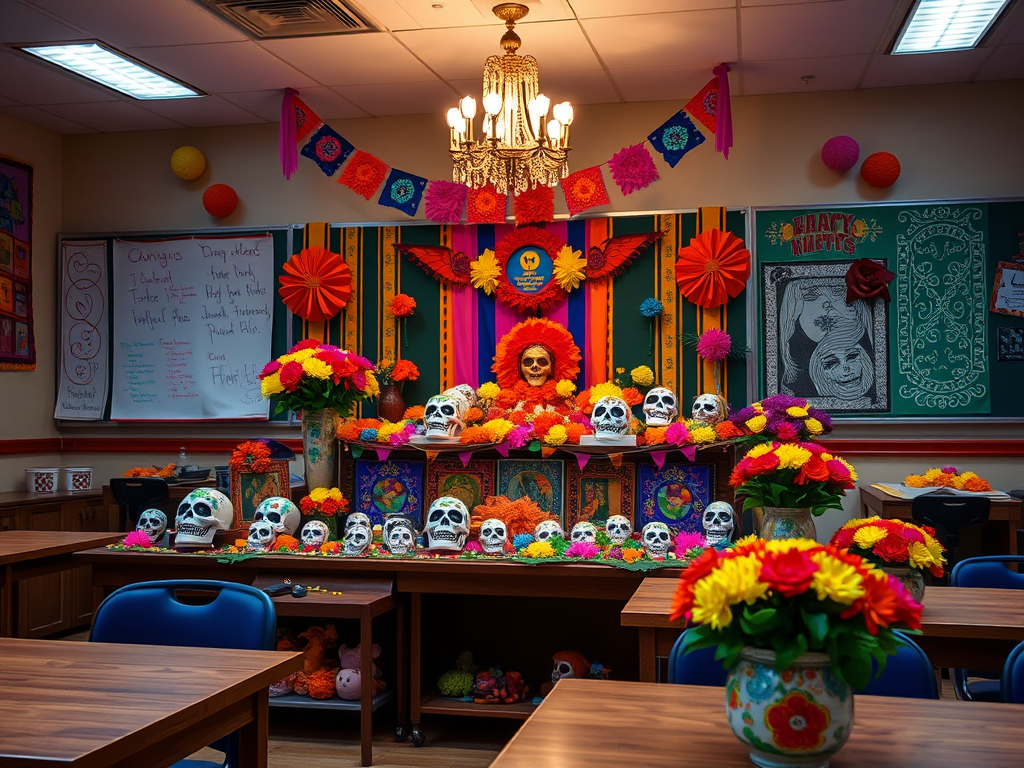
If you’re wanting inspiration, you can find some materials here with MFL Magic, Jose Garcia is has some of the most artistic cultural displays I have seen or you can go full mural as seen at this school on X. There are companies who can produce bespoke murals when given a set of criteria. If you are really stuck for inspiration regarding layout and how it could look then the picture below was created by giving an AI image generator a prompt “classroom dia de los muertos display.” Bear in mind these are highly predictive generating tools and will not be perfect but it might spark some ideas.

Like other approaches this does not detract from classroom time and it makes for a pleasant learning environment. The drawback is again that the display may need refreshing every so often and then you have to balance time invested against the return.

Culture slide approach

This is probably my most recent evolution in culture teaching and the one that I actually feel has done it best.  Dedicating 2 minutes of a lesson to culture after answers to a starter/do now task and before the lesson fully starts.  I prepare a single slide on a topic that includes some pictures and some fun facts.  I talk through it for a minute or two and then we crack on with the lesson.  The benefits of this approach are that there is largely something for everyone.  The students who enjoy history enjoyed learning the history of Spain. The musicians enjoyed learning about singers/songwriters, bands and music.  The students who go on holidays learn a bit more about the places they have been.  The students – for whom a holiday abroad is unlikely – broaden their horizons.  The students who don’t appear to enjoy language lessons often appear to enjoy this part.

Just to unpack what I mean a little bit more by “some pictures and fun facts”…

The Spanish island of El Hierro had a whistling language that was used to communicate between villagers.  William Shakespeare was given a barrel of wine from Tenerife as part of his salary.  Ibiza and Formentera were used as a base by pirates.  Francesco Tarregas’s Gran Vals in A contains a tune known by millions around the world without realising its Spanish origins (seriously, look it up).  The Menorcan city of Mahon is home to Salsa Mahonesa, or – thanks to the French – as we now know it: Mayonaise (an utterly disgusting substance with which people inexplicably ruin sandwiches).

I cannot reproduce the slides as they produced in the context of my work for an academy trust and therefore property of the trust, however, here is a rough guide to what you could do:

Year 7

Term 1Term 2Term 3Term 4Term 5Term 6
Spanish Islands Mallorca Tenerife IbizaMajor players in Spain. King, President, famous peopleSpanish cities Madrid, Valencia, Barcelona, SevillaSpanish speaking countries in South AmericaHistory of Spain Cavemen to present day in 10 lessons. *Customs / Festivals Mealtimes Siestas
Padel Tomatina
San Juan  

*Simon Barton’s History of Spain was quite useful for this for the division of eras into 10 lessons.

Year 8

Term 1Term 2Term 3Term 4Term 5Term 6
Spanish artists.Spanish musiciansCentral American countriesFoods including Paella
Mole Negro
Pique Macho
Idioms from SpainQuirky places to visit in Spain + South America Smurf village Water fights in Bolivia
Colombian festival of Yipao

Culture can make great cover work

Feedback from the cover supervisors in my first school was that they hated covering Spanish/French/German as they didn’t know the answers, students would struggle with not knowing words and most people sending in cover are often too ill to provide much more than “do these grammar exercises.” Whilst a set of sentence builder activities goes a long way towards solving this, a cultural based lesson could work. A set of cultural based activities means students are still learning, they do not pick up or reinforce misconceptions with unchecked exercises and the cover teacher has a significantly easier job.

I have done this two ways in the past:

Spain Live – This was a great textbook teaching pupils about Spain. It works very like a geography textbook with articles and questions to answer. There are also France and Germany versions.

IT room/library – Write out a list of Spanish speaking countries, periods in Spanish history or famous Spanish people. Give each student a different one so that they have to do their own piece of work. Students have to create a poster / powerpoint / document of some description that explains everything they can find using the computers or the library (if your school has one). To avoid copying and pasting, make them write it in a horrible histories style where it has to be accessible for a child aged 8-10.

Conclusion

However you choose to teach it, there is no escaping the fact that culture can broaden horizons, enrich the mind and enthuse our students. The above are some ways I have done it over the past 15 years. You may have others in which case feel free to suggest them in the comments or underneath the social media posts.

5 Things to Try Tomorrow

The whole idea behind these posts is five simple things you can do in your classroom with minimal preparation tomorrow.

Adam Boxer’s Tick Trick (adapted to MFL)

This arose from a post on X by Adam Boxer (you can find his website here). I started using this with my classes for translation tasks. It’s devastatingly simple to add into a lesson: “If you have that bit on your answer, give it a tick on your board.“ You can even convert it into TL with more simplistic language “If you have A, correct. If you have B, correct.” I used it to break sentence translations down into chunks of languages so that students were being rewarded for the bits that they were getting right. The current AQA GCSE does a similar thing where 2/3 chunks correct might equal a mark.

Photo by Photo By: Kaboompics.com on Pexels.com

The power of underlining.

Recently, our department has begun experimenting with sentence builders. I currently share some groups and wanted to check how much of the sentence builder my class actually knew and could reproduce because when you see them every other lesson, it is inevitably harder to track their progress. Being a fully-signed up fan of mini-whiteboards, I chose 5 sentences from the sentence builder for my class to reproduce in Spanish. In this case, the sentence builders described a house. Each sentence was different, used adjectives with the highest surrender value (that is to say applicable across multiple contexts) and students could attempt an extra sentence from the previous sentence builder if they finished quickly. I asked students to turn their sentence builders over and try to produce the sentences from memory. If they peeked, looked up a word or phrase then I asked them to underline that phrase on the sentence builder. It gave me quick intel as to how much each student could remember.

AI seedling image

Seed-planting for GCSE

One of my Year 9 class this week asked a question about GCSE. It was one of those “let’s slow the lesson down by getting the teacher to talk about something” moments. I quickly weighed up the pros and cons and thought let’s take the opportunity to sell GCSE MFL to this mixed ability group. We have not begun our options process yet but they had some thoughts that needed unpacking.

Do I have to take it?

What is foundation / higher?

My sister says it’s ****** hard?

Do i really have to talk for 12 minutes?

What if i don’t want to teach / translate? Is it worth it?

It’s always worth reminding students that they have been preparing for their language GCSE since Y7. The words that they learn then are equally likely to make an appearance and the topics in Key Stage 3 often map to the GCSE ones. When the foundation reading text says “does Ximena enjoy her history lessons?”, they learnt that in Year 7. I sometimes think we are not so different from maths in that our GCSE is the culmination of everything learnt so far.

Photo by Yan Krukau on Pexels.com Grumpy Smurf picture was copyrighted

Grumpy Time

Not my idea at all and full credit goes to Gianfranco Conti for this one. Having seen that my class had used the sentence builder mentioned above to write about where they live (more ideas for this topic here), I asked them to produce me an answer that was entirely grumpy. Having not done this for a few years, none of my students had written a grumpy answer before so we had a brief moment about adding in adverbs of degree (sometimes MFL teachers and resources refer to these as quantifiers). We noted down a few to add in to sound significantly more grumpy. Students then produced some extremely grumpy sentences and seemed to enjoy it rather than the generic “write about where you live.”

Photo by Binyamin Mellish on Pexels.com

Spot the difference with AI

You might notice we have been teaching a fair bit of “in my house” stuff recently from the post above. This idea continues that theme I asked ChatGPT to produce me an image containing two houses and specified what rooms i wanted in each (after a disastrous first go where we had staircases to nowhere). In the end, I ended up using both images! One for a simple writing activity where students wrote “In house A there is but in house B there is not…” The disaster house came in useful as an extension where with a few adjectives given students could write “there is a useless staircase”, “there is a garage upstairs which is stupid.”

A cautionary note on this one. ChatGPT only allows you a certain amount of images per day also since then I have also learnt that AI image generation has a significant water footprint.

Lastly, if you are starting to look for Christmas MFL ideas then…

Here’s 9 ideas

Here’s 9 more ideas

Also a relatively new blog from Beth M is well worth a look. I remember Steve Smith being kind enough to mention mine in the early days which raised my viewing numbers. I hope this will do the same.

Everyday Displays

Over the past 9-10 years, I have had a number of classroom displays. I’ll be the first to admit, I’m not very artistic. I look at some of the displays I see on Twitter and think “that looks incredible”, shortly followed by “I could never do that.” If you search MFL displays on Twitter you will soon see what I mean, along with a wonderfully deadpan nativity one! Here is what I can do with my limited artistic abilities and have done. Hopefuly ahead of the new term, it inspires some ideas.

When it comes to displays, I think there two types of display:

  1. Learning
  2. Inspiring

The kind of questions we need to be asking are:

  1. How does this display help my students learning, or help me while teaching?
  2. Is this display doing the thinking for them or making them do some thinking?
  3. Is this helping to inspire a love of languages, an understanding of their value or an appreciation of culture?

I have 4 display boards in my classroom.

Display Board 1 (front) – TL phrases I want students to use in lessons

Display Board 2 (side) – Phonics board – this is an experiment from September

Display Board 3 (back) – Why study langauges

Display Board 4 back) – Map of Spain

My Current Displays

I’m aware that some people out there argue in favour of a “less is more” approach from a perspective of aiming to reduce visual stimulus in a classroom. I can completely see their point of view and definitely lean more towards this now than I did when I first started teaching.

Display Board 1: TL Phrases

File:WA 80 cm archery target.svg - Wikimedia Commons

I cannot find the original online so it is entirely possible my Head of Department made this. The phrases on this board are largely similar to this one on TES: https://www.tes.com/teaching-resource/spanish-classroom-language-mat-12359711 The overriding aim in any display like this is that it has to be stuff that students are actually going to use. We have quite a strict equipment policy in our school so any “I have forgotten a pen/book” phrase is out. The rationale for having this at the front of the room is that I can just tap the board if a pupil asks me something in English that could easily be done in Spanish. Phrases it includes are:

“te toca a ti” (your turn) “espera un momento” (wait a second) “lo he dicho bien?” (did I say it right?)

he puesto (I’ve put…) “creo que es” (i think it’s…) “no es justo” (it’s not fair)

Display Board 2: Phonics

Credit: https://www.flickr.com/photos/jeffdjevdet/20611280311
Owner requests  speedpropertybuyers.co.uk/ be credited

This is an experiment for this year. I wanted pupils to be a bit more conscious of how words are formed in Spanish and essentially take a bit more responsibility in working out how they are said. That way if someone says “I don’t know how to say it”, they can break the word down and reconstruct it. This uses some enlarged slides from Rachel Hawkes’ phonics powerpoints here.

Display Board 3: Why study languages

Question Mark Response - Free image on Pixabay

This one is at the back of the room so chances are students are only going to see it when they are a) walking in and b) turning around to look at the clock (how dare they!). It could be more prominently placed if my classroom allowed for it but the material on there is large enough to read even with a cursory glance. Again, I am not the most artistic of people so my first trip was to Instant Displays for some lettering and then to use these resources from NST.

Display Board 4: Map of Spain

File:CCAA of Spain (Blank map).PNG - Wikimedia Commons

If I’m honest this is the one I am most proud of. It took a while to make so here is how:

You will need:

  • yellow and blue display paper
  • A marker pen
  • a projector that projects on to a whiteboard

Here is how to do it:

  1. Find this map of Spain.
  2. Fix yellow display paper to your whiteboard.
  3. Project map on to the yellow paper.
  4. Draw around the outline map adding dots for places.
  5. Remove yellow paper from whiteboard.
  6. Cut it out.
  7. Cover display board in blue paper (sea).
  8. Fix your map of Spain in the middle.
  9. Write on the places.
  10. Don’t forget the Canary Islands and the Balearic Islands.

This tends to be used quite regularly in lessons particularly when a place is mentioned in a text. It can be quite helpful to say: “This place is here. If you have been to … then you were not very far way from it.”

One year we also put some stars on places where students and staff in the school had been to Spain and where.

With apologies to Portugal.

Other things on the walls

The Weather: Students in our lessons write the date, learning aim (post on learning aims and objectives in the works) and weather.

Numbers 1-20: This is quite useful for lower ability classes when getting feedback on tasks. “How many people scored …?” Or for randomly selecting the next person. “Charlie, pick a number between 1-20.” you count along the rows for the next person. This is of course when you are not using Wheel of Names.

Both of these can be found at Instant Displays.

Spanish Speaking countries: This is quite a nice poster set by Twinkl. You can check it out here.

My Past Displays

The Sentence Builder

In the past I have turned a display into a giant sentence builder. The sentence builder was modelled on one in this video from Vincent Everett (the sentence builder appears at the 3min 20), which uses modal verbs and infinitives. It was extremely helpful to students, however I quickly learnt I needed to cover it up during tests!!! He also has an excellent blog, which you should check out. His Toblerone idea will be making it into a lesson in September.

Origami Houses

You can find out how to make these here

I set up a display board as above and then populated it with the origami houses that the students had made. I asked a few students to print off some useful vocabulary that could float in clouds in the sky, which they duly did….only with a few additions such as the house from Up! and the Death Star from Star Wars.

The Three Tenses Board

This was quite a simple idea from my previous Head of Department but effective. It contained 30 phrases all students had to know. His original looked something like the table below. I will let you decide what verbs should make it into the 30.

PastPresentFuture
J’ai mangéJe mangeJe vais manger
J’ai buJe boisJe vais boire

Teaching Spanish at the time I simply adapted the phrases. Again, this was a “cover up during assessments” board.

Hopefully, this has inspired you with a few ideas. I have probably done others that I cannot remember but these are the ones that I feel answered the three questions best.

European Day of Languages

It is that time of year again and it always comes around really fast.  European Day of Languages.  If your school does not take part then this is your opportunity.  It is great free publicity for your subject!  Not to place ideas in any of your heads but you could even call it “Languages Week”…

There are many ideas out there, resources on TES and even on the EDL website itself.  Here are a few I have seen work over the years…

Update: ALL have also produced some ideas here.

School site quiz quest.

This one requires some prior preparation, you will require: a quiz on paper, answers on paper, blue tac, sweets.  Give students a set of quiz questions with answers around the school in creative places. Put the answers up a few days before announcing to generate interest.  Any students who complete the quiz in their breaks and lunches get some kind of reward.  It is very likely you will have a fair number of keen year 7s for this.  Students collect the quiz sheets from you and hand in to an agreed location.

40454733712_200ddbf6e5_m

Tutor time quizzes/videos.

Some schools do not have a tutor time programme so create one for the week.  Your other staff will often get on board if they are invited to take part.  If they are forced then they may resent it.  My experience was that 2/3 of staff would willingly go along with it.

We did the following:

  1. Quiz on a different European country each day.
  2. Video on a different European city each day.
  3. The register in a different language each day (modelled and practised in staff briefing of course).
  4. Staff used Digital Dialects to teach themselves and the kids a new language
  5. Some members of staff taught languages they knew such as Gaelic, Spanish Welsh and Hebrew.
  6. Some members of staff from other countries insisted on registers being done in the language in their classes!
  7. Some members of staff kept the language from registration going all day.

Who speaks what? Display board

Do you have pupils and staff from other countries?  Prepare a display with a photo and a short bio as to what languages they speak, how they learnt and how much they can still do.

Who speaks what? Video interviews

Get around your multilingual staff and interview them about their experiences of language learning.  How easy/difficult did they find it?  What are the benefits and advantages of speaking a language? You could show the videos in an assembly or tutor time.

Displays

Various famous people have learnt languages.  If you want a list then here are a few…  It didn’t take long to create a nice PowerPoint background, add a picture from the internet and a text box with the languages they have learnt.  These then went along the corridor.

  • Bradley Cooper – French.
  • Carlo Ancelotti – English, French, Spanish.
  • Mark Zuckerberg – Mandarin.
  • Zlatan Ibrahimovic – English, Spanish, Italian.
  • Tom Hiddeston – Spanish, French, Greek.
  • Tom Daley – Spanish.
  • José Mourinho – English, Spanish, Italian, French.
  • Natalie Portman – German, Spanish, Japanese.
  • Colin Firth – Italian.
  • Viggo Mortenson – Spanish, French, Norwegian, Italian.
  • Dory – Whale.*
  • Christoph Waltz – French, English, Italian.

*may not be a recognised language

Assemblies

Image result for assembly

I appreciate that some readers may have visibly tensed up at this suggestion.  It is a great bit of free advertising for your subject!  Two years ago, I did an assembly titled “I never planned to teach languages”.  It went down really well.  We began with a quiz of film quotes translated into other languages (we used google, more on the evils of google here).  They got sweets for guessing  the film and the quote. Languages such as Portuguese, Dutch and Romanian are great for this.  Then I started telling a little bit of my story about how I got into MFL teaching and where it has taken me.  If you’re interested in that story, or in need of a good night’s sleep then you can read a bit here.

Dress up

One of my former colleagues is a little too keen on this idea… I’ll let your imagination take care of this one.

Foreign Food Stall/Tasting – courtesy of a great colleague from previous school.

Bring in plenty of foreign foods for kids to try at a breaktime.  Staff and students could contribute to this.  This could be run much like a cake sale with profits going to a language related charity or a charity run in a European country.  Efforts we had one year included Schwarzwaldkirschetorte, Tortilla Española, Tarte au Citron Apfelstrudel and Croissants.  You could even insist on orders being given in the foreign language.

Get the canteen involved.

If your canteen is up for it, then take over the menu for a week.  I’ve given each day a theme as they will know what is practical.  As nice as it may be to have a Croquembouche, it might be a little too much to ask!

  • Monday – French.
  • Tuesday – Spanish.
  • Wednesday – Welsh (that’s for Secondary MFL matters in Wales – you guys are great).
  • Thursday – German.
  • Friday – Portuguese.

Your canteen staff will probably welcome the opportunity to vary the menu a bit, just give them plenty of warning.

Language Learning Videos

Here are a set of videos with a pro-language learning theme.


Funny Foreign Language Videos

Who doesn’t love a funny or odd Youtube video at some point? Here are a few favourites from the past few years:

This one had the kids saying “poom” for a few days.

PE Department will approve of this one!

One semester clearly hasn’t convinced her…


What do you do?  Share your ideas on Twitter

Blogging for Languages

The following is the transcript of a talk I gave at the ISMLA Conference Feb 2018.  The talk was titled “Blogging for Languages”.  It is a long read.

Blogging for Languages

I was invited by John Wilson of the ISMLA to talk this morning about “Blogging for Languages”.  My plan is to go through 5 things.  Firstly, who am I.  Why blog?  What have I gained?  Can you do it?  What’s next?

Question 1: Who are you?

My name is Dave.  I teach MFL in a secondary school in Devon.  I have taught German, Spanish and a little bit of French since starting in late 2011.  In that time I have served as Second in Department and also in a pastoral role.  I didn’t ever plan to be a language teacher.  I went to university to study English and German.  My first English lecture convinced me that I needed to be doing something else.  A number of friends I had made in my halls were studying Spanish ab initio, so I joined them and it carried on.  This led to a year abroad spent in a mixture of München, Bolivia and Marburg.  I completed my PGCE with South West Teacher Training, and got a job teaching languages.  I’m now just an everyday MFL teacher.

Question 2: Why blog?

I came across the idea of blogging sometime into my third or fourth year of teaching.  I had started looking at a couple of websites called Classteaching, a blog by a teacher called Chris Hildrew (who is now a Headteacher and occasionally blogs) and Frenchteacher.net.  They were all great for ideas and I wondered if I could do the same, so I did.  Everydaymfl started life as North DevonMFL.  It was a place to store activities and teaching ideas. It attracted a few visitors each week.  I was quite proud of my 20 or so readers.  Aside from a blog called Dom’s MFL blog and the aforementioned Frenchteacher.net there was not much giving practical ideas for teaching topics, grammar and ideas to use inside the classroom.  I wanted somewhere to store ideas that was not going to get lost, disappear and was easily accessible.

After the first few months, I changed the name to reflect the nature of the blog and also because I had started looking around for jobs elsewhere.  If I were no longer in North Devon, I didn’t think I could really retain the name.  Over time the blog has grown from 1000 views in 2015 to 10,000 unique visitors in 2017.  The United Kingdom leads the way with an overwhelming majority of views.  The top ten does include the USA, Ireland, UAE, Spain, Austrailia, France, Brazil, Canada, Malaysia and Italy.  I’m still awaiting visitors from Bolivia, Paraguay, Uruguay, Iran and Cuba.

The vision behind the blog was practical ideas that teachers can use every day.  On Everdaymfl you can find ideas for teaching a variety of topics, how to help pupil-premium students, feedback and marking, questioning and some thoughts regarding approaching a visit from “they-who-shall-not-be named”.

Question 3: What have you gained?

I have gained a lot from doing this.  Composing a blogpost makes me reflect on what works, allows me to imagine ideal situations and helps with retaining ideas I may have had and filtering out the ideas that didn’t work.  I have also found it hugely helpful in working out what I believe about language teaching.

Regarding what works, there are plenty of posts on ideas that I have tried in lessons.  I have written a series of posts titled “5 things to try tomorrow”.  If you really want clicks on a website then it needs that kind of title!  I have refrained from the clickbait titles you see on some websites such as: “I did this activity with my students and you wouldn’t believe what happened next” or “the reaction from students to this lesson broke the internet”.  If we’re honest, what happened next was probably SLT on a learning walk, or that the bell went!

In terms of ideal situations, I have written about options, Parents Evening (is currently in the works) and keeping year 9 going after options .  Some of the ideas in the blog are things that I would like to do but thought of weeks after a meeting where a decision was taken; others are things that we have done in the past that still have merit but perhaps we no longer do.  Sometimes the ideas might not work in our context, or might be rejected in favour of something else.  That does not mean that it will not work for someone else.

When it comes to retaining ideas, I now have a post on charity and volunteering to help me remember how to teach it the next time around, along with social media and the internet.  The most recent one was a post on the environment.  It is a tough enough topic to make engaging anyway but hopefully will spark my thoughts and imagination in future years.  Posts can jog my memory and makes me remember the activities, along with the lesson, which can often provoke further memories.

From reading other peoples’ blogs I have gained a huge amount in terms of knowledge about second language acquisition and schools of thought regarding it.  It has helped me to develop my ideas and principles about language teaching.  At some point I will put these to paper but have not got around to that one.  It has encouraged me to reflect on what I was taught and how MFL teaching was modelled in my PGCE.  This has then led to me ditching certain types of activity because they don’t promote learning enough or don’t encourage students to use the language enough.  It has led to me trying out new activities on a weekly basis and even in the past few days such as the Card Stealing activity seen on the Global Innovative Language Teachers Facebook Group.

Publicising the blog on Twitter and various Facebook groups have put me in contact with other professionals.  They also have helped to massively bump up the visitor numbers.  The Global Innovative Language Teachers Facebook group caused a massive spike in views when one of my posts was shared there by someone else.  The post concerned marking and feedback.  Forty something comments afterwards; it had proved slightly divisive but provoked a debate.  The blog has also put me in contact with some extremely helpful people such as Laura Simons who runs the Secondary MFL in Wales Facebook group, and also Steve Smith (author of Frenchteacher.net) who kindly reviewed the blog.  I felt some trepidation when I discovered the next post on Frenchteacher was a review of my site!  He was very complimentary so I will return the favour by suggesting you have a look at his books on Amazon.

Question 4: Can I do it?

The answer is simply yes.  If you are happy using a computer, can search for images and are willing to read a little bit about hyperlinks and sign up to Twitter then you can.   There are a variety of sites out there that will help you compose a website and get it up and running.  The main ones seem to be WordPress, Blogger and Wix.  I went with WordPress having seen other people use them.

The next question you need to ask is do you have the time?  I have managed less blogs this year than previous years due to a variety of new demands on my time.  If you have time then you need to consider subject matter.  What are you going to focus on?  Taking the blogs out there you have Jess Lund’s blog which elaborates on what happens at Michaela School.  Gianfranco Conti writes a lot about research on second language learning and how it impacts upon his classroom practice, which is well worth a read.  Steve Smith writes about issues facing language teachers and shares lots of good ideas for lessons.  Helen Myers has a blog with useful information concerning Ofqual, the new GCSEs, the Association for Language Learning and various other bodies.  John Bald mixes language and literacy in his blog.  Chris Fuller used to write about some crazy ideas and different ways of teaching the same old topics.

If you have a subject then you need to consider frequency.  At the moment I am averaging one post a month and would like to do more.  Having said that, one of the great things about a WordPress blog is that you can set the blog to upload at any time of your choosing.  This means you could write a few and then let them upload at different points in the month.  It will then share it across your social media platforms if you let it.

As for how to get started, Teacher Toolkit is a great place to go if starting to write a blog.  It used to be a member of SLT in a UK school writing about his practice.  It has since grown quite considerably, but somewhere in there the original posts about having a blog should be available.  My main gains from Teacher-Toolkit were to have a Twitter handle and use it for publicising and use of the website compfight.com to provide copyright free photos.  If you do not own the rights to the photo then you shouldn’t be using it.  You also need to make sure the photo is properly accredited.  It has been very useful, although google have now also introduced this as a search feature.  I have also had to be very careful about where the ideas come from.  Most of the time they are easy to attribute: “this came from …’s website” or my PGCE mentor was a big fan of this activity.  Credit is sometimes very hard to give as with social media things can move very fast.  One person shares an activity on a Facebook group and then suddenly every teacher is doing it.  I’m still completely unaware as to who developed the idea of Spanish revision balloon towers or the more recent “one pen one dice” activity.  It is then hard to give credit to the people who deserve it.

Lastly I feel I should mention a little bit on safeguarding.  Initially, I chose to leave my name off Everydaymfl, as I didn’t want my students finding me.  Whilst some of my writing may come from experiences involving students you will find no names on my site.  What you will find are replacement names borrowed from TV series and films.  Joey and Chandler, Sheldon and Penny etc.

Question 5: What next?

The first aim is to blog more in 2018 than 2017.  I have no idea yet what the topics will be but have a few in the pipeline including one on parents’ evenings that needs finishing along with another “5 things to try tomorrow”.

The second is to possibly offer one or two guest posts to maintain the momentum from this year.  It also might allow someone to share their take on something or ideas they have had.  If you are keen then please drop me an email via the “about” page  I currently do not teach A-level and there is definitely a space there for sharing effective practice and favourite activities, particularly as there have been changes to A-level and I’m sure teachers out there would appreciate some practical ideas.

The final aim is to keep writing, keep reading, keep learning, keep reflecting and developing as a teacher.  Ultimately we all want to be at our best in the classroom, achieve the best results for our students and give them a really good experience of languages and hopefully I have helped the MFL community in doing that.

The second “what’s next?” is for you the reader.  What kind of blog could you create?  It could be personal, departmental, whole school, or even for your students?  I am aware that St Bernadettes’ School in Bristol posts their CPD on their blog.  I have heard of teachers start a blog listing resources for students (this may be more appropriate at A-level).  You could create an online portfolio of excellent work.  With schools using Google then you could create a google-site.  This would be accessible only by those who have the link.  The aim could be personal, educational or professional or a mixture of the three.  What really counts is what we do inside the classroom, trying to be the best and deliver the best for our students every day.  I know blogging has helped me improve my practice.  If Everydaymfl has helped colleagues around the country in delivering the best for their students then I would say that’s a very pleasing outcome.


Some gems from ISMLA

View image on Twitter

I was recently invited to lead a seminar titled “Blogging for Languages” at the ISMLA conference in Cambridge.  I had a great time, met some great professionals and learnt a lot over the course of the day.  The following are some gems that I picked up from Jocelyn Wyburd, Wendy Ayres-Bennett and Jess Lund from the Michaela School

Jocelyn Wyburd (@jwyburd) 

Jocelyn was the first speaker at the conference.  She is the Director of Languages Centre at the University of Cambridge.  She spoke about how the landscape in the United Kingdom currently looks for languages and language learning.  There are some points from her talk that are particularly relevant and encouraging for us as MFL teachers.

Jocelyn mentioned referred to an article in the Washington Post, shared on the Transparent Language Blog that stated most important qualities required to work at Google were being a “good coach, listening, empathy, problem solver, communicating well, insights into others and critical thinker.”  STEM came last on this list.  Jocelyn’s view was that a language develops all of those qualities that Google look for.

The British Academy wrote in 2017 that half of global leaders have a arts/hums/social science degree, along with 58% of FTSE 100 CEOs and 62% of UK election candidates.  This goes against what might be expected given the current push for STEM subjects.  Jocelyn then referred to research into languages that the UK needs post-Brexit.  A summary of that research can be found here courtesy of the British Council.   There is also a report on Languages for the Future which was cited in Jocelyn’s talk.

Jocelyn’s spoke strongly about how the UK needs more MFL to remain globally competitive, how the CBI (confederation of British industry sees languages as a “valuable asset to businesses” and how the Financial Times when reviewing the book Languages after Brexit spoke of a need for greater “cultural agility”.  Again this cultural agility is something MFL teachers are developing in our lessons, departments, displays and trips.

Lastly, she mentioned 300 different languages are spoken in London.  I would imagine this situation is slightly reduced but similar in other large cities.  The MET benefit greatly from police officers with language skills.  She also highlighted the MOD, GCHQ and armed forces as recruiters who see the value of languages.

I have always been of the view that languages are important and develop a variety of skills.  Jocelyn’s talk has reminded me of how much unseen development occurs in our students, the value of languages to employers and given me some really up-to-date stats, facts and information to share with my year 9s.

Wendy  Ayres-Bennett – Multilingualism: Empowering Individuals, Transforming Societies

Wendy spoke about the MEITs programme (Multilingualism: Empowering Individuals, Transforming Societies).  Here are some nuggets of information taken from her seminar:

1 in 5 UK school children have a language other than English as their home language.

90% of UK primaries do French but transition is variable and often poor in state sector.

Cognitive Benefits of learning a language were demonstrated in a study in Canada.  The study involved 230 dementia patients.  50% were bilingual.  The bilinguals developed dementia 4 years later.  This study was then replicated in India in 2016.  Another study showed that bilinguals recovered twice as well from strokes.  Greater detail can be found in Wendy’s blog here.

Jess Lund – The Michaela Way

The Michaela School has divided opinion.  The Guardian called it Britain’s Strictest School”, Tom Bennett writes “I left, as I have before, impressed. The kids are happy, and totally loyal to the school. Parents for the most part love it.”  From what I have seen, they have a strong belief in their approach and a desire for their students to be the very best they can be.

Jess’ presentation was delivered at the kind of pace that makes speed cameras flash.  It was informative, humourous and engaging.  What came across was her love of language teaching, her passion for her pupils and her belief in the Michaela Way.

The biggest take-away for me personally was the acronym: “PROFS” (past, reasons, opinions, future, subjunctive).  How had I not come across this before?!  I introduced my year 9s to it on the Monday after the conference and they are getting the idea that PROFS = better work and higher marks.

Other ideas I took were:

  • Dotting silent letters in French to improve security with pronunciation.  Unfortunately, my French class did tests in the lesson before half-term so I have not had an opportunity to try it out!
  • Constant phonics and over-pronunciation.  I do fairly regular lessons on phonics but perhaps something more systematic and targeted would help my students even more.
  • Teaching high frequency structures earlier on.  This is something I had been trying with my year 8s but not in quite the same way.  Jess’ sets of “awesome top 10s” definitely go further than I have.  They are something I am starting to look at.

Jess’ presentation made me question a few things about language teaching:

  • Should we be teaching high frequency structures in year 7 as student enthusiasm is higher?  Also teaching the language that makes the biggest impact earlier could lead to greater long-term retention.
  • They attempt to have “no wasted time” in their lessons.  This got me thinking, out of the 50 minutes I teach, how many might have been lost?