Blogging during the holidays, you cannot be serious?!!! A while ago I did a post of favourite MFL youtube videos. It’s the holidays and I’m not doing any work yet so enjoy the light-hearted fun below:
French
German
Spanish
Multi-language
Blogging during the holidays, you cannot be serious?!!! A while ago I did a post of favourite MFL youtube videos. It’s the holidays and I’m not doing any work yet so enjoy the light-hearted fun below:
French
German
Spanish
Multi-language
When i was in year 8 (a long time ago, in a galaxy far far away) we looked at how to order from an Eisdiele. It proved to be a useful lesson as two years later in Germany i was ordering ice creams and surprising my classmates with my ability to make sprinkles, cream and flakes appear. Their 99s looked pitiful in comparison. It made the language come alive. I’m happy that it would appear that roleplays are making a return. I remember doing them at GCSEs. I remember the school coach had broken down and I had to explain where I was on the autobahn and get help (in the the role play -my school trips have been largely incident free).
I have recently been forced to attempt some typical roleplay situations in my third and weakest language such as visiting the chemists after being a mosquito banquet, hiring a car and buying stamps in a tabac. My experiences of this lead me to think that as teachers we are faced with two questions.
Transferable language.
Pour students need to be in e habit of transferring language between situations. I often remind students that unlike science, languages require recycling knowledge. Science lessons seem to cover space one half term before moving to plants the next, languages requires a constant revisiting of key structures and vocabulary. My plan would be that students at he end of each half term have a bank of words they can apply to a variety of topics. Rachel Hawkes’ saco mágico is a good idea here – a page in students’ books where they note down phrases they need to reuse. It should probably b tested regularly to give it value in the eyes of the students.
Confidence
Students need to feel they can talk and they can get out of situations. This needs to be without using je ne sais pas for every situation encountered! Below are some activities that might help in developing confidence.
Schwindler/Trampa – students write cards with key phrases and some cards with just the word trampa. They play the cards face down reading the phrase but if they play a trampa card then they have to improvise a phrase. This developed he abilities of my bottom set yr 11s and saved me from some silent oral exams.
Dialogue chop up – Exactly as the name suggests. Give students a dialogue to rearrange either in terms of words or sentence.
KS3 drama – I have always done dramas when we have covered buying food and drink, buying clothes or going to the doctors. Make it more challenging by giving groups certain challenges to complete eg broken leg – explain how it happened. Sometimes i have included curveballs at the last minute in the restaurant drama such as “lo siento señor pero no tenemos pizza”, it forces thinking and improvisation. Students also feel a greater sense of achievement if they can do something real life. They may not get to talk about their school subjects on holiday but they will likely order food.
Face/shoulder/diagonal partner – Make students practice with everyone. The more practice the do and feedback they receive; the likelier a successful outcome. Face partner is the person opposite and shoulder partner are the people next to them. I never use the terms but it is a helpful distinction for the blog.
If this is the answer what is the question – Borrowed from Mock the Week, students need to know what they are asking if they have to pose a question and equally they need an understanding of what they are being asked. Take the breakdown situation earlier, we do not want students answering blau when the question was “wo ist dein Auto jetzt?”
What do you do? Share what works as it is coming and we’re all in this together. Be the first to leave a comment!
Life is fast. We get our news from 140 letter tweets. We boil a kettle and squeeze the life of that tea bag so we can have a quick brew. Google is the answer to whatever question appears too difficult. How then can language teachers with busy lives maintain their level of language so that we remain at the top of our game? This would be particularly pertinent for those of us (myself included) who do not teach A-level. It would appear easier to stay up-to-date in other subjects. Science teachers can look up the CERN website and myriad other research agencies. History teachers can always read more, watch footage or visit museums. I’ve been guilty in the past few years of being a little slack with this at times. Here are some things I’ve done to actively address it:
Go there!
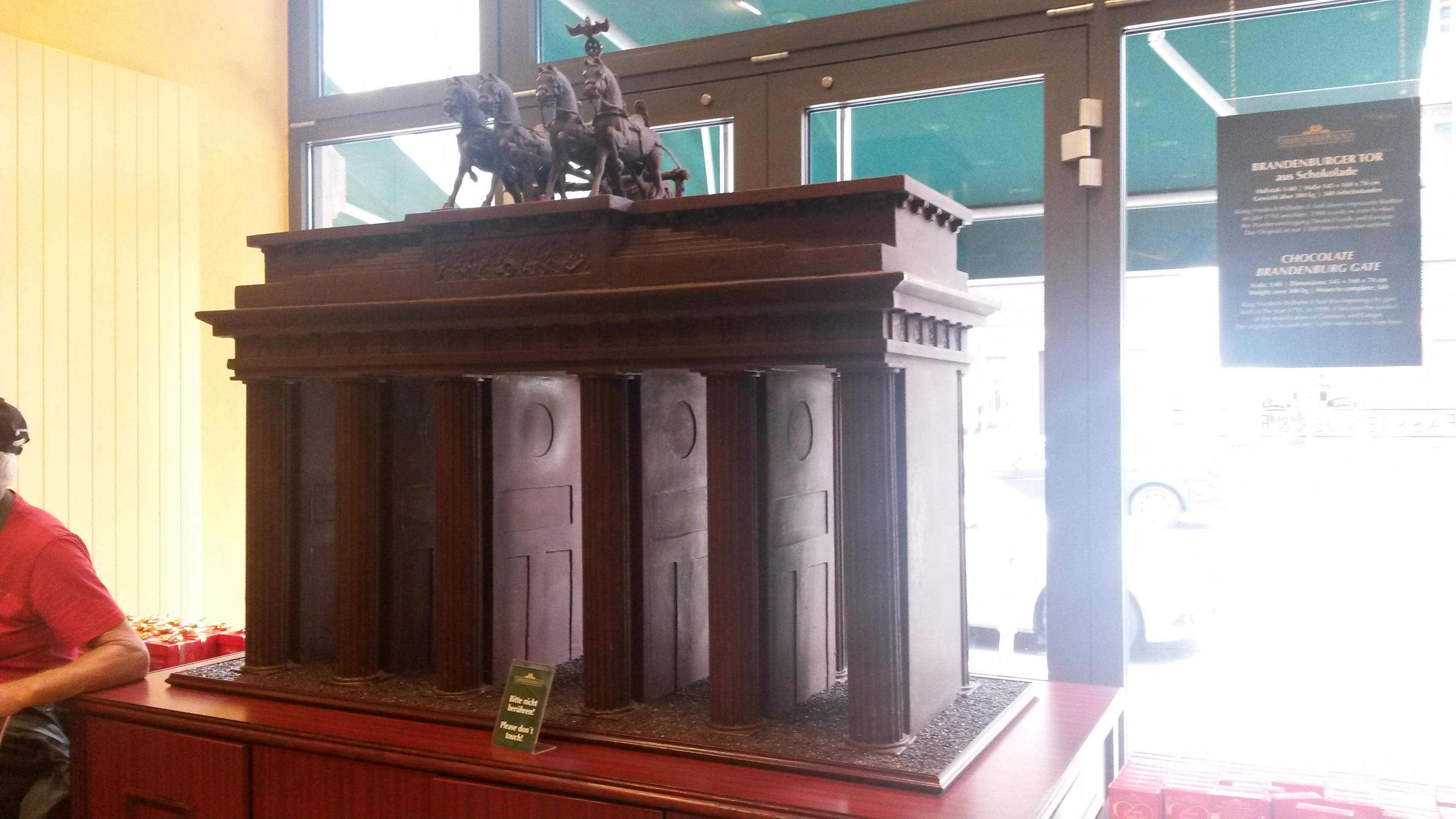
Last summer, I took a short break to Berlin. This summer I plan to visit parts of Spain and France I’ve never seen before. I’m also going to be in Switzerland for a short time. It is a great time to pick up authentic materials that you can use in a classroom or material to improve your displays. You get to see some absolutely unique things (see chocolate Brandenburg Gate below) and learn stuff you never knew before.
Make the most of the opportunities.
I can speak three languages with varying degrees of competence, and confidence. However, that does not stop the “what if I get this wrong?” thought from entering my head. In Berlin, I forced myself to interact with people, even a waiter in a café can offer a good conversation and lead to learning new words. I visited as many places as I could. I took the option of audio or tour guides in the foreign language. If you are visiting the Reichstag then the guide only begins when you set foot on the slope in the dome – took 10mins and 3 sets of headphones to work out why it wouldn’t work! I read the leaflets and flyers given to me on the street, even if I did not agree with their politics. In stations and airports, if you are not sure of something then talk to someone who looks like they know what is going on. This goes against the grain for us men, but it yields conversation and practice, particularly in languages you may be less comfortable with. This year my challenges will involve dealing with car hire in Spain, finding accommodation in France and navigating public transport in triglossic Switzerland. Bring it on!
Join Twitter
I am not a biggest fan of Twitter but I have learned that I can pick up new vocabulary and refresh my memory of words that I didn’t realise I knew. If you look at the everydaymfl twitter people I follow you will find a considerable number of Spanish, French and German speaking footballers and sportsmen (you may also work out the club I support). Sadly, one or two tweet too often in English but I’ve learnt new vocabulary and seen words used in different contexts. “Una racha” can refer to a winning or losing streak (thanks Juan Mata for that one).
Read, listen, note, make it memorable.
I’m constantly telling kids that reading does not equate to revision; they need to do more It’s the same with teachers. Are you trying to learn new words? I’ve decided this year I want a whiteboard or two on the wall in my room for vocabulary that I am learning. I also want to spend more time on www.ard.de to improve my listen skills and range of vocabulary. I should listen to more foreign radio and news than I do. With the internet at my disposal, the only excuse is my own laziness and that’s not an excuse!
Talk to colleagues
It is so easy to lapse into English with colleagues who are conversant in a foreign language. I’m trying to do this less as it has two major benefits. Firstly, it shows the kids what they can achieve with hard work and effort. Secondly it shows your colleagues from other departments that you don’t spend your lessons playing games and learning how to say items in a pencil case. Thirdly, it also really hooks the interest of the students as they try to work out what you are saying. The look on their face when they realise they understood one or two words spoken at a relatively fast speed is worth it.
Subtitles
Let’s face it some films sound awful dubbed. Some actors just sound wrong. The same German voice does Jack Sparrow and Jack from Titanic. Use the subtitles to learn new words. It’s simple but I have definitely picked up the word Zauberei from subtitles (although not sure how much use it will be). Alternatively…
Watch foreign films
Current recommendations
Have I missed anything? What do you do?
To all readers.
Thank you to those of you who have read this blog on what we could call “everyday mfl”. The stats say that it has been read by more people in 2015 than 2014, and from countries as diverse as Mexico, UAE, Switzerland, the UK, Spain and France. Thanks to those who have tweeted, shared, followed, and passed around departments.
It’s that time of year again (no, sadly not Christmas). Most year 11s are taking a pummelling from all sides with a revision sized baseball bat. How can we do revision effectively in MFL? It would appear to me there are three key areas. 1) Teaching exam technique 2) Vocabulary refreshing and/or building 3) Revision technique
Exam Technique
Certain things are guaranteed on an exam paper and students need to be aware of this.
Vocabulary refreshing / building
I have a mixed ability GCSE group with grades ranging from A*-G. It is a two year fast-track German course. I have seen many good ideas on the secondary mfl facebook group but due to the nature of the course there is simply not time for trivial pursuit, jenga or balloon towers. They do look fun though! Below is a typical revision lesson:
Topic: healthy living and lifestyle
STARTER: activity that refreshes their memory of large amounts of vocab eg: odd one out, make a mindmap, 30 word vocab test German–> English or English–> German.
MAIN:
Present: a revision activity students could do at home on any topic but model it with this one.
Listening practice using past exam questions or revision workbook questions. Immediate feedback and discussion of where the marks were won and lost. Suitable for both higher and foundation although leaning towards higher.
Split class into two groups
Highers do some practice reading questions on the topic while foundations do practice listening appropriate to their level on the topic, then they switch. Students doing the listening will be talked through how to approach the question, what the question is looking for and any handy strategies that come to mind. We then attempt it. Those doing reading are largely left to it.
Set homework: revision via vocabexpress / samlearning / past paper / make a mindmap / make a tarsia puzzle / languagesonline
PLENARY:
Students then may face one more listening text (because you can never practise this enough) or another vocabulary building activity based on my experiences over the course of the lesson.
Revision Technique. https://classteaching.wordpress.com/2015/01/29/supporting-learning-through-effective-revision-techniques/ This one blog post gave me a lot of ideas. I don’t think I can improve on what Shaun Allison has written so enjoy. Lastly, show this poster to your students (thank to Chris Hildrew).

Sorry for the lack of posts, things got busy at work so here is a double whammy. One of the 5 ideas to try series and the other is a collection of thoughts on GCSE revision.
1) No ICT at all
I think we can become too dependent on computers. The phrase “death by Powerpoint” is not a new one. Kids are largely unsurprised by anything we can do with a computer. So how about turning it off for a lesson (apart from your register of course). The other day with my French class we had a lesson with no ICT at all. They did not have to even look at a screen. It was great! Everything was old-school. We had flashcards, card sorts and all manner of activities but nothing involved a computer.
2) Giant scrabble
Great way of stretching pupils thinking skills and knowledge of vocabulary on a particular topic. Put as many mini-whiteboards together as you can. Start with a word in the middle. Pupils get a point per letter for their word and a point per letter from any word it bisects. You could make it a team effort if you have large classes so two pupils work cooperatively. My old German teacher used to do this on an OHP, we loved it but the mini-whiteboard version allows everybody to be involved. I’ve also tried adding challenges such as: include words on the theme of … (double word score), include a particular grammar item (triple word score). The possibilities are not endless, as that is a cliché, but there are quite a few.
3) Differentiated dice speaking.
I might have posted this one before but it keeps with the no-ICT theme above. Give pupils dice. If you can buy some D12s (12-sided dice) then do. You then have the following options.
4) 50-50 Hands up/hands down
I’ve seen some classes where the rule is no hands up and others where the rule is hands up all the time. I’ve been trying a mixture of both recently and it’s working. It maintains the engagement as both other methods have two distinct problems. The no hands up rule is great but only if the teacher makes a point of picking on all class members. It can easily lead to picking on the brighter ones, further the learning and progress of a class. The latter has an issue as it allows the quieter members of our class to hide. I find this one neatly counters both. It shows you who is keen but allows you to keep all members of the class on their toes.
5) Murder mystery https://www.tes.co.uk/teaching-resource/murder-mystery-lesson–food-and-drink-6091212
Brilliant resource by the exceptional rosaespanola on TES revising foods, likes and dislikes. My only concern is that my bottom set did a better job than my top set. The language was quite challenging and the task is not particularly easy. If you use it then give it the 5* rating it merits.
Whilst not a pre-requisite to good teaching or good learning, some ICT room input is useful every now and again. Students enjoy the occasional trip to the computer room. I should use it more and my classes often remind me to do so! Here are my regular ICT room lessons. If you have a good idea drop one in the comments section below.
Sell your sibling (thanks to a former colleague for this one)
https://www.tes.co.uk/teaching-resource/Sell-your-brother-on-Ebay-6193621
Surprisingly, I have never got into trouble for this and the kids love it. If they are an only child like the writer of this blog then suggest they sell their teacher. Currently I am for sale on the wall of my own classroom. In the event that your pursue the latter course, you may wish to correct any factual inaccuracies that ensue from the pupils description of you (which can often best be described as skewed, misinformed or just wrong). If you’re wondering, I went for €1500.
WANTED
Great way to reinforce descriptions. Give the pupils a helpsheet with phrases like “armed and dangerous”, “do not approach”, “reward” and then get them to find a celebrity and go for it. A good plan is to tell them they are doing this lesson and have them think of someone beforehand, otherwise the normal battle of pictures vs content ensues and content loses out. Ideally, they should probably avoid doing one of their teachers but if they’re learning and being creative with the language don’t stop them. Display it in the corridor for maximum effect!
Gap Year

Students plan a gap year using the future tense. They need to explain where they are going to go, would like to go, intend to go etc and why. If you have access to www.youtube.com then “where the hell is matt 2008” could provide some inspiration, although it might have more of an effect on your travel plans this summer.
Students could add more details and description. The trick is to get them to focus on the language first and the pictures later.
Lebenslauf
Designing a CV. Great way of teaching a range of vocabulary and revising a variety of topics. Microsoft word has some good templates for this that can be customised. You could set homework prior to this lesson so the pupils find the vocabulary they need and then produce the CV, or equally do it the other way around and teach them how to use http://www.wordreference.com properly.
Audio guide using audacity
Students produce a radio advert to encourage people to visit their town. This can be done using the program audacity (free to download – or it used to be). The difficulty is recording it. Most students will happily do it but in an ICT room it does mean there is a lot of background noise. Maybe suggest they do it at home or if your school allows then use http://www.spreaker.com/
Past listening exam papers
If you have a mixed ability group the ICT room is a great place for these. Give the pupils the papers and put the listening tracks on the system or intranet where they can access them. It also allows them to control volume and work through at their own pace. This is good when you are developing exam technique. Obviously some in-class or exam hall practice is good but this helps build confidence. It allows you to cater to higher and foundation students if you have a mixed group.
Google Earth Directions
Why not create some directions that the pupils have to use google-earth to follow. They could also create directions for their friends. If they get to the right place then clearly they understood the directions – very easy way to evidence progress. There is a good resource on the TES for this but if you know where you are and where you are going then do your own. I tried some with Madrid and got pupils going around the main square before being dropped elsewhere in the city and having to find the Bernabeu stadium.
Languagesonline.org.uk and samlearning.com
Both of these are superb websites and are improving all the time. The former has recently been improved to facilitate use of tablet and smartphone. The latter is gradually building up its stock of listening practice. Languages online is free to use and has a lot of good exercises for practising grammar. It also offers the explanations and hints to remind students of the rules they are practising and links well to Key Stage 3 schemes of work.
Little explorers picture dictionary
Great resource for early years or lower school. My students have recently found this a great help on the house and home topic. Whilst they see the title of “little explorers” as patronising, the website is very good. Useful resource for weaker learners and perhaps getting students to make their own vocabulary lists.
Worksheets 1 and 2 are great for developing cultural knowledge. I’ve only just discovered the rest of the site and there looks to be some really good material for French, German and Spanish.
Dear readers
Just a few simple ideas this time. Thank you to whoever is tweeting this site as the views go rocketing up. I haven’t ventured on to Twitter yet but it might happen soon.
Extreme battleships

How about an 8×8 grid with two people playing against two other people at the same time using the same board? It sounds mental but it can work. You need a very competitive class, very clear instructions and a certain arrangement of desks.
Differentiated Quiz Quiz Trade with mini-whiteboards
Get students to write a question on their whiteboard and the start of the answer on the back of the whiteboard. Students must ask and answer a question before swapping whiteboards. I tried this with ¿Qué estudias? and ¿Qué vas a estudiar? Students had “estudio” or “voy a estudiar” on the other side so when the person was answering, they had help with their answer. Went down well with a low ability group.
Extreme holiday consequences

A fair amount of pre-teaching of verbs needed here. Give students a long piece of paper, tell them to put their name at the bottom (this throws them a bit). Then lead them through the following insisting that they fold over and pass the paper on each time. At the end return it to the original person. Writing and reading task in one 🙂
You can adapt this to your heart’s content. This could work with what you do at the weekend, what you plan to do at the weekend. It could be done with school. Very flexible activity that allows for a high degree of creativity and teaches some useful phrases at the same time.
30 second summary
A great plenary activity that allows you to check on the learning of a class or even better an individual. You know how some students do not give much away by their facial expressions, set the class the task of summarising the content of the lesson or explaining a grammar point in 30 seconds., Go over and listen to that particular student.
Youtube
There is a lot of dross out there but if you find something good, make it part of your practice. I am not a massive fan of songs given that my ability to sing is …well.. “limited” would be putting it kindly. The school insurance probably does not cover the resultant broken glass.
Particularly enjoyed using these two recently:
We exploited them by listening, gap fills, finding phrases, and then trying to sing it. If you have VLC media player you can slow the play speed (0.85 is good)
Differentiation is key to developing the abilities of ALL of our learners. Often you hear about “differentiation by outcome”. This is the idea that wherever the learners end up is differentiated, as some will inevitably produce more or better quality work than others. I’ll summarise the types of differentiation I use below and then give you some ideas you can try tomorrow for each. The graphic above explains what differentiation is. The picture below explains why we need it.

Differentiation by resource
Resource is often a euphemism for worksheet at this point. It can be effective if you are somebody who rarely uses worksheets. Students like to have things they can go through at their own pace and given that other subjects use them, why not MFL? However, resource does not have to mean worksheet.
Differentiation by task/choice
This can take various forms. I think it is best employed in the production stage of a lesson or equally the practice stage if you are covering a grammar point.
Differentiation by support (TA)
Whilst I realise that differentiation by support could mean significantly more, I wanted to devote a section of this to the use and direction of TAs. Here is what the best TAs I have worked with have done:
Check out my post on TAs, unsung heroes of the classroom
Differentiation by interest
Sometimes students want to write or speak about things unique to them. It may be that comparing modes of transport or the environment hold little interst for them. Sometimes differentiation is not about ability but about interest. I find I can get a lot of kids engaged if I can make links to things they are interested in (football is very useful). The pets topic works for a lot, as do clothes, food and holidays However, we must be careful to engage all kids, what about the one who reads? Could he/she do their coursework on a book rather than a film?
Happy New Year to you all. I hope you had an excellent Christmas and a promising start to the new year.
I’ve decided this should be a simple post about things I will try this term, starting next week. There are numerous aspects of teaching that I want to improve and various ideas that I want to try. All of it is aimed at trying to make my lessons the very best they can be. While inevitably some lessons will go better than others, I want the return in terms of learning to be high every lesson.
Here are 4 ideas I want to try in January:
1) Experiments with excellence
I’ve been reading a little about Ron Berger and his “ethic of excellence” and his insistence on feedback and how it can drive improvement. Whilst Berger teaches in a relatively unique setting I wonder if his ideas can be applied in an MFL classroom. My year 8 Spanish class will produce a postcard from a holiday but rather than it being a week long homework at the end of the topic, we will draft it over 2 weeks before they do a final version at the end of the topic.
https://www.youtube.com/watch?v=hqh1MRWZjms
2) Speaking/Translation tandem
Inspired by a Bristol colleague. Students have phrases on a sheet of A4 with alternating Spanish/English. They have to say what they think is the phrase and their partner can nudge them towards a correct version. It should have the effect of reinforcing grammar structures, raising translation as an activity (with the new GCSE in mind) and could work quite well. Probably will try it with year 7s or year 10s.
3) Insistence on TL
All students have phrases in their books they can use but I’m really going to push it this term. I want to see if we can get lessons where there is an 80/20% ratio of Spanish – English. To this end I plan to have 3 things in place:
i) A TL monitor – a student I trust who can monitor my TL usage and that of the class. They will have a traffic light card to indicate this. In lower years this will probably be referred to as the Spanish Sy
ii) TL phrases on wall – students need to use these in responding after a listening exercises or wherever possible.
iii) Rewards for students who use most TL, this will be monitored by my TL monitor.
4) Live marking
That is “live” in the sense of “in the moment” not live as in “live, breathe, eat, sleep marking.” I saw this suggested on another post. A teacher picks 8 students and aims to mark their books whilst the students are on a task of some description. The marking then finishes with a question relating to what he/she has seen and demands a response. Our students have to respond to our marking, this might be a way of encouraging it. They are more likely to respond if I am stood next to them marking their neighbours book. It might also be a way to reduce the marking load. We will see.
Hit a milestone with visitors on this blog today. thank you to those of you who read it. I hope you find something useful that helps your teaching, or at the very least it triggers an idea. Drop a comment if you want a particular topic or skill exploring . You could also be the first comment (another milestone).
GCSE Languages places a heavier emphasis on writing and speaking, which can lead to listening being neglected. Listening activities can be time consuming but they are vital in being able to understand a language. They allow students to experience a range of accents, ages and speeds of talking without leaving the classroom. Some are contrived and others are effective but how can you exploit a listening text for all it is worth? There seems to be a school of thought emerging that if teachers teach using maximum TL then that counts as listening. I think there is still a place for the recorded material.
Listening can be differentiated for pupils of various abilities. Below are some of the ways I have used in a classroom that work. I wish I did them all more often. The majority will work at Key Stage 3 and Key Stage 4.
This takes some planning but consider how you could stretch your more able and support your less able.
More able
Less able
Conducting a listening effectively
Make it lead to something.
Could your students do a similar thing later in the lesson? Perhaps they could record it and you could use that instead (providing you have permission). Could they do a speeddating style activity and use some of the phrases from the listening recording, or any other activity for that matter?
I was told by one of my students that they do more games with their Spanish teacher and “lessons are more fun because we spend about 15minutes playing games”. I have nothing against games but they have to have a purpose and some kind of learning gain. Here are some favourites with purpose:
If you have the patience to keep reading,
Battleships (submarinos)
Phrases along the top and going down. Students copy table and put in ships. Read out along top, say “y” and then read down. If students get the square where the boat is then they sink it.
Hit : tocado
Miss: agua
Sink: hundido
Scenes we’d like to see/Would I lie to you
Great for teaching tenses or negatives. Give students a topic and see what they can come up with on mini-whiteboards, award prizes for the funniest/most grammatically sound/most advanced. E.g “what her majesty will do at the weekend” or “things that <insert teacher/student name here> will never do”.
¿Qué falta?
After introducing vocabulary – which one is missing? Simple and easy to do with pictures
Last man standing
Students write down 4 items of vocabulary that they have learnt from the lesson. Teacher or student calls them out. Students cross off the ones called out. The aim is to be the last man standing.
Speed-dating
Always good for any paired speaking activities.
Reading race
Excellent for pronunciation. In pairs get students to race to see who can finish the text first whilst saying every word. To spice it up, get one of them to start when the other reaches the 5th,6th,7th word.
Best sentence/paragraph competition
If you have your students grouped in fours get them competing for best sentence on a mini-whiteboard. Works with any topic and any ability group
Noughts and crosses
Put the English in the boxes on your board, force pupils to say the TL
Heads down thumbs up
I know I said learning gain and this one only has one if you want to practice mixing tenses and giving opinions
Pienso que es … – I think it’s Pensaba que fue – I thought it was. Pienso que va a ser … – I think it’s going to be (get students to guess beforehand).
Infinitive running charades.
Have two lists of infinitives. Students come to you and you give them one, they act it to their team, team guesses in TL and you work through the list until one team finishes. For higher level sets use adverbs “passionately”, “slowly” etc
For further ideas look at the following:
Been trying to get more of this into my lessons recently. Although that was before I read an article on http://classteaching.wordpress.com (check it out, lots of good ideas and reflections).
80% of feedback a student receives about his or her work in primary school is from other students. But 80% of this student provided feedback is incorrect!”
So how can we do it well? I’m not great at it but these are things that I have been learning.
1) Give students a simple set of criteria and a simple scoring system.
You may need to ditch the levels for a while. If for example you are assessing speaking could you assess various aspects of it, e.g: confidence, pronunciation, intontation etc. Score each one out of 5 to keep life easy or 4 if your school is not facing OFSTED.
2) Teach them how to identify levels
If using levels then make sure they know that the need multiple examples of tenses to get higher levels. Ditch the sub-levels for a while. Make sure that they know what the verbs are. I find this is the most difficult bit.
3) Don’t let them get away with minimalist contributions or comments.
Last year, I remember one student wrote “good use of connectives”, the only issue was that they had no idea what else to write. There was also not a single connecting word in the piece of work! Students need a checklist of things to work through.
4) 2 stars and a wish is not always practical.
Make sure that if peers are asked to give positive and negative comments (or areas of improvement) then they do as many as they can. I find sometimes that 2 stars is a bit of a stretch.
5) Don’t give it to the person next to them.
Shake things up a little. Get them to hand their books to someone completely different. Even insist they do not look at the name on the front. They’re more likely to write honest feedback if they don’t know who they are writing for. Also helps to avoid numerous hearts, flowers, declarations of affection and all sorts of teenage artwork gracing your exercise books.
I personally feel there is too much of an emphasis on writing in GCSEs. In spite of this it is a good means of checking understanding, encouraging creativity and developing literacy.
This is a short summary of 5 things that you can try and apply next week. You can judge my maths abilities at the end!
Writing Points.
Give students a grid of phrases with various points for various things. It is similar to a writing frame but encourage them to use the more complicated material by giving it a higher points score:
5 10 20
me gusta reason with porque es double reason with porque
me encanta reason with porque son use of “en mi opinion”
no me gusta creo que use of connecting word not y/también/pero
odio pienso que use of negative in reasons given
This works really well with year 8-9 boys and a set time limit. It also gets numeracy into your lesson. It is really easy to differentiate by ability. If you have a top set, stretch them, maybe 20 points should be for another tense. The example above is for year 7s and links in with last week’s post.
Writing Bingo

Photo Credit: Leo Reynolds via Compfight cc
Same as above but the mission is to use everything in the grid whilst still making sense. Winner is first one to use them all.
Writing frames
These can be effective however they need to be tailored to the relationship you have with your group and material you have covered. I have seen a number of excellent ones on the TES website but sometimes they need altering, correcting or rewriting for another topic as the layout is good but the material doesn’t help you! If you know of particular interests within the group then consider playing to those. For a more able group, the key to a good one is how much it forces adaptation and develops creativity. For a lower ability group the question should be how it helps them to sequence their work and does it help to prevent the phrases such as “me lamo” “me prefiero” or “me juego” and the ubiquitous “me odio”?
Silly sentences

Photo Credit: Marcus E. Thomas via Compfight cc
This works, my old German teacher used to practise grammatical concepts by increasing the difficulty of what we were expected to produce. Emily’s horse said that it did not want to be eaten (passive, modal verbs and konjunktiv I – she had high expectations).
Pupils love it but it is about practising structure and aiming at automaticity with the structures. Can students manipulate the language successfully?
Scenes we’d like to see
Borrowed from the popular jocular television show Mock the Week. This is excellent for future tense or present tense writing. “Things … will not do at Christmas” (insert name of celebrity or royalty). “How Katniss Everdeen will spend her weekend.” It really helps if you use mini-whiteboards as you can check that pupils have grasped the structures. I made the mistake of allowing the kids to use me for the first one. The results were interesting to say the least…
Flow Charts
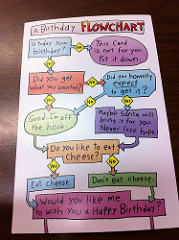
Students are used to these in other subjects such as technology. So use them to your advantage in structuring an argument. Say for example you want the pupils to debate the environment, work experience etc. Start with a variety of opinion phrases so that students make a point, explain it, add a contrasting view with “einige Leute denken, dass” and then add a further opinion and reason. The exam boards say “express and explain a range of ideas and points of view.” This is ideal for that very aim.
Before I start, thank you to the handful of regular readers and the ones who shared me on twitter (something I have never used) , it precipitated a massive spike in viewings in the UK and further afield so thank you! I hope the material and ideas are useful. Enjoy half-term.
School is a topic we cover a number of times. If you’re following Mira then it comes up in years 7 and 9. I find in year 9 it is a lot harder to make it engaging. The students are going through that stage where school means hard work, drudgery and the novelty value the topic had in year 7 is all but lost. We then often revisit it on GCSE syllabuses so I guess it is worth having some good ideas.
Here is a selection of things I’ve tried with both years.
Options discussion.
Great way to revise school subjects, opinions and reasons without it seeming like repeating year 7 material. ¿Qué vas a estudiar el año que viene? or ¿Vas a estudiar …? This lends itself to a nice discussion in fours where the students have to see which group can keep discussing options the longest in Spanish. If you have done various activities to revise the subjects, opinion phrases and reasons, they should be able to keep this going. A speaking frame is also helpful.
Options discussion in pairs with flowchart.
Give students a flowchart on powerpoint. They can then work through the various stages
I’m (not) going to study… because…
it is … (positives) it is … (negatives)
and
the teacher is …. (positives) the teacher is … (negatives)
Hopefully the flowchart makes sense although wordpress does not permit the use of lines and arrows, just imagine they are there.
Good student/bad student
A lot of textbooks take the opportunity to teach verbs with this topic. Why not have a diary of a good student or a bad student and simply get your students (presumably good and bad) to create the opposite one?
Describing your school
Students in year 9 seemed very happy to do this once I said you can talk about Waterloo Road or your primary. They spend every day at your school, the difference made it more fun for them somehow
Rate your teacher/favourite subject
Very simple activity probably for year 9 although for year 7s following Mira it could work. Who is your favourite teacher and why. Conduct a class survey and note the responses. For those of you facing OFSTED and having to evidence numeracy, get some graph paper from your maths or science department and get them to produce a graph. You could equally do this with school subjects.
Harry Potter Extension
Very simply give any year 7 a timetable that looks like it came from Hogwarts and tell them you want to know what subjects are when.
aritmancia, estudios muggles, adivinación, estudio de runas antiguas y cuidado de criaturas mágicas, transformaciones, encantamientos, pociones, historia de la magia, defensa contra las Artes oscuras, astronomía y herbología.
Then they can also pretend to be the characters and explain their like or dislike for various subjects.
Say something else
Ban the following words if students are relatively able: “good”, “nice”, “interesting”, “boring” and “fun”. Your English department probably already operates on this policy but it is a good opportunity to use dictionaries and make their language more interesting.
Whilst it may not be up there with my preferred topics of food, holidays, media and Christmas, house and home always makes its way on to a year 7 or year 10 course. Here’s a few of my favourite activities.
Origami houses (massive thanks to Mrs Shepherd and Mrs Cotton on my teacher training course)
This is tricky but kids love it and there are plenty of youtube videos showing how to make morecomplicated ones. Once you have the technique nailed you can produce it year in year out.
Try this.
Luxury House
Independent learning is the order of the day. After teaching the house topic, students have to produce an A3 brochure page for a luxury house. One half must be the pictures and students can get these from magazines or the internet. the other half has to be a description. Put students in pairs. You have of course the normal options here
“I can’t help noticing I am considerably richer than you”
Based on the Harry Enfield sketch. This is essentially the shops game. Students try to out compete each other as to the features their house has. This is great for practising plurals and numbers too.
Student 1: En mi casa hay un baño grande.
Student 2: En mi casa hay tres baños grandes, dos aseos and a partridge in a pear tree etc…
Chocolate eclairs prepositions mini-plenary
I remember this lesson from when I was in school a long time ago. Our teacher had taught us the prepositions but to test us, she had glued or placed a number of Cadburys chocolate eccairs in positions around the room. Any one who could use it in a sentence got one. The nature of toffee is that it keeps kids quiet for a while. Genuis! Make sure your most disruptive student is not lactose intolerant 😉
Sherlock
If you have seen the TV programme of the same name. You will notice the hero’s ability to remember and remark upon every feature of a room. Give students a picture and get them to do the same
12 days of House-mas
Great practice of rooms in house, phrases like il y a, numbers and plural endings. Using the 12 days of Christmas as a model get students to describe a house. Then get them to draw a floorplan of their partner’s house and label it accurately.
En mi casa hay doce …
En mi casa hay once ..
En mi casa hay nueve…
Before and after.
Exactly what it says and there is not much of a leap between il y a and il y’avait or es gibt and es gab Give students two pictures of the same rooms and get them to comment on before and after.
Spot the difference
Again exactly what it says, try and find two pictures of a similar room on google. Or compare a double and a single room from a hotel website
Famous houses
Essentially the same as the Sherlock activity above however you can recycle language previously taught by bringing in family vocabulary.
Dans ma maison au premier etage il y a la chambre de mes parents. Mes parents s’appellent Robert et Carla.



Some of the blog posts have taken a serious tone. So here are some links to a bit of light relief with a foreign language theme and who knows maybe you’ll learn something.
French (if you don’t like cats skip the first three)
https://www.youtube.com/watch?v=KIePsbJSS04 Dansons la capucine
https://www.youtube.com/watch?v=LJaGUmjlGuc Mission Imposible
https://www.youtube.com/watch?v=xXnaN5U43F4 Les miroirs
https://www.youtube.com/watch?v=fbJ1PHloeoQ Je suis en bonne forme
German:
https://www.youtube.com/watch?v=1Hw1ndNXTdM Volkswagen Advert from Germany. Stereotyping at its best.
https://www.youtube.com/watch?v=0MUsVcYhERY Why learn languages? No further argument needed.
Spanish:
https://www.youtube.com/watch?v=ngRq82c8Baw The first semester of Spanish love song
https://www.youtube.com/watch?v=glLWYv8X9eg Just a lively catchy happy song with some nice guitar playing
https://www.youtube.com/watch?v=LHxnqP9Dh9o Preterites and imperfects getting you down? They also do por/para and ser/estar.
Whatever your view of G+T, it is clear that the brightest students in your class need pushing to achieve. In a climate where languages takeup at GCSE is rising as a result of performance 8 or EBACC measures, A-level and university courses are experiencing decline. A simple google search shows that in 2012,2013 and 2014 a major newspaper reported on the decline in A-level languages. Our best students should be the ones going on to study it yet most are not. There are blogs which explore and consider why. Rather than do that, I thought I would share some of the things that I have tried, with varying successes.
Before looking at some ideas there are three questions you need to consider with extension work:
Ideas for the classroom or outside of the classroom
Reading
Writing
Listening
Speaking
2 final salient points
1) Encourage use of previously learnt language in all written and spoken assessments. G&T students always want to do something new but the challenge should also be to include EVERYTHING they already know as a means of consolidation and a showcase of their abilities.
2) Check they are not sprinting before they can walk. It goes against everything I have said above but they if they are playing around with subjunctives and still struggling with present tense forms, then you might want to sort the foundations out before building any more of the house.
I’m going to be up front here. I’m not a fan of google-translate. I’ve tried various techniques over the years to get students to avoid it and here they are. I have seen arguments such as: “I only use it for single words” or “it’s ok for short phrases if the students can explain the grammar”. I have to say I completely disagree as they are not producing the work themselves. It is the languages lesson equivalent of copying and pasted a flawed Wikipedia article and presenting it as your work on the life of Leonardo da Vinci.
My all-time favourite use of the website was a student who handed in this perfect piece of work in Dutch. They wholeheartedly admitted their use of google for their German homework, failing to realise that Dutch and Deutsch are two very different things.
1) Point out how ridiculous their work sounds.
Malinda Kathleen Reese on youtube is excellent. Whilst she sends her long lyrics through several layers of google, it still makes the point that machine translation is extremely fallible. Current favourites with classes include “let it go” and “do you want to build a snowmale?” If you can tolerate the tune in your head all day then do it.
Update: she’s produced this…
2) Don’t tolerate it. Sanction it.
I’ve always taken the approach that typing it into google and hitting print is like getting a friend to do your homework for you. You know you shouldn’t and therefore don’t. They will learn quickly. Make them do it again is always a good policy. Mention that you do not tolerate it in the first few lessons of the year . Some will try and push this. When you sanction it; it will put off the others from trying.
3) Drill them in modal verbs and infinitives on a half-termly basis.
Germanists will be familiar with modalverben. If you teach Spanish or French then consider phrases that you can start a sentence with that require an infinitive.
Je peux / Je dois/ Je voudrais / J’aime etc
Quiero / Me gusta / Suelo / Solía etc
My old German teacher used to start every lesson with a 20 minute drill of verbs and modal verbs in all sorts of tenses. They built up over time. She would use silly sentences or translations and a variety of activities but it got our verbs sorted.
4) Teach them to use verb tables and have a big wall poster explaining how to look up verbs.
This could save any amount of “yo jugar” pieces of work. There is a superb resource on TES on this in the Spanish section but it could be adapted to French (less so German). The resource involves a fairly well sequenced set of exercises and instructions on how to find verbs in a dictionary. Equally you could take students into an ICT room and teach them how to use the verb conjugator on http://www.wordreference.com
I’ve found that a lesson on using verb tables helps but again it needs regular drilling. Students also see it as hard work but if they understand the potential that it has then it can be effective.
Holidays. It is the quintessential topic all MFL teachers have to be capable of doing and most cover on a bi-yearly basis. Most holiday modules in textbooks tend to deal with the past tense so this seemed like a good place to start but there will be other tenses below. Aiming at 9 things you can try tomorrow, here goes…
1) Consequences.
If you know how this works great. If not try the following:
Bottom sets like it because it seems like less work. Top sets can get creative. Everyone wins unless they start to get mean…
2) Trapdoor/mindread/paired speaking thing.
Sentences on whiteboard with multiple options at various points. Students have to say the sentence out loud that their partner is thinking. Partner can shake head to indicate wrong choice. The other has to keep talking until the get the right answer to carry on.
Fui a Italia Alemania con mis padres mis amigos
Grecia Suiza mi familia mis abuelos
3) Postcards – it is a great homework and you get some creative efforts. Use it at the end of a holidays topic. Tell them it has to look authentic and you will get some great efforts. One teacher I know hangs them from a washing line in her classroom. Both ends of the ability spectrum tend to enjoy this. The less artistic ones can use a computer.
4) Quiz Quiz Trade
Not technically my activity but get pupils to write a question on a whiteboard. They go around the class and must ask and answer a question before swapping whiteboards. Excellent practice of questions and answers as long as TL is maintained.
5) 50 places to visit before you die/Plan a gap year
You’ve seen the books but to reinforce the future tense why not get them to plan a year out using “voy a” and infinitives. Allows for creativity and personal interest. Lower abilities could do it on a powerpoint and add pictures. Tricky bit is if they spend more time looking at places than writing Spanish. Be careful there.
6) Hotel Review (GCSE)
Tripadvisor is one of the best known hotel reviewing sites. Give half of your students some pictures of New York’s Plaza hotel (last seen in Home Alone 2) and for the other half the worst hotel you can find on google. Students then have to produce a review using as much subject specific vocab as possible (or as edexcel calls them “complex lexical items”) such as service, personnel, concierge etc. For a broader task, give them the title holidays from hell and a starter with some more powerful adjectives (dilapidated, depressing, disastrous etc)
7) Dice speaking (borrowed from a Rachel Hawkes ppt)
9 boxes each with a starting sentence and 6 options. One student rolls dice and says the phrases while the other produces a translation on a mini-whiteboard. Tried it with a yr9 bottom set the other day and they enjoyed it! I could not quite believe what I was seeing.
8) Voki.com
Use the postcard idea above or the hotel idea but get voki.com to convert it into speech. No need to sign up but fun and then allows students to practise pronunciation.
9) No personal experience allowed.
Sometimes we tell students to use their personal experiences. What about if we encouraged creativity and imagination by insisting they cannot use anything they have already done. The entire past holiday has to be imagined. Not so much an idea to use tomorrow but a thought. Would they be more creative and would it lead to better work?
 Everyday MFL