Making marking work

Photo Credit: BenjaminCookDesigns Flickr via Compfight cc

Time to get out the red pen

This post should probably start with a disclaimer.  My marking is not perfect.  I do my absolute best to make sure the pupils get the best feedback on their work but it will not always yield the seismic improvements that one might hope.

Before we discuss marking and feedback, I think it is worth pointing the reader towards this document produced by Sean Harford HMI.  Yes, he does work for “they-who-shall-not-be-named” but you really do need to read it.  You could also follow him on Twitter as he is quite good at busting the various OFSTED myths that fly around.

Over the past few years, I have seen a variety of marking policies in my own school and in visiting others.  Out there, there is a plethora of feedback and marking styles such as “comment only” marking, highlighter marking, DIRT time, group feedback, whole class feedback, flipped learning, self-marking online assessments, self-assessment, peer-assessment, raw scores, averages, levels, flightpaths, progress indicators, RAG etc.  Don’t worry, this post is not going to cover all of those!  Instead, here are three that have really worked for me, and my students, in the classroom:

Whole class feedback & Individual Feedback.

Whilst marking a set of books I will formulate a series of targets to be placed on a PowerPoint.  In the book, I will simply write something that the student did well along with T1, T7, T8.  There is an example below.  The following lesson will probably follow this pattern:

1) Whole class feedback or starter activity relating to an issue most struggled with.

2) DIRT time – students have opportunity to act upon individual targets.  Extension tasks available for those who finish.

3) Remaining time refreshing material from previous lesson or preparing for subsequent lesson.

The activities in part 1 above could be…

  1. Grammar exercises
  2. Spot the errors / Correct the errors (anonymously lifted or amalgamated from work marked)
  3. Match present and past tense verbs so that students are clear which is which.
  4. Spot the correct sentence from a choice of 3.

An example of what students will see in part 2 above is below.  I have found that the “what it means” and “what to do” leaves no room for excuses of “I don’t get what I have to do”.
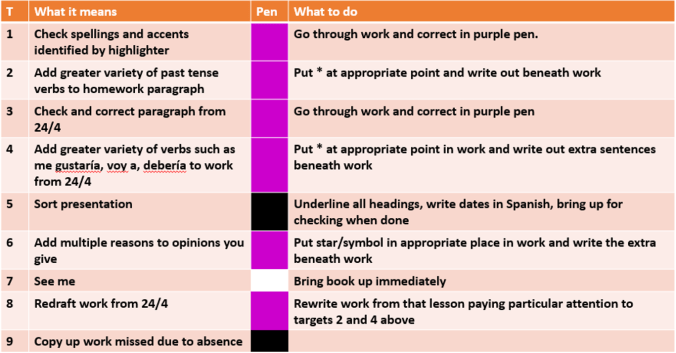
feedforward

Feedback needs to be about improvement and development, not simply error correction. That is my hope behind targets 2,4,6.  However, where some heavy error correction is needed, then I still want them thinking about it (see T1,T3).

T5 allows me to challenge, and insist on improvement of, any poorly presented pieces that I may not notice from across the room during the lesson.

T7 allowed me to work with one to one with a student who was miles ahead of the rest of the class and teach them something they can add to their work.

T9 was to give a student time to catch up on work missed through no fault of their own.

This approach massively shortened the time I spent marking and still allowed me to deal with misconceptions and give specific, personalised feedback that led to definite, visible improvements.

Highlighter Marking

Mentioned in a full length post  a while back, I still think this is one of the best ways for boosting confidence of students.

Underline an entire piece of work in two highlighter pens.  Green if it’s good.  Yellow if it needs work.  Immediately a student can see what is good and what is not.  If the overwhelming picture is green then it can be a massive confidence boost.  If they realise that the yellow is a repeated error, then we are on the road to eradicating it.  If there is a substantial amount of yellow then maybe a rewrite is in order.  Sometimes the yellow would not be underlining anything, to demonstrate that there was a need to add something.  To show students bits of their work that were particularly good such as a wenn clause (German), a reflexive verb in the passé composé (French), or use of the imperfect subjunctive (Spanish), I simply double-ticked those parts.  

I have tried to demonstrate the visual impact below:

Gestern Abend habe ich mit meiner Famille ins Kino gegangen.  Dort wir haben “Fast and Furious 14” gesehen.  Es war toll.  Ich mag Actionfilmen, weil sie sind spannend

Advantages include how well it combines with marking codes and it is speedy. Disadvantages include that one needs a constant supply of highlighter pens or felt-tips!

Self/Peer Assessment

Peer assessment is something I struggle with in MFL.  Sometimes I find that the students do not have enough knowledge to effectively assess the work of another.  You find comments such as “great use of connectives”, when there were none in the work at all.  I think it works best when the students have sufficient knowledge to draw upon, or with a reasonably restrictive mark-scheme. 

I have tried a little bit with the new GCSE roleplays.  The following pattern yielded some success.

  • Teacher shows students mark scheme and script for roleplay.
  • One student is selected to conduct the roleplay.  Teacher plays role of student
  • Roleplay is then performed by teacher and student (in reversed roles).
    • Teacher (as student) produces a roleplay that can be described as a shambles full of mistakes, hesitation, use of English, use of Spanglish, use of French, adding O to any English word to make it sound Spanish.   
    • Teacher (as student) produces a half-decent roleplay that ticks some boxes but not all.
    • Teacher (as student) produces a roleplay that would knock the socks off the most examiners.
  • After each the students are asked to give numerical scores.  The AQA mark-scheme is extremely helpful in this as for each element of the roleplay there is a score of 0, 1 or 2.  Their language says “message conveyed without ambiguity” or “message partially conveyed or conveyed with some ambiguity”.  In short:  2 = job done   1 = partly done  0 = was it done?   Students are then asked to give a score out of 5 for quality of language.  The teacher can guide them towards this one a bit more.
  • Students then have silent prep time for a roleplay on the same theme but with different bullet points.  10-12mins.
  • Students conduct the roleplay in pairs with script on projector screen.  After which, they assess their partner’s performance.  When they switch over, you need to switch the unpredictable question to something else!  Or generate a new task for the other.  
  • They need to repeat this so that they have two sets of scores.  They can then calculate an average.  By doing so, hopefully any overly generous or overly harsh marking is minimised.

Example:

Joe gives Martina   2+2+1+1+1   /10   +3   /5     = 10/15

Kelsey gives Martina 1+2+1+2+2  / 10      4/5     =12/15

Average = 11/15  

Plenty to come from EverydayMFL

Dear all.

It’s the summer holidays so I’m taking a few weeks off.  From September there will hopefully be more regular posts as things got a little sporadic towards the end of last term.

In the meantime you can have a read of the following:

Top post:  Outstanding MFL Everyday

Second most popular post: GCSE Revision

Third most popular post: Feedback and marking.

Least popular posts: 5 Things to try tomorrow and 5 ideas to try this week

One for the NQTs: First Lesson of the year

Posts to come in the new academic year:

  • Making marking work
  • Teaching the new GCSE – reflections at the halfway point.
  • What is going to be different this year (lessons learnt from The Language Gym)

I’m sure there will be others but those are the three I’m working on.

Have a great summer!


Teaching the weather

Weather phrases in foreign languages are odd.  I have never really understood quite why “il fait” or “hace” makes more sense than “it is”.  However, we have to teach them so here are a few ways to make it more interesting.

Predict the weather

As a plenary activity students write 5 sentences predicting the weather in various locations on the day of your next lesson.  As a starter in the subsequent lesson, they check if they were correct / incorrect / bit of both.

The maps on El Tiempo.es are really good for this.  See exhibit A belowweather

Photo Response

Show students some photos and have them write sentences quickly on mini-whiteboards.  If you use Spanish speaking countries you can generate quite a bit of interest as pupils will inevitably ask “where is that?”  Exhibits below include Peru in the height of summer and Bolivia during rainy season.  That falling grey mass is rain, not a tornado, as one of the kids thought.

perubolivia

Today at Wimbledon / Euros / World Cup Scripts

Students in year 7 cover present and future tense.  It will take a little bit of revision of verbs but they should be able to produce the following using the near future

va a jugar        va a ganar        va a perder        va  a llover

va jouer            va gagner         va perdre           va pleuvoir

They have hopefully covered simple time phrases such as “today”, “tomorrow”, “later on”.

All of this leads to being in a position to present a TV programme.  Students need to produce a script for the Today at Wimbledon programme.    Click here for the theme tune, which will remain in your head for hours afterwards.  They should include

  • Weather today
  • Who plays who today
  • Weather tomorrow
  • Who is going to play who tomorrow
  • Opinions on who is going to win or lose.

 They then perform this and can peer-assess each other on whatever criteria you set.  Personally I would go for the following with scores out of 5 for each:

  1. Fluency – does it flow? Can they sound natural?
  2. Confidence – do they come across confidently?
  3. Communciation – can they make themselves understood?
  4. Pronunciation – How strong is their knowledge of phonics?

Translation Tandems

This idea came from Greg Horton on a CPD course about 2 years ago.  He used it for vocabulary tests so this is a small tweak.

Hold an A4 piece of paper portrait.  Divide the piece of A4 paper. into 2 halves down the middle.

¦   ¦   ¦

Students write sentences alternating between English and TL.   Students then fold the piece of paper down the middle and sit facing each other.  They have to translate whatever sentence their partner reads out into the other language.  This is a great activity to practise translation both ways.  It does require a fair bit of pre-teaching so that it is challenging but not demotivating.

Mira 1 Rap

Mira 1 has a listening text that might be a song or a poem.  It can be found on p103 and works rather well as a rap.  Challenge your class to turn it into one.  A good rap backing can be found for free at this link here on TES.  If you have VLC media player then you can alter the playback speed and slow it down if needed.

Real life listening

I experimented the other day.  I listened to a weather report on eltiempo.es and the guy was super fast.  I picked out 10-15 words that my students might pick up from the video, and then added some more that were not there.  I challenged them to listen and see how many of my words on the board they would find.  I was pleasantly surprised with the results, and so were they.

If you have managed to read this far then this weather report did make me chuckle.


Everyday Questioning

31338932574_c13f32c0de_m

Photo Credit: Ekspresevim Flickr via Compfight cc

A lot of subjects rely on questioning.  Teachers of English, History, Geography, Science and RE can elicit huge amounts of discussion, understanding and thought through questioning techniques.   Maybe your SLT are keen on Blooms, SAMR,  lolly sticks, think/pair/share or pose/pause/pounce/bounce.  It is first worth remembering that MFL is very different.  This quote sums up much of my thinking around questioning:

“language teaching is not like the teaching of, say, mathematics or history. Much of our questioning is of a special type, with the purpose of developing internalised competence with grammar, vocabulary and, ultimately, fluency. Language teachers must therefore treat the most recent recent pronouncements on questioning technique with at least a degree of scepticism.”  Quote from Steve Smith Frenchteacher.net

Steve mentions scepticism, not rejection.  I believe that other subjects do have a few things to teach us and some of the CPD I have experienced around questioning can and has been useful.

This post is about some ways to sharpen your questioning in MFL lessons in the classroom.  Some of the thoughts come from experience, others from seeing other colleagues.

32653789582_4fb5bf8d0e_m

Hands up or no hands up?

In one school that I trained in, hands up was considered pure evil, you simply did not do it.  In the other school, hands up was fine. Since training and teaching I have tended to take a 50-50 approach.  I personally like to see the enthusiasm and speed of recall that hands up reveals.  I also like to challenge my students and keep them on their toes.

It seemed worth summarising the three approaches in a table below so you can make your own decision:

Hands up 50-50 No hands up
Pros Enthusiasm clear.
Students rewarded for effort.
Clear engagement and participation.
Effort rewarded.
Opportunities to build confidence.
Keeps pupils on toes whilst rewarding
keenness.
Keeps everyone on their toes.
Clear engagement
Students forced to pay greater attention.
Might be less likely to pick same kids.
Cons Some students will not put their hands up.
Tendency to pick the ones who know it.
Some students remain unchallenged,
Students will not always be clear on which
is required.
Some students find it very disconcerting.
Could be demoralising if they genuinely do
not know.

Think/pair/share

A much-used technique from other subjects that we can use in MFL.  Tom Sherrington writes about this as “washing hands of learning”.  I was slightly alarmed by the title but I see his point.  This can be a really useful technique when you have presented students with a grammar structure and you want them to work out how it works, rather than simply telling them.  Here is how it works:  THINK:  Give them at least 30 real seconds thinking time on their own (“teacher seconds” are a completely diifferent time frame). PAIR: discuss with partner or table group.  SHARE: share with the class or another group.  Tom writes “in doing this you are creating a small bubble of security around each pair; a safe space where they can think for a while and say whatever they like.”

Going off topic for a second.  Tom Sherrington was a headteacher and his series of pedagogy postcards and great lessons blogs were really useful in my first few years of teaching.  Worth a look.

target-297821_960_720.png

Targeted questioning

Who are you selecting?  Who is contributing in your lessons?  One of my colleagues (who will probably read this), talks about first responders and second responders.  I have tried to emulate this.  First responders are any of the following:

  • Pupil Premium, underachievers, disengaged.

Second responders are the rest of the class.

  • More able.
  • English as an additional language.
  • Special educational needs & disabilities.
  • The rest of the class.

Random name generators

Targeted questioning could also be brought about by random name generators.  I’ll be honest.  I am not a massive fan of lolly sticks.  It seems like a lot of preparation every year, you have to have somewhere to keep them and there is a yearly cost implication.  I used to use random name generators and have not used them for a while.  So that is my mission for this week.

Super Teacher Tools is a personal favourite

Classtools.net  has an excellent one

Have you tried stacking the generator slightly?  The first of the two above websites allows up to 40 names and maybe your class is only 28 strong.  Some names could accidentally find their way in there twice or three times.  If the kids start to question this then perhaps remind them that random means the same name could come up 3 times in a row.

You might want to consider when to use these generators as they will not always be appropriate:

Steve Smith (author of The Language Teacher Toolkit) writes the following:

“I understand the theory that we should have the same expectation of all students and that students need to be challenged and ready to respond at any time, but I also believe that as teachers we should be using our skill and knowledge of our students to pitch questions at an appropriate level. This is sensible differentiation. Each student can be challenged at their own level and we know all too well how great the variability is in language learning aptitude.”

With that in mind, let’s look at the next bit…

Planning your questions

There is a story that suggests a child was asked by an inspector what their favourite part of a lesson was.  The child replied “the plenary”.  The inspector was impressed that the child knew the word and pressed them as to why.  The child responded: “because that’s the bit when we get to pack up and go home”.

Most language teachers will conduct a plenary at the end of a lesson.  How many of the plenary questions do you genuinely plan ahead of that time?  Similarly, when you are teaching grammar, what questions have you planned to check understanding?  How are you going to seek the answers?  Who are you going to ask?  What questions could you add to challenge your high achievers?

no-entry-706905_960_720

No opt out

This comes from Doug Lemov’s “Teach like a Champion”.  Doug insists that “I don’t know” is not an acceptable answer.   I would largely agree unless you have asked a question that all students might not know the answer to.  Looking at his ways of implementing this, my personal preference would be for formats 3 and 4.

Format 1. You provide the answer; your student repeats the answer.
Format 2. Another student provides the answer; the initial student repeats the answer.
Format 3. You provide a cue; your student uses it to find the answer.
Format 4. Another student provides a cue; the initial student uses it to find the answer

Source: teach like a champion field guide sample chapter

Occasionally on a reading text when going through answers I may accept that a student didn’t know the answer on number 3 but will tell them that I want the answer to number 8.  They have until I get there to find it.  This way you maintain your standard of everyone trying hard but accept they may simply not have found the answer.  You know your pupils and can decide when this is appropriate.

Some light reading

Books to improve your practice

It might seem odd to some teachers out there to read a book about teaching, particularly during the holidays, when one should be relaxing.   However, there is definitely a lot to be gained from some of the literature out there.  Here are the ones I have learnt the most from when it comes to MFL teaching.  To some readers, it may come as a shock that “The Language Teacher Toolkit” is not on there, however I have only just purchased it and have only read a couple of chapters.

5983398803_46d2a631a9_m

The Craft of the Classroom – Michael Marland (1934-2008)

This book was immensely helpful in my PGCE, NQT year and early years of teaching.  Although it was written in the early nineties, the wisdom it provides is timeless.  The late author covers relationships, discipline, establishing habits, parents, pressure, classroom layout, displays and more.  Michael Marland, the author, comes across as a man who loved teaching.  This book leaves nothing out.  The effects of adverse weather on pupils is noted and the presence of plant-life to brighten up the classroom is suggested.  His emphasis on the power of positive strong relationships comes across throughout.  Having lent the book to an NQT, I am indebted to the Guardian for the following quote from the final page of the book:

“The craft [of the classroom] won’t work without a spirit compounded of the salesman, the music-hall performer, the parent, the clown, the intellectual, the lover and the organiser, but the spirit won’t win through on its own either. Method matters. The more ‘organised’ you are, the more sympathetic you can be. The better your classroom management, the more help you can be to your pupils.”

Michael Marland Obituary

Photo Credit: Richard Ricciardi Flickr via Compfight cc

Student reactions to speaking activities.

Target Language Toolkit – Allison Chase

Target language use varies widely between classes, teachers, students, lessons and schools.  This book has 90 ideas to increase TL usage in the classroom and is great to dip into for ideas occasionally to avoid getting stuck in a rut.  Having picked it up again recently I am very tempted to try the following:

  1. List of 100 phrases.  This is a list of 100 phrases or utterances that all pupils should be able to use.  I think a mixture of testing and rewards may get them to use them more.
  2. Talk Time – 5-10mins speaking at the end of a lesson using whatever prompts the teacher brings.  This could be objects, photo, music, something to eat.  The author mentions she tried a blindfolded taste test of dark, milk and white chocolate with learners having to explain which kind they were eating, and which they preferred.  I may make this one a teacher-led activity!
  3. Emergency flashcards for TL-shy classes – series of flashcards with the most basic phrases “yes”, “no”, “please”, “thank you”.  I may adapt this slightly to have pronunciation on there too so that the learners can build their confidence.

Other areas covered include routines, games and activities, developing TL beyond the classroom and having a department wide TL policy.  If you are considering a purchase, a longer review can be found here courtesy of Steve Smith.  You can also follow the author on Twitter @AllisonChaseMFL.

Photo Credit: <a href="https://www.flickr.com/photos/35844974@N07/4635579067/">Arthur Schneider</a> Flickr via <a href="http://compfight.com">Compfight</a> <a href="https://creativecommons.org/licenses/by-nd/2.0/">cc</a>

Photo Credit: Arthur Schneider Flickr via Compfight cc

Why don’t students like school? – Daniel T Willingham

This is quite simply a superb book.  The blurb on the front says “a cognitive scientist answers questions about how the mind works and what it means for the classroom.”  It sets out this vision and sticks to it.  A selection of chapter titles includes:

  • “Why do students remember everything that’s on television and forget everything I say?”
  • “How can I help slow learners?”
  • “Is drilling worth it?”
  • “How should I adjust my teaching for different types of learners?”  This  chapter ripped apart the Learning Styles Theories that I was taught on my PGCE.

The questions above are ones teachers ask themselves regularly!  Each chapter is easy to read and answers the question it poses.  Some chapters contain examples that the author explains.  Sometimes there are examples that he lets you follow and work out, before presenting you with the answer, along with how your brain got there.  Each chapter concludes with “implications for the classroom” and the book concludes by turning its attention to the reader.  It asks the questions we should ask at the end of any educational book: What have you learnt?  And what are you going to do about it?

German French Spanish Flags

Upgrade your French / German / Spanish – Margaret Jubb, Annemarie Künzl-Snodgrass, Silke Mentchen, Abigail Lee Six.

30 days of grammar, vocabulary and language development lie within the pages of these books.  The books are generally designed for those between Sixth Form and University to shore up the basics of their language use.  I would suggest they are excellent for MFL teachers who wish to work on their weaker language, but cannot access evening classes or are pressed for time.  They may also be a good resource for your G&T students or native speakers.

Self-testing quizzes allow you to track your progress and see how you are doing. Answers can be found in the back.  The first week of the German one is as follows:

  1. Cases
  2. Describing people -acquaintances, hairstyle, eyes, glasses, character, attitude, being keen on someone
  3. Pronouns
  4. Family and Society – genitive and possessive pronouns
  5. Nouns – genders and plurals
  6. Leisure – sport, verbs using fahren, meeting up with friends,
  7. Relative Clauses


Photo Credit: inspirationsyouth Flickr via Compfight cc

Photo Credit: inspirationsyouth Flickr via Compfight cc

Cracking the Tough Class – Bill Rogers

Bill Rogers is a bit of a favourite on PGCE courses.  None of the books on behaviour seemed to deal with some of the classes I encountered.  This one gets close.  It looks at the features of tough classes and how to deal with them.  There is an entire chapter on how to establish the right environment with a tough class at the outset and how to effectively follow up disruptive students.  One of the later sections suggests how more experienced colleagues might support members of their department.  An idea – from this book – that changed my practice was having my tougher classes in teams that worked together.  There would be a prize for the top two at the end of a term, and a transfer window at the start of a the new term.  This book will not solve all your problems, but it might help you to find some solutions.  If the picture that headed this review summarises how you feel, when that group (you know which one) appear on the timetable; it may well be worth a look!


Everyday Revision

It’s getting light in the mornings now so that means it is probably time to look at revision.  This is a new post that is attempting to improve upon an older post.  Here’s how I’m planning to drag  help my year 11s through their final listening and reading exam.

Make a plan

40767.jpg


My plans tend to work like this.  As I’m running a fast-track course then we probably have no more than 1 lesson per common topic on the Edexcel Spec.  Therefore my students need vocabulary, listening practice/reading practice and things that they can actively take away from the lessons and try.  The following is an example:

Topic to be taught Vocabulary Focus L/R Take away exam technique Take-away revision technique
General interests Sports, hobbies, free time. L Dealing with the picture questions Mindmapping
Lifestyle (healthy eating) Foods, drinks, gern/nicht gern

Gesund/ungesund etc

L+R Dealing with multiple choice (pick 4 from list of 8) Flashcards
School and college Subjects, likes/dislikes, L+R Dealing with past/present/future questions Make a Tarsia

Vocabulary – Revise / Refresh / Build

The listening and reading exams are essentially one massive vocabulary test of 2 or 5 years worth of learning (depending how you run your course). Therefore most lessons need to begin with some refreshing of vocabulary.

I have the following principles when it comes to selecting revision activities:

  1. The students need to be made to think or to listen carefully
  2. It has to involve the students using and hearing target language
  3. How much do students gain from it?

Here are a few go-to ideas:

Worksheets – For a few years it was almost heresy to suggest a worksheet but if it is a good worksheet then use it.  The benefit is that the students have something to take home to revise from and they may appreciate not having to write things down for a bit.

Last man standing bingo – students write five words from a vocabulary list and then stand up.  Teacher (or willing student) calls out the words.  If all five are called out the student sits down and has lost.  Winners are those left standing.

Environmentally friendly strip bingo – students write a list of seven words on the mini-whiteboard from a vocabulary list.  Teacher (or willing student) calls out the words.  Students may only rub off the top or bottom word when they hear it.  Winner is the first one with a clean whiteboard.

Normal bingo – You’re reading this and you’re a language teacher.  I’m not going to explain this one!

Vocab battles – Students have two lists of vocabulary and test each other.  Winner is the one with the most correct.

Wordsnakes – Students have to separate the words in the snake.  Here is one for work and work experience topic.  If doing German, you will probably need to remove the capital letters.

arbeitspraktikumchefgehaltbedienenkundigen

Tarsia puzzles – This involves chopping up a sheet of A4 into 8 pieces and writing matching English and German along each inside edge.  The idea is to put the paper back together again with every English and German definition matching perfectly with no text around the outside.  They can be automatically made here.

Dictation – minimal preparation.  Read out sentences from a past paper transcript or textbook reading activity.  Students have to write down exactly what they hear.

Discovery Education PuzzlemakerThis was a staple of my NQT year until I accidentally and rather dramatically exceeded my photocopying budget .  I only recently remembered its existence.  Well worth a look and free to create simple puzzles involving vocabulary.

Vocabulary Toolkit – These are some rather old but still  very good books in our department.  They are sadly out of print but perhaps purchase a few for PP students.  The book in question is here.   Whilst it will not relate exactly to your exam board they are good little tools for revision.  German and French versions only I think..

Collaborative Mindmaps – Students work in a group of 3-4.  Start with the topic area in the middle and give them 4 branches out.  They have a minute to add whatever they can before passing it on to the next person.  Rinse and repeat.

It is worth mentioning that in the above activities I will probably focus on non-cognates over cognates.  Most students can deduce a word such as “telefonieren” but may struggle with “anrufen”.

For more ideas of games that work then head to Frenchteacher.net or this page (shameless self-promotion).

Teaching Exam Technique – some thoughts on past papers.

This technique of going through past papers is something I have found valuable.  My thanks to Chris Hildrew’s website for this:

PQRST Past Paper Method

Preview: revise the topics before tackling the paper

Questions: now do the paper.

Review: see questions below

Scribble: note any new vocabulary on the paper that was not known.

Test: test yourself two or three days later on that vocabulary to check retention.

Past papers should not just be an end in themselves.  Completing a past paper is good but using it to push revision and learning forward is better.  Students should be looking at the following after completing a paper:

  • What new vocabulary is there that I didn’t know?
  • Did I miss out on marks from misunderstanding the question requirements?
  • Did I miss out on marks because I didn’t know the material?l
  • Did I miss out an answer – the crime above all crimes on an MFL paper.  When the odds on a correct answer are 33% or higher, missing answers out is silly.

General Exam Technique Teaching Ideas

  • Teach features of language such as prefixes and suffixes.  For example, “ent” always implies removal of something in German (entfernen, entspannen).
  • Test them regularly on the little words and the negatives “jamais” “rien” “personne”.
  • Use the listening 5 minutes well.  Model it on a visualiser if you have one or get your entire group stood around you while you do it and invite their contributions.
  • Have a twilight with your higher level students where you practise the target language question at the end of the higher reading papers.
  • There will be a question on tenses – can they spot them?  Sometimes time markers play a role here.  Students need to be aware of the features of each tense.  Chris Fuller made a good point that anything future adds and anything present/past takes away in French and Spanish.  If they  spot an infinitive it is likely a future tense unless preceded by an opinion phrase.
  • Higher level papers will often mention all three of their multiple choice options.  The trick is working out the right one.  Two are probably close to right so listen carefully the second time to the ones that appear similar.
  • Exam boards have to promote SMSC just as schools do, students need to remember the exam is written for teenagers.  When the question says “What are Karla’s views on smoking?”  The answer is unlikely to be “it is harmless and we should all just light up now”
  • Remind students that Edexcel exams follow a peak-trough model where harder questions are preceded by easier ones.  They need to make sure they do not give up too quickly.  Question 9 can be a walk in the park after question 7 on nordic walking or the training of guide dogs.
  • Leave nothing blank!  I’ve had a student get 5 extra marks in past paper as a result.  When the kid said he got an A, he shocked most of his classmates!  He later admitted not answering 8 questions but guessed them and was rewarded for it.
  • Some subjects have introduced walking/talking mocks.  I prefer to brief students before they do they paper, allow them to make any notes of reminders and then let them go.

Remind them that they have been preparing for this for 2-5 years but shouldn’t assume that they can just do it without revision.  Make the following your mantra:

dont-be-upset-poster

EverydayMFL’s typical revision lesson

As a teacher of a mixed ability group on a fast-track 2 year course.  Here is a lesson outline that I would use.  There are so many good revision activities out there and I’ve seen all sorts of ideas on the Facebook groups involving balloons, jenga, trivial pursuit etc.  You will notice that these do not feature heavily in the plan below.  It is simply that with the time pressures of such a course, I’ve had to prioritise listening practice and as much vocabulary input as possible.  The final lesson will generally involve some revision fun and German or Spanish food.

Topic: Healthy living and lifestyle

STARTER: activity that refreshes their memory of large amounts of vocab eg: odd one out, make a mindmap, 30 word vocab test German–> English or English–> German.

MAIN:

Present: a revision activity students could do at home on any topic but model it with this one.  Students do the activity building in vocabulary from the starter and what they can remember.

Listening practice using past exam questions or revision workbook questions.  Immediate feedback and discussion of where the marks were won and lost.  Suitable for both higher and foundation although leaning towards higher.  Sometimes completed with transcript.

Split class into two groups

Highers do some practice reading questions on the topic while foundations do practice listening appropriate to their level on the topic, then they switch.  Students doing the listening will be talked through how to approach the question, what the question is looking for and any handy strategies that come to mind.  We then attempt it.  Those doing reading are largely left to it.

Set homework: revision via vocabexpress / samlearning / past paper / make a mindmap / make a tarsia puzzle / languagesonline / linguascope / language gym workouts etc

PLENARY: 

Students then may face one more listening text (because you can never practise this skill enough) or another vocabulary building activity based on my experiences over the course of the lesson.

Students on study leave – what to do when you cannot do anything to help them anymore!

  • Make sure they know what constitutes effective revision – for a blog that changed my practice, click here.
  • Mail a document on useful ways to revise for languages to the parents.
  • Set them up some vocab lists on Quizlet / Memrise / Vocabexpress.
  • Give them a pack of past papers to work through and the mark schemes.
  • Give them a sheet of QR codes leading to language revision websites.
  • Make them purchase a revision workbook or guide to help them revise prior to study leave.

All the best with the final furlong.


The Options Lesson

These next few weeks, we’re trying to convince the year 9s to carry on with a language or two.  Here’s my thinking for…

The Options Lesson.

STARTER: Brainstorm every reason to learn a language.  Could be done as a Think Pair Share.  Students can then share with the class.  Some commentary from teacher probably required to clarify, explain and correct.  Typical answers include

Travel, teaching, interpreting, translating, fun, challenge, interaction with others, live abroad, get girls, get guys etc.

MAIN – 3 sections of approx 10 minutes each

Section 1: English is not enough

Quiz using powerpoint from TES.  Slides 8-12  On this powerpoint you will find:

  • Guess the amount of speakers
  • Guess the percentage of people in Europe who speak…
  • Match the language to the people who speak it

The last activity may require some updating so modern multilinguals include Roger Federer, Bradley Cooper, Tom Hiddleston and more found here

The percentage question and the guess the amount activity could be done on mini-whiteboards so every student has to think about the answer.

You could also share some quotes from celebs found on the internet if you so choose.  Mandela is my personal favourite:

Section 2: Skills and Business

Explain skills that can be gained by learning language using above PowerPoint.

Give pupils a list of 10 jobs and work out how a language could be useful in those jobs. Alternatively ask them to generate a list of jobs, give it to another group who then suggest how a language could be used.

Here are some if you are pressed for time:

  • Walkers Crisps Employee
  • BMW Employee
  • Easyjet Steward/Stewardess
  • Hotel Receptionist
  • Surf Instructor
  • Civil Servant
  • MP
  • Firefighter
  • Police
  • NHS Frontline staff.

Get pupils to generate a list of French / German / Spanish companies that have links with the UK.  The list below is just to get you started.

  • French: Christian Dior, L’Oreal, Michelin, Peugeot, Renault, EDF, Agence France Presse, Bugatti.
  • German: Audi, Siemens, Mercedes, BMW, Volkswagen, Adidas, Haribo, Aldi, Lidl, Puma, Hugo Boss, Bauhaus, Bayer, Carl Zeiss, Bosch, Kraft,
  • Hispanic: SEAT, BBVA, Santander, Iberia, Alpargatas, Topper, CoronaExtra

Ok, maybe don’t mention that last one…

This section of the lesson finishes with this:

Section 3: What about Brexit?

“Brexit means Brexit” we were told.  Most students seem aware that we will leave the E.U and some believe all sorts of weird and wonderful things about what this means. Regardless of your view when it came to leave or remain, and regardless of what kind of Brexit we go through, languages will remain vital to trade, business and growth of the UK economy.

Share the following statements with students.  The links to the original websites have been added so that you can fact check the statements.

“Language skills are vital for our exports, education, public services and diplomacy.” – All Party Parliamentary Group on Modern Foreign Languages.  Article found here

Lack of language skills costs the UK £48,000,000,000 a year in lost trade- Department for Business, Innovation and Skills).  Quoted in The Guardian here

30% of UK businesses have no need for foreign language skills – Confederation of British Industry.  Also found in Guardian here.  Conclusion from this one, 70% would welcome someone with language skills

¨If I’m selling to you, I speak your language.  If you’re selling to me, dann müssen sie Deutsch sprechen” – Willy Brandt

75% of the world speaks no English. -Routes into Languages quote this statistic in a helpful article here

“Brexit means higher priority for language skills. If we found it challenging to deal with the 24 official and working languages of the EU and the Single Market, let’s consider that there are 164 members of the World Trade Organisation.  Each potential trading partner and regulator will be requiring precise negotiations. New relationships require trust, reliability and cultural empathy – those soft skills that come from knowledge of other languages and cultures.”- Bernadette Holmes MP.  Original article here

PLENARY

Coming in to land now… I will try and explain what the GCSE entails and how they make their choices.  All the normal warnings “don’t pick subjects based on friends/teacher preference/perceived ease/novelty”etc will be given at this point.  We will conclude with a video:

Finish off with Options Girl

And/Or finish with Lindsay.

And/Or Alex


During my “research” for this lesson.  I stumbled across the British Council video below.  It sadly does not fit in to what I plan to do, however their series of videos are pretty good.

Also considered using this one…

And this…

Things to keep from 2016

A belated Happy New Year to any readers and huge big thank you to almost 7500 people who read my ramblings last year!  It is quite humbling to see stats like that and also how far across the world it has gone.  Having said that, I’m sure there are some NFL fans out there wondering quite how they ended up on a language teaching website!

A bit of a reflective one to kick off 2017.  Looking back at 2016, there are some things I did for the first time that I want to keep doing.  Here they are…

Core Language Sheets

My 8s,9s and 10s have a sheet glued in the middle of their book where the staples are.  These sheets contain key verbs (conjugated and infinitives), time adverbs, conjunctions (not a fan of “connectives”), opinion phrases and much more.  They are used regularly by the majority of students in my class.  They are adaptations of ones that can be found on Rachel Hawkes’ website.  I changed some vocabulary items and also gave the fonts a slight upgrade.  They are great for learning homeworks such as “learn time adverbs section” or “write a sentence using each infinitive with no repetition”.  It has also stopped some of the “me gusta juego” that pupils often default to.

50-50 no hands up/hands up

I’m a fan of “hands up” and “no hands up” when questioning.  I am aware that some teachers will advocate a 100% no hands up approach.  This was suggested as an “outstanding” technique when I was training.  I’ve listed the pros and cons in the table below.  Hopefully you will see why I favour a mixture of both…

Pros Cons
Hands up 1) You see student enthusiasum for learning.
2) You gain an idea of student competence
3) Occasionally low-confidence students will go
for it so you have a good opportunity to build their
confidence with success!
1) Some students will never put their hands up
2) Some students will be too passive in lessons
3) The two above may become learned behaviours
No hands up 1) Keeps everyone on their toes
2) Does not allow an “opt out”
3) Allows teacher to target questions to
underachievers, pupil premiums, G&T etc.
1) High anxiety for some students low on confidence
2) Some students will go with “don’t know” and resist your attempts
to lead them to an answer.
3) If targeting underachievers, pupil premium etc too often, you
may miss others.

Find someone who…

My new favourite speaking/listening task.  For a detailed explanation look at 2.7 on Gianfranco Conti’s blog.  The example Gianfranco shares links to free time.  I have used it for future tense practice “find someone who will…” or past tense “find the person who did…”  It requires a little bit of preparation and printing.  The hard part is making sure that the students stay completely in the TL.

Teacher-led listening (Nick Muir / Gianfranco Conti / Steve Smith)

Photo Credit: musiccard Flickr via Compfight cc

Photo Credit: musiccard Flickr via Compfight cc

Listening activities in textbooks can be useful.  However, I  object greatly when the listening text involving types of transport contains sound effects!  I have started to do some of my own with varying successes.

  1. Sense or nonsense – Students work out if the sentence given is sense or nonsense.
  2. LH, RH, BH – Allocate three categories in advance, students close eyes and put hands up.  This can be done with tenses, opinions, negatives etc
    1. Left hand = future tense
    2. Right hand = past tense
    3. Both hands = present tense
  3. Spot the word missed.  Sentences on board, teacher reads out and students spot missing word or word added in.
  4. Mr Men/Real Madrid listening – used at the start of the year to help develop sound and spelling links.  Students have to spell the name of the Mr Man having only heard the Spanish.  Can also work with members of Real Madrid’s reserve team.

Invitation only twilights.

Finally, we get to some of my own ideas!  That being said, I’m sure that it is not original.  I know a number of teachers who organise twilights and invite their entire class and attain varying attendance figures.  This is compounded when you are up against core subjects, intervention classes, after-school detentions and some departments with more clout.  I tried a different tactic.  I invited 2-3 students each time.  Only one did not turn up.  Ways to make it work are as follows:

  1. Invite the student personally a week in advance, have them note it in a planner.
  2. Make it really clear what they are going to get from the session.
  3. Bring something of a sugary nature

Having a smaller GCSE group helps, but even with a larger one you could plan it out over time.

L shapes game – conjugation and translation

Produce a grid of conjugated verbs in TL or English (8×8, 6×8, 10×5 whatever size suits you or whatever preparation time allows).  Students start in opposite corners but can only move in L shapes like the knight on a chessboard.  To be able to shade in the next square they need to be able to pronounce the word accurately and translate it.  They keep going until they cannot move any longer.  Winner is then the one with the most squares.


Traffic light book hand in.

Photo Credit: <a href="https://www.flickr.com/photos/34001170@N03/31256222322/">enzovelasco</a> Flickr via <a href="http://compfight.com">Compfight</a> <a href="https://www.flickr.com/help/general/#147">cc</a>

Photo Credit: enzovelasco Flickr via Compfight cc

This came from one of our newer teachers.  She has three boxes in her room.  Green, yellow and red.  Pupils put their books in at the end of the lesson depending on how well they feel they have coped with the material covered.

  • Green = I’m fine, no problems
  • Yellow = I struggled a bit
  • Red = I found that really tough.  Help!

You can then mark in an order that deals with the greatest need first, and target your marking more effectively.

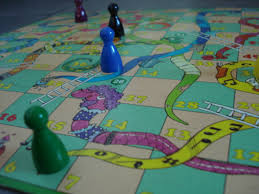
Snakes and Ladders with heavy TL use.

snakes-ladders

I tried this with a low ability group and then with a higher one. Pupils have to do a task if they land on odd numbers.  If they fail they move vertically down a square.  Pupils also have to do a task to ascend a ladder or stop themselves slipping down a snake.

  • 1 – sentence with fui a + country
  • 3 – sentence with fui + transport
  • 5 – sentence with fui + people
  • 7 – sentence with fue +opinion
  • 9 – sentence with fueron
  • Ladder ascension: sentence with fui + country, transport and people
  • Snake Stopper: sentence with fui + country and 2x activities in preterite.

Save your money by doing the following:

  1. Get 8-10 boards photocopied for your class.
  2. Counters are rubbers, sharpeners, pen lids, 5 pence coins etc.


GCSE: Technology and Social Media

Photo Credit: Apex Web Firm Flickr via Compfight cc

Photo Credit: Apex Web Firm Flickr via Compfight cc

I’m learning new words with this topic!  Here are a few:

  • delizar – to swipe
  • tuitear – to tweet,  hotly debated – should it enter the Spanish language or not?
  • unidad de red – cloud storage

So how do you teach it to tech savvy teenagers?  I’ll be honest.  I haven’t cracked it and I’m teaching the module at the moment.  I’ll add to the ideas below if I stumble on anything useful.

Translation challenge

Divide students into A and B before revealing a slide with these:

Translations A Translations B
5 Sentence in Spanish here Sentence in English here
10 Tougher sentence in English here Tougher sentence in Spanish here
15 Equally tough sentence in Spanish here Equally tough sentence in English here
20 Horrible sentence in English here Horrible sentence in Spanish here (present subjunctive anyone?)

Student who gets the highest points score wins.  They can start wherever they like.

A3 Answers B2 Responses and C1 sentences

This is an adaptation of an idea from the brilliant Rachel Hawkes.  You give the kids questions like the ones below but tell them that you want an A3 answer.  The kids then have to include those things in the answer to the question.

¿Para qué usas Facebook?

¿Tienes un blog?

¿Cuántas seguidores tienes en Twitter?

A use perfect tense                                            1 use a linking word that is not “y”

B use a sentence containing lo/la                 2 use an opinion without the word “gusta”

C use present tense                                           3 include a time phrase

D use opinion                                                      4 include an item of vocabulary from last lesson

5 lines up

Whilst this is not in anyway linked to the internet topic, it is something I am experimenting with.  All learners rule off their page 5 lines up from the bottom.  This new section of book is for any new vocabulary.  This could be something they ask me for, something they find in the dictionary, or a new word encountered in a reading or listening text that they plan to look up later.  It has the advantage of allowing them a means of retaining the new language and also shows it linking to the learning that took place in that lesson.  Hopefully that should mean that words heard once or seen once, are not simply forgotten.  My hope is that by processing it a few more times that they will retain it.  It might also foster some independence.

Language Gym Verb Trainer & Boxing

The topics in the AQA book have a hefty amount of grammar (perfect tense, verbs with prepositions, por/para and the present continuous).

The Language Gym website has a great verb trainer but also in the “games room” section there is a boxing game on technology. It is a nice way to consolidate and extend vocabulary.  It could be very effective in the practice phase of a lesson or equally as a consolidation homework.  The rock-climbing game is really clever although I feel terrible when I get it wrong and hear the “aaaaaaaaaaahhhhhhhhh” sound.

Photo Credit: <a href="https://www.flickr.com/photos/36647280@N07/29104615800/">beyondhue</a> Flickr via <a href="http://compfight.com">Compfight</a> <a href="https://www.flickr.com/help/general/#147">cc</a>

Photo Credit: beyondhue Flickr via Compfight cc

How long can you keep it  up for?

This one is all about conversation.  Give groups of 3-4 students a series of cards with questions and maybe some support via a speaking mat if needed.   Nominate a starting student.  Explain that student 1 can question any of students 2,3, and 4.  After 2,3 or 4 has answered then they have 3 options.  The first is to ping the question back at person one.  The second is to ask someone else the same question.  The third is to ask another question of someone else.  Tell the group they have to keep the conversation going as long as possible.  Write up on the board the amount of minute and half-minutes they have managed to keep the conversation going in Spanish.  I think some teachers call this group talk.  It may well be that but I want the focus to be on the time aspect.  They tend to feel more confident and sit taller when they realise they have just managed 5 minutes in Spanish together.

Perfect Tense – “Have you ever…?”

The AQA book uses the internet topic to introduce the perfect tense so once the students have got the concept then you could get them generating a series of 5 questions for their partner on any topic.

¿Has jugado … ?

¿Has probado …?

Tarsia Puzzles & Dominoes

Photo Credit: <a href="https://www.flickr.com/photos/111950422@N04/29791627590/">toonarmy59</a> Flickr via <a href="http://compfight.com">Compfight</a> <a href="https://www.flickr.com/help/general/#147">cc</a>

Photo Credit: toonarmy59 Flickr via Compfight cc

Tarsia is one of my favourite activities but does take a while to set up.  It is a good plenary or starter to recap something you have taught in a prior lesson.  You will need a printing and photocopying budget!  Clicking the link will take you to the website where you can download the program.  It allows you to make activities such as dominoes.  You can also make triangles of little triangles where all the vocab must match in both languages.  Maths teachers use it for formulas.   Remember to set the form of entry to “TEXT” or it will crush your letters together.  If you can trust your students with scissors then they can chop them.  If not, employ the skills of your tutor group and bribe reward them for their efforts.

2 options for use:

  1. English – Spanish vocabulary matching  “deslizar” = “to swipe”
  2. English word – Spanish definition “Youtube”= “Sitio para videos”  “desinstalar” = “proceso de borrar app”.

¡No te metas a mi facebook!

Resources for this lesson can be found here

Lyric video here

If the lesson plan and resources on TES are not enough then how to exploit songs can be found in the Teacher’s Guide section of Frenchteacher.net

Spanish Text Lingo

I believe the kids call them “group chats” now but teach them some basic Spanish phrases for this purpose.  See if the students can work out any of the following:

  • grax – gracias
  • tqm – te quiero mucho
  • bss – besos
  • komotás – ¿Cómo estás?
  • de nax – de nada
  • 50538 – I’m not telling you this one.  Turn your phone upside-down and read it

Verb Tables / Verb Stars

There is a lot of good grammar in this topic if you are following an AQA scheme of work so make use of it as an opportunity to teach them verb tables and how to use them.

descargar – to download

descargo    descargüe    voy a descargar    he descargado   etc

Whilst I am not a massive fan of learning styles theories, I appreciate that some learners prefer to lay out information in different ways.

Lists – colour-coded subdivisions:

Descargar

Present:  descargo

Past: he descargado / descargüe  / descargaba

Future: voy a descargar / descargaré

Make sure students stick to the same colour coding or they are simply going to cause themselves confusion.

Brainstorm / Star

Put infinitive in the middle and add others around it.  To make it more asthetically appealing putting a star around the infinitive is useful.

How many different ways can you use that infinitive?

There are many verbs in Spanish that precede an infinitive.  Students could use those as well.  Germanists will know what I mean by Modalverben.

Puedo / Quiero / Tengo que / Debería / Me gustaría etc

Everyday Grammar Fun (part 1)

Grammar teaching is an inevitable part of MFL teaching.  Whilst there are debates about how much should be taught and how it should be taught; there is no escaping it.  Grammar can be tougher to teach in some schools than others.  So below are a variety of ways that I have used to try and make it a little bit more memorable and enjoyable.

Verbs and Conjugation

Chocolate can be used to explain a fair number of grammatical principles.  Whilst it is ideally suited to the idea of singular and plural,  I stumbled across this one a while back.

Chocolate – In Spanish to conjugate any tense, one removes the AR/ER/IR ending on the infinitive and replaces it with a different ending.  It is a bit like having a bar of dairy milk (infinitive), ripping off the final third (ending) and replacing it with a piece of Yorkie. The bar is largely still a dairy milk (thankfully) but the ending has changed and so looks slightly different as a result.  I have found this can help some students to get the concept in their head.  If using this explanation it is best done visually with the chocolate bars themselves.  You can offer them to whoever works the hardest that lesson, or simply consume it yourself at lunch.

Throw – Normally this is a plenary activity.  I have seen a good number of MFL teachers throw some form of stuffed toy around a room with some differentiated questions to discern the level of understanding their pupils have attained or demonstrate what they have learned.  Equally you could use the stuffed toy to explain verbs, pronouns and ending changes.  I throw, you throw, he catches, she throws, we catch, they throw etc.  When moving into plurals you may need 2 animal toys…

Yo tiro    Tu coges   El/Ella tira   El/ella coge   etc

Ich werfe   Du wirfst     Er wirft   Wir fangen   Er fängt   etc

In AS & A2 German, I had a teacher who insisted that we conjugate verbs as a starter every lesson.  It would follow this pattern:

  1. Class call out verbs – the more varied the better: springen, streichen, schminken, treffen, lesen, lassen, sprengen, pfeiffen etc.
  2. Verbs listed down side of whiteboard with (W) for weak verbs/regular verbs

  3. Each verb would be chanted: “pfropfen, pfropft, pfropfte, gepfroft”, “denken, denkt, dachte, gedacht”, “singen, singt, sang, gesungen”.
  4.  She would demand snappy sentences with modal verbs in various tenses “i have to sing”, “i want to sing”, “I wanted to sing”, “I had to sing”
  5. After that came the recent grammar items eg: relative clauses “the man, who had to sing”.
  6. After the main part of the lesson began, the challenge was then to use them in written or spoken form later in the lesson.

It worked as I can still do it years after.  Admittedly the nature of German tenses makes it easier and rhythmic but maybe there is a way to do it in French and Spanish.  I have started to try stages 4 , 5 and 6 with Key Stage 3 and 4 in Spanish to get them combining verbs and infinitives.

Present Tense

Today at Wimbledon.  This is a nice one for Mira 1 after the modules on verbs, sports and weather all appear within a short space of time.  You will need to recap the verbs, particularly in the third person and then the weather phrases.

Students have to script the Today at Wimbledon programme to explain what is happening today.

eg: Hoy en corte número uno Roger Federer juega contra Bob Marley*.  Ahora es la una y media.  Esta manana hace sol y hace calor pero a las cuatro llueve.

*most of your class will only know a handful of tennis players but they seem to enjoy it when Roger Federer defeats the Headteacher in straight sets 6-0  6-1  6-0.

To extend them and prepare them for the idea of tenses, you could give them a conversion table for the key verbs for future and past tenses.  It might be helpful for them to see how the stem remains largely unaffected but the ending changes to indicate the time-frame.

jugó  ¦    juega ¦  va a jugar   ¦ jugará

Past Tense

Consequences is a great game whatever age you are.  Great for practising past tenses.  You give a kid a piece of paper and ask them to put their name at the bottom.  This is a really important bit of instruction but you would be amazed how many go on autopilot at this point!   The students write a sentence, folder the top of the paper over so it cannot be read and pass it on.  You may like to give them a particular verb to use or a time/manner/place phrase to fit into their sentence.  This is ideally done at the production phase of your lesson when they have acquired plenty of vocabulary and past-participles.

Anna hat Georg getroffen.

Anna und Georg sind ins Kino gegangen

Anna und Georg haben Krieg der Sterne gesehen

When you are finished with the story the students should be able to locate and return the original piece of paper to its rightful owner.  From there you could turn it into a translation task or a comprehension task.  You could set homework to produce a corrected or embellished version.

Songs – Songs get stuck in heads.  Fact.  One for French and one for Spanish below.  Enjoy!

Raps – I wish these guys would go slightly slower but they have added subtitles!

Future Tense / Conditional

The following two are definitely more for the practise/production phase of your lesson.

Bucket lists – The idea of making a list of things to do before you kick the bucket has been around for a long time and was popularised by the appropriately named Hollywood feature “the bucket list”.    Most students will be asked at some point about things they would like to do later in life, probably in a GCSE oral exam.  Depending on the level you teach you may want to warn them not to overcomplicate!

I will go to Disneyland – Ich werde nach Disneyland fahren

If you are going beyond the simple then insist on reasons with subordinate clauses or a new clause bringing in a third person “my friend will…”

Scenes we’d like to see – This was borrowed from a mixture of Frenchteacher.net and popular comedy TV show Mock the Week.  The TV show has a final round where comedians give short comments on topics they are given.  Here are some “topics” you could use in class:

  • Things the queen will do at the weekend
  • Things <insert teacher here> will never do – this one is dangerous in the wrong hands!
  • Things that will never happen – expect England team related comments here!
  • The new school uniform will be..
  • <insert teacher here>’s new years resolutions.

Imperatives

In French this is largely easy to teach.  The “tu” form for informal commands and the “vous” form for more formal.  If you have presented and practised the rules then you could do the following:

  1. Blindfolded directions – set your classroom up in a bit of a maze shape and get students to direct a blindfolded partner through the maze.  Teach them the word “step” so they can take two, three, four steps forward etc.
  2. School trail – give students directions to follow around the school.  They probably need a sound warning about behaviour.  You can get very creative with this.  Here is how:
    1. When students arrive at the location, they collect a new set of directions from the room of that particular member of staff.  Give another member of staff an envelope containing a second set of directions back to your room.  Alternatively blue-tac the envelope to the door
    2. If students study two languages then use both!
    3. Have an expert in your group.  Give one student an idea of the route they will take and have them occasionally advise the group on the right way to go.
    4.  On their return the group composes a new set of directions.  It is then given to another group to test out!
  3. Make paper aeroplanes/swans etc – give the students a set of instructions and a piece of paper.  Using their knowledge of conjugation and translation, students have to follow the instructions to make whatever paper creation you have decided upon.

Prepositions

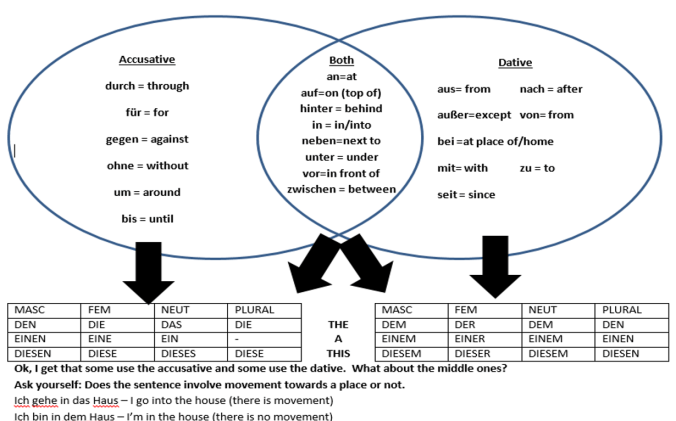
In German these are trickier as they involve cases.  Most students do not struggle with accusative and dative ones.  The struggle is for the ones that could be either.  Explaining the rule of movement vs position helps massively. My university professor once took great delight in telling a class that my translation had me driving my car “into the doctor”.  He did miss a teaching opportunity for further practice with sentences such as “mein Arzt liegt auf dem Boden” or “jetzt bin ich direkt vor dem Richter”.  I find the following flowchart helpful:

Prepositions

Feel free to use this resource in your own teaching.  To alter a well-worn teacher cliche I would be “angry and disappointed” to find it on TES with a charge attached.  

Eclairs – My old German teacher finished a lesson on prepositions by positioning chocolate eclairs (the little ones, not the cream filled ones) around her classroom as a plenary task.  If you could explain where it was in German, you got it.  Instant engagement and a bit of a challenge.  Strangely, the class wanted to practise prepositions every week after that…

Frog – there is a really good powerpoint somewhere out there where a frog appears in different places in a room.  Students then have to produce the sentence on mini-whiteboards.  As I cannot find it anywhere then here is a link to a worksheet on the topic. For those who are au fait with Powerpoint,  it should not take too long to produce a powerpoint with a picture of a room and a frog that appears in different locations.  With the mini-whiteboards you do gain an idea of who simply knows the vocabulary and who can manipulate it.

Reflexive verbs

I would assume most MFL teachers would introduce this with a  few rounds of Simon says and a comic strip for homework.  My boss looked worried when I told a class to use a website called Strip Generator.  I really have no idea what was going through his mind…  Reflexive verbs are almost always introduced in this context.  One thing I will absolutely hammer throughout the lesson is that “me” only precedes the verb if it is “an action you do to yourself”.  When, or if, they start to giggle you can pretend to have no idea why they are laughing.  This is one way to get them out of the misunderstanding that me = I.  Sometimes I wonder if we teach me gusta etc too early and to our detriment.

There are probably a limited number of ways to make daily routine more interesting.  However, one way I have done it is this:

Third World Daily Routine.  Mira 3 does this quite well with a comic strip of life in a developing country.  Having lived there I will give pupils a text based on the experiences of a child I worked with.  You could give the text on paper or have it appearing in short chunks on a slide  with pictures to illustrate.  Students could then produce their own text, produce a script for a Tear Fund video that explains a little bit about the life of someone in a third world country or even do the old comic strip.

Adjectival Agreements

Definitely one of the times i can get boys engaged in working on their grammar.  For more details, read on…

Adjectival agreements are mostly introduced in the context of clothes and colours.  For Spanish, my lesson would have multiple present/practise/produce sections.  I divide the colours and other adjectives into 3 groups.

Group 1: O/A/OS/AS

Group 2: +ES

Group 3: + S

I will explain the first group, pointing out they are the trickiest and if they can handle that then they can manage the rest.  I show them some examples, do a couple of gap-fills and then with mini-whiteboards I ask them to describe a football shirt that fits the colours in group one.  We then do the same with groups 2 and 3 to embed the rules. At this point I then give the class a health warning regarding the next few football shirts.  Type into google “truly awful football shirts” and what will greet you is aesthetic anarchy.  The great thing is that they allow you the students to practise the rules they have been working on with both masculine (un jersey) and feminine (una camiseta) nouns. The starter for the next lesson will likely be another fashion disaster to see if they can still apply the rules a few days on.

Was he mocked endlessly by his mates?  Probably.

Known at the time as “the bird poo kit”, poor Norwich fans…

Described as resembling tube of fruit pastilles at the time.


Summer is here

It finally happened! After a weekend that was full of fog, rain and dull weather, summer appeared. I’m not sure if it is sticking around but it happened for all of 1 day.

If you’re not feeling summery enough then click here or here or even here before continuing to read. Don’t do all three as that would be like mixing mint ice-cream, strawberry ice-cream and honeycomb ice-cream. All the right intentions but it would not end well!

8072673734_71b791a196_m

Photo Credit: `James Wheeler via Compfight cc

It’s the end of term so this blog contains some stats, a quick thank you and an update on what to expect from Everydaymfl.com in the future.

Stats

Thanks to…

Thank you to all the people from the secondary MFL facebook groups for your encouragement and suggestions. Thank you also to those who have commented on the site or have followed me on Twitter. Thank you to Steve Smith for listing me on the excellent FrenchTeacher.net.

What’s coming?

Fun with Grammar– Since someone asked for it on facebook, I’ve wanted to do a post on quirky ways to make grammar rules stick and good grammar practice activities.

Teaching the new GCSE – I’ve done two posts on preparing for it here and here but as I’m teaching it next year then I need to reflect on things such as how well am I preparing the students for the exams they will face?

Teaching the new GCSE content– some of the newer content. I’ve trialled a bit this term such as customs, festivals, poverty and homelessness so there will be a blog on that.

A facelift for the site – This is something I consider every now and again but it hasn’t happened yet.

A guest blog? – Maybe you have been reading this thanks to the facebook groups and thought “I wouldn’t want to run my own site but I could do that!” Drop me a line here and let me know.

Sorting out the categories – there has to be an easier system. I’m working on it!

Have a great summer!

Outstanding MFL everyday.

For some reason, despite lessons being no longer graded, people are still searching for outstanding MFL activities.  Please bear in mind that this post was written in 2016 and reflective of the current prevailing educational landscape of the time

‘Hypothetical’ conversation overheard in staffroom:

Experienced teacher 1: “I delivered a number of outstanding lessons today”

Experienced teacher 2 “Ha! Your definition of an outstanding lesson is you putting your feet up while the kids are standing outside!”

Experienced teacher 1: “you saw them then!”

I’ve seen a lot of requests on TES forums, Twitter and Facebook for outstanding activities or an outstanding lesson on (insert topic here).  I’ve probably wished for a few myself in the past.  There’s nothing wrong with asking for something that works when you’re low on time and your desk is covered by paper and looks like a scale model of the himalayas. What makes an outstanding lesson is highly subjective and is based largely on the observations of the person watching.  I think even OFSTED realised this recently.  OFSTED say they will no longer grade individual lessons or learning walks.  This is good news, although they have to deliver a judgement on quality of teaching and learning across the school so some form of grading still has to take place (in their heads one assumes). Teaching and learning still has to be judged as outstanding/good/requires improvement/inadequate.

This is not a post on “how to play the OFSTED game” as the only OFSTED game to be played is simply high quality teaching and learning.  It is a post about the key ingredients for an outstanding lesson and how we might apply those in MFL teaching everyday.

Before we look at the ingredients.  Let’s hear it from the horses mouth:

Inspectors will use a considerable amount of first-hand evidence gained from observing pupils in lessons, talking to them about their work, scrutinising their work and assessing how well leaders are securing continual improvements in teaching. Direct observations in lessons will be supplemented by a range of other evidence to enable inspectors to evaluate the impact that teachers and support assistants have on pupils’ progress. Inspectors will not grade the quality of teaching, learning and assessment in individual lessons or learning walks.

Inspectors will consider:

  • how information at transition points between schools is used effectively so that teachers plan to meet pupils’ needs in all lessons from the outset – this is particularly important between the early years and Key Stage 1 and between Key Stages 2 and 3
  • whether work in all year groups, particularly in Key Stage 3, is demanding enough for all pupils
  • pupils’ views about the work they have undertaken, what they have learned from it and their experience of teaching and learning over time
  • information from discussions about teaching, learning and assessment with teachers, teaching assistants and other staff
  • parents’ views about the quality of teaching, whether they feel their children are challenged sufficiently and how quickly leaders tackle poor teaching
  • scrutiny of pupils’ work, with particular attention to:
  • pupils’ effort and success in completing their work, both in and outside lessons, so that they can progress and enjoy learning across the curriculum
  • how pupils’ knowledge, understanding and skills have developed and improved
  • the level of challenge and whether pupils have to grapple appropriately with content, not necessarily ‘getting it right’ first time, which could be evidence that the work is too easy
  • how well teachers’ feedback, written and oral, is used by pupils to improve their knowledge, understanding and skills. 

Source text here P44.

Outstanding (1)

  • Teachers demonstrate deep knowledge and understanding of the subjects they teach. They use questioning highly effectively and demonstrate understanding of the ways pupils think about subject content. They identify pupils’ common misconceptions and act to ensure they are corrected.
  • Teachers plan lessons very effectively, making maximum use of lesson time and coordinating lesson resources well. They manage pupils’ behaviour highly effectively with clear rules that are consistently enforced.
  • Teachers provide adequate time for practice to embed the pupils’ knowledge, understanding and skills securely. They introduce subject content progressively and constantly demand more of pupils. Teachers identify and support any pupil who is falling behind, and enable almost all to catch up.
  • Teachers check pupils’ understanding systematically and effectively in lessons, offering clearly directed and timely support.
  • Teachers provide pupils with incisive feedback, in line with the school’s assessment policy, about what pupils can do to improve their knowledge, understanding and skills. The pupils use this feedback effectively.
  • Teachers set challenging homework, in line with the school’s policy and as appropriate for the age and stage of pupils, that consolidates learning, deepens understanding and prepares pupils very well for work to come.
  • Teachers embed reading, writing and communication and, where appropriate, mathematics exceptionally well across the curriculum, equipping all pupils with the necessary skills to make progress. For younger children in particular, phonics teaching is highly effective in enabling them to tackle unfamiliar words.
  • Teachers are determined that pupils achieve well. They encourage pupils to try hard, recognise their efforts and ensure that pupils take pride in all aspects of their work. Teachers have consistently high expectations of all pupils’ attitudes to learning.
  • Pupils love the challenge of learning and are resilient to failure. They are curious, interested learners who seek out and use new information to develop, consolidate and deepen their knowledge, understanding and skills. They thrive in lessons and also regularly take up opportunities to learn through extra-curricular activities.
  • Pupils are eager to know how to improve their learning. They capitalise on opportunities to use feedback, written or oral, to improve.
  • Parents are provided with clear and timely information on how well their child is progressing and how well their child is doing in relation to the standards expected. Parents are given guidance about how to support their child to improve.
  • Teachers are quick to challenge stereotypes and the use of derogatory language in lessons and around the school. Resources and teaching strategies reflect and value the diversity of pupils’ experiences and provide pupils with a comprehensive understanding of people and communities beyond their immediate experience.

So let’s have a look at those key ingredients and what they mean for us in the classroom:

Key Ingredient: What it means for MFL teachers:
Transition information We need a knowledge of where the children are coming from.  We need some idea of how much language tuition the children have had, what language and how effectively it was taught.  This is more applicable to year 7.  As far as year 8s and 9s are concerned, you will need an idea of where they finished at the end of year 7.
Challenge Is your work demanding enough?  I don’t mean simply sticking an extension task on a starter or a reading activity.  Are you sufficiently challenging that little lass who finishes the task seconds after you have explained it?  Should she have finished that quickly?  Are your tasks differentiated enough to keep all students challenged and engaged?  Could you give different students a different task?  How could you reward risk-taking with the language?
Pupils views ARGH?!   What would they say about your lessons?
Parents views Informed by the above as few parents have likely seen your superb lesson on the future tense!
Scrutiny of work From this I understand the following:1)      Pupils must be seen to be making an effort and doing well and this should be seen through their exercise books.

2)      There must be some evidence that their abilities have improved.  You can do this through various ways.  Some staff will use charts with “can do” statements or it could simply be that there are less corrections in the book later in the year.

3)      There must be some work that is not “too easy” for them where they struggle.  Struggle is part of learning so that is not a bad thing.  If it is all ticked and correct then it could be interpreted as too easy.

4)      Feedback should inform and foster improvements in knowledge, understanding and skills.  For more on feedback see here

Subject Knowledge Must be evident along with questioning.  Questioning varies depending on subjects.  I think certain subjects have it easier than MFL but students could deduce a grammar rule if given sufficient examples and then go on to some structured practice of that rule.  If you are thinking of ways to develop your subject knowledge then look no further:  Keeping your languages up!
Effective Planning No time wasted and all resources readily available and accessible.  They may not want to see a lesson plan per se but would expect to see a well planned MFL lesson.  This is probably the best thing I have read on planning an MFL lesson.
Behaviour Management Clear rules and consistently enforced.  I would argue that there is nothing wrong with removing a student whose behaviour is detrimental to the progress of the rest of the class, even in an observation.
Adequate practice time Pupils must be allowed enough time to practice and embed what they are learning.  There must then be a definite increase in demand and evident progression in difficulty of the material covered in the lesson.  Practice in MFL will obvious take place through different skills but it is worth considering: how do they link to your overall objectives in that lesson?
Checking understanding Understanding must be checked and any misconceptions identified.  You can probably tell who will struggle so maybe set the class a short activity that they can use to demonstrate their learning, while you go and help those who need it.
Challenging h/wk Homework could consolidate, extend or prepare the students for future work.  It should do all of these.  More on homework here
Literacy and Numeracy Whilst numeracy is harder to shoehorn into MFL, literacy is very much the bedrock of what we do.  Start using grammatical terms and do not shy away from them.  You’re a language teacher and probably a fan of the odd reflexive verb, subordinating conjunction or relative clause.
Pupils know how to improve Pupils have to know how they can make their French/Spanish/German better.  What does their book tell them and what does your classroom wall tell them?
Challenging stereotypes As MFL teachers we are in an ideal place to do this and hopefully avoid situations like the recent awful match of the day video where the presenters butcher the French language.  I’m not giving you a link, as a football fan I find it embarrassing.

OFSTED’s descriptions miss out one major feature of teaching that I believe is key to delivering outstanding lessons and that is relationships.  Admittedly you can produce an outstanding lesson that meets all of the above boxes but there is likely to be one question in the observer’s mind that also needs answering: “would I be happy for this person to teach my kids?”  Your relationships with your students will answer that.  John Tomsett says: ‘Fundamentally students need to feel loved and I really don’t care what anyone might think of that, to be honest, because if I know anything about teaching, I know that is true.’

What could I do now? 5 things to try this term.

If you’re English then make a cup of tea before contemplating the following:

  1. Build those relationships.  Grab your seating plans or markbook and find 3 students per class who you are going to develop your relationship with.  How are you going to do that?  Will you be teaching those kids next year?  Who knows?  Do it anyway.
  2. Key Ingredients.  Pick one of the key ingredients that you need to work on.  In your planning for next week incorporate it into every lesson.  Yep, that’s every single one.  It’s all very well reading a blog post but you have to act on it.  My Headteacher likes the phrase purposeful practice.  To paraphrase Aristotle, “we are what we repeatedly do.  Excellence therefore is a habit not an act.”
  3. Share.  Share the OFSTED descriptors or key ingredients above with your department.  What ones do you want to work on over the coming weeks?  What do you need to put into place for next year?
  4. Gained time.  Can you devote some of it to CPD?  Who in your department is good at challenge, differentiation, target language use?  Who could you learn from?
  5. Power of praise.  I used to do termly phone-calls home to a parent to give some positive feedback on a student.  I’ve slipped on this and may well do a few in the coming half-term.  Shaun Allison writes about them here.  You could also do an email although make sure you personalise it.  One simple phone-call has massive potential in terms of relationship with the pupil, their parents and the parents of other students.
  6. Consider September.  Yep, right now!  September is where we set the tone, set the patterns and culture in our departments, what would you like an observer to see if they entered your classroom?  What needs to be part of your practice?
  7. Iron sharpening iron.  “As iron sharpens iron, so one person sharpens another” (biblical proverb).  I love this proverb as it applies to most areas of life. Another person can always be guaranteed to sharpen you and smooth out the rough edges.  Most NQTs have a mentor and most PGCE trainees do too.  Once we exit that process, we are on our own.  Who could you work with to improve your own teaching?  Can you get them to pop in and watch?  No notes, no agenda, no judgments and no threat, but just someone there simply to develop your practice.

Further Reading

Indicators of Outstanding – a blog post by education adviser Mary Myatt.

Great Lessons – a series of blogs by Tom Sherrington (Headteacher) on what makes for great lessons.

An Outstanding Teacher – short blog post by Shaun Allison

Six Steps to Outstanding – I read this when I was starting as an NQT and found it useful.

Teaching around the town

Coming up soon in Expo 1 and a bit later in Mira 1 is that topic of what there is in your town.  Here’s some ideas to make a slightly drab topic slightly more exciting.

Videos

In my town video   This is a great little video for year 7s.  I tend to give them a list of places and they check off the ones they find.  Equally you could give them a variety of spellings and they could select the correct one.  You could then ask pupils to prepare their own version if you have access to smartphones and the like.

Colombia video   Complete with traditional South American music and there is a degree of cultural knowledge to be gleaned.  Perhaps give the pupils a script to gap fill or some questions to answer.

Visit … Advert

23847035544_cd57b6e657_m.jpg

Pupils could make a radio advert using spreaker or audacity.  This is best done at the end of the topic.

Google street-view directions.

9241539678_c910601416_m

I have tried this recently and to an extent it worked.  I made my own using the city of Madrid and getting students to follow the directions I gave them.  I allowed the weaker ones to use LINGRO to turn my exercise sheet into a clickable dictionary.  It can work really well as long as your students have some staying power.  If you’re unsure as to how to put one together then a highly rated example can be found here.

Talk and draw.

Great for practising prepositions, listening and speaking.  Student 1 has a mini-whiteboard and a working pen.  Student 2 has a brain and vocal chords.  Student 2 puts a building in the centre such as a football stadium.  They then begin to describe their town “a la derecha del estadio hay un parque” and the other student starts to draw a plan.

Past and present

6371570767_3851bf1d68_m7166010369_9d02a2cc97_m

Antes había… ahora hay…

Antes era … ahora es …

This is a great way to introduce students to some basic past tense phrases and also go a little cross curricular with a historical picture of their town.

SIM City

SIM City was a simulator game where players had to build a city.  Students could do the same.  They would produce a town map, a description of each building or area of town.  I’m sure some could do it via audio or visual means if you choose to let them have that freedom.


Bit of fun part 2

Blogging during the holidays, you cannot be serious?!!!  A while ago I did a post of favourite MFL youtube videos.  It’s the holidays and I’m not doing any work yet so enjoy the light-hearted fun below:

French

German

Spanish

Multi-language

Keeping your languages up!

Life is fast.  We get our news from 140 letter tweets.  We boil a kettle and squeeze the life of that tea bag so we can have a quick brew.  Google is the answer to whatever question appears too difficult.  How then can language teachers with busy lives maintain their level of language so that we remain at the top of our game?  This would be particularly pertinent for those of us (myself included) who do not teach A-level.  It would appear easier to stay up-to-date in other subjects.  Science teachers can look up the CERN website and myriad other research agencies. History teachers can always read more, watch footage or visit museums.  I’ve been guilty in the past few years of being a little slack with this at times.  Here are some things I’ve done to actively address it:

Go there!

Last summer, I took a short break to Berlin.  This summer I plan to visit parts of Spain and France I’ve never seen before.  I’m also going to be in Switzerland for a short time.  It is a great time to pick up authentic materials that you can use in a classroom or material to improve your displays.  You get to see some absolutely unique things (see chocolate Brandenburg Gate below) and learn stuff you never knew before.

It's the Brandenburg Gate made with chocolate!!

Make the most of the opportunities.

I can speak three languages with varying degrees of competence, and confidence.  However, that does not stop the “what if I get this wrong?” thought from entering my head.  In Berlin, I forced myself to interact with people, even a waiter in a café can offer a good conversation and lead to learning new words.  I visited as many places as I could. I took the option of audio or tour guides in the foreign language.  If you are visiting the Reichstag then the guide only begins when you set foot on the slope in the dome – took 10mins and 3 sets of headphones to work out why it wouldn’t work!  I read the leaflets and flyers given to me on the street, even if I did not agree with their politics.  In stations and airports, if you are not sure of something then talk to someone who looks like they know what is going on.  This goes against the grain for us men, but it yields conversation and practice, particularly in languages you may be less comfortable with.  This year my challenges will involve dealing with car hire in Spain, finding accommodation in France and navigating public transport in triglossic Switzerland.  Bring it on!

Join Twitter

I am not a biggest fan of Twitter but I have learned that I can pick up new vocabulary and refresh my memory of words that I didn’t realise I knew.  If you look at the everydaymfl twitter people I follow you will find a considerable number of Spanish, French and German speaking footballers and sportsmen (you may also work out the club I support).  Sadly, one or two tweet too often in English but I’ve learnt new vocabulary and seen words used in different contexts.  “Una racha” can refer to a winning or losing streak (thanks Juan Mata for that one).

Read, listen, note, make it memorable.

I’m constantly telling kids that reading does not equate to revision; they need to do more  It’s the same with teachers.  Are you trying to learn new words?  I’ve decided this year I want a whiteboard or two on the wall in my room for vocabulary that I am learning.  I also want to spend more time on www.ard.de to improve my listen skills and range of vocabulary.  I should listen to more foreign radio and news than I do.  With the internet at my disposal, the only excuse is my own laziness and that’s not an excuse!

Talk to colleagues

It is so easy to lapse into English with colleagues who are conversant in a foreign language.  I’m trying to do this less as it has two major benefits.  Firstly, it shows the kids what they can achieve with hard work and effort.  Secondly it shows your colleagues from other departments that you don’t spend your lessons playing games and learning how to say items in a pencil case.  Thirdly, it also really hooks the interest of the students as they try to work out what you are saying.  The look on their face when they realise they understood one or two words spoken at a relatively fast speed is worth it.

Subtitles

Let’s face it some films sound awful dubbed.  Some actors just sound wrong.  The same German voice does Jack Sparrow and Jack from Titanic.  Use the subtitles to learn new words.  It’s simple but I have definitely picked up the word Zauberei from subtitles (although not sure how much use it will be).  Alternatively…

Watch foreign films

Current recommendations

  • The Counterfeiters – German film about forging of banknotes in the second world war.
  • El Mar Adentro – Spanish film – harrowing subject matter but beautifully acted dealing with paralysis and euthanasia debate.  Javier Bardem pulls off an incredible performance from a bed without actually moving.
  • Nueve Reinas – Argentinian film about con artists.  As the tv programme Hustle taught me “you can’t con an honest man”.

Have I missed anything?  What do you do?

A small thank you

To all readers.

Thank you to those of you who have read this blog on what we could call “everyday mfl”.  The stats say that it has been read by more people in 2015 than 2014, and from countries as diverse as Mexico, UAE, Switzerland, the UK, Spain and France.  Thanks to those who have tweeted, shared, followed, and passed around departments.

Lessons learnt teaching MFL to KS3 bottom sets

I’ve not quite cracked it with KS4 yet but i’ll have a go at ideas for key stage 3.

Having taught a number of bottom sets in the past 3 years I’ve learnt the following:

1) The next level is quite a big jump in their minds

2) Memorisation, literacy, behaviour and confidence are your main battlegrounds

3) Positive reinforcement has to be relentless – yep even for that kid you just thought of. 🙂

4) Relationships and rules are of equal importance.

5) They are reluctant to use the TL.

Some teaching ideas that regularly work:

1) Writing challenge (adapted from Rachel Hawkes)

Rachel Hawkes’ idea is to give an answer to a question that is exactly … words long 9/11/13.  The idea was to get students extending sentences with ,weil.   I’ve changed it a little.  Get a student to pick a number between 35 and 55 (whatever range you choose).  Then tell them that whoever can write a piece using everything they’ve learnt, the textbook and their exercise book gets a merit or whatever reward system you run with.  80-90% of kids will give it a good shot and be surprised that they can be quite successful.

2) Running dictations

Really good way of practising speaking, listening and writing.  Just make sure the runner does not have a pen or they will write the difficult words on their hand.  Caught a budding tattoo artist the other day.  Another thought: don’t make them too long.  Or if they must be longer put part II on another piece of paper somewhere else in the room and that way it doesn’t look like so much!

3) Bingo/Last man standing bingo

Bingo is exactly what it says.  Last man standing bingo is similar.  Write down four items of vocabulary on topic then stand up.  One student is a caller and goes through words.  If you have all four crossed out then you are out and sit down.  Winners are the last few left standing.  Good mini-test of listening skills and injects some fun into the lesson.  Think it might work well with Queen’s “another one bites the dust” music as they start to be “out”

4) Speaking bingo grid. 

You make a 4×4 grid of phrases you want them to use.  Students then have a time limit to use as many as possible making sure they make sense.  Their partner notes the ones that they use.  The person who uses the most  in the time wins.

5) Points for speaking/writing. 

You make another grid but the top row has various point allocations for what they say.  So depending on what you want them to use then give them various points (keep scores in 2 or 5 times table for easy adding).  Again give a time limit and set them off.  Award winners appropriately.

6) Teams idea (massive thanks to Bill Rogers “tackling the tough class). 

Get the students to write down someone they respect and someone they like.  Put your class into teams and give them points for everything: uniform, presentation, work rate, use of TL in lessons, helping others, helping put out equipment, being kind, answering questions, winning team games etc.  Take off points if they talk when you are or break other rules.  Keep this going over a term with a prize for winners at the end of the term.  Seems laborious at first but can engender really good habits and cooperative/collaborative learning.  Allow students to submit transfer requests at end of term that you will “consider”. Have done this 3 years in a row with tough groups and find I have far less bad behaviour and far less detentions.  Kids, particularly boys are used to team sports and it plays to their sense of competitiveness.

7) Reading reduction paper (thanks to my HoD although he swears he can’t remember having this idea). 

If students with weak literacy are tackling a tough reading text then give them a post-it note or an opaque ruler and encourage them to tackle it line by line.  I have found that the reduction of information bombardment helps and they can then work at their own pace.  It is a simple way of catering to students who find reading difficult.  It is also successful with dyslexics.

I think this post requires a part II sometime.  I’ve enjoyed writing it, hope you’ve enjoyed reading it and have something you can use.

Teaching the present tense

I’ve had to do this with my German and Spanish groups recently.  Here is a selection of activities I have tried.  The main idea behind this blog is things that you can use easily without having to upload a powerpoint or extra resources.

Generally I will introduce the present tense from the whiteboard with colour coding for endings.  I have used powerpoints but students stare at powerpoints about 4 hours a day so sometimes the change is nice.

1) MM Paired Speaking (it’s called MM after the lady I learnt it from)

Students divide page into 3 columns with about 14 lines needed in their books.

  • In the first column students write either time phrases or days of week
  • In the second column they write activities (or could draw pictures to force more spontaneous language)
  • They leave the third column blank.  Eg:      Am Montag  |  spiele ich Fussball  |
  • Students then take it in turns to read out what they have written and their partner has to write down the sentences.

I find it practises speaking, listening and word order at the same time.  The year 10s seemed to enjoy it.  You can produce your own with clipart etc but that costs time and photocopying.  Get the students to do it for you in the lesson or prepare it as a homework.

2) http://www.languagesonline.org.uk  I cannot recommend this website enough.  It is excellent.

3) Cheat

Students get given 10 cards each and write sentences in the present tense on 8.  On the remaining two they write Schwindler.  They then get into groups of 4, shuffle the cards and play “cheat” (the card game)

  • Read out phrase on card and put into middle facedown
  • If they have a Schwindler card they have to make up a phrase similar to the ones they have been putting down.
  • If they are accused of being a cheat and the accuser is right, the cheater must pick up the cards.
  • If they are accused of being a cheat and were innocent, the accuser must pick up the cards.
  • Winner is the first to get rid of all their cards.

4) Translations / gap fills / correct the mistakes

All three of these are useful in fixing rules in learners heads and getting them to think through why they are putting particular endings on words.  They make great starters, mini-plenaries and plenary activities.  You can also differentiate them by having two sets of activities with different difficulty levels.

Teaching numbers

Have been doing quite a bit of this recently and decided to try as many different activities as I could.

Idea 1 – class member counts but misses out numbers – others have to spot which ones were missed.

Idea 2 – groups of 4.  Students can count from 1-31 or however high you wish to go.  They can say 1,2 or 3 numbers at a time but have to avoid numbers in the 5 times table.  If they say a 5,10,15 etc they collect a letter.  The letters are BURRO or LIMON and the idea is that you do not want to be a donkey or a lemon.

Idea 3 – finger twister.  Students draw a grid on mini-whiteboards or paper and fill in with numbers.  One student acts as a caller, the others have to use their thumb, index finger and middle finger.  It is twister in miniature.

Idea 4https://www.youtube.com/watch?v=8ydJr1Is8xI  songs, textbooks often have some.

Idea 5 – Last man standing.  Basically bingo in reverse.  Every student writes 4-5 numbers between a given range and stands up.  A student (or teacher) is the caller.  The aim is to be the last man left standing.  If all 4 numbers are called you are out and you sit down.  This would work really well with Queen’s “another one bites the dust” in the background.

Why blog?

In short, the aim of this blog is to provide MFL teachers a wealth of quick ideas, games and activities that can be deployed in a classroom.  If you want simple activities that work with specific topics in German, Spanish or French then keep coming back,  More will be added over the year.  Hopefully this will be a useful resource for someone out there.