Cultural Capital: Strategies for Language Classrooms

Other cultures have always fascinated me ever since learning about Norway in Year 5 or tasting a Stollen in German class in Year 7.     My experience of teaching secondary languages suggests that this fascination is true for our students as well.


Was Norway where this fascination with other cultures started? Possibly! It’s still on the list to visit…

We teach culture to build enthusiasm interest and develop the cultural capital of our students. for those students who do not enjoy the language learning process so much, this can be a great way to hook them in.

There are four approaches to the teaching of culture that I have used in my career.

Unit based approach

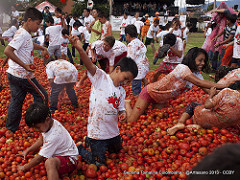
The obvious benefit of a unit-based approach is that students can gain a deeper understanding of the target language culture full stop.  I’ve seen units structured around the films “Innocent Voices” or Valentín.  I have seen lessons centered around schools in Latin America or French speaking Africa.  I have taught lessons about Cuba (thanks Listos 2), Dali, Goodbye Lenin and the Carnival de Oruro over time.  There are schools who use artists such as Miro, Matisse and Picasso as the foundation for some of their early Spanish modules.   Some textbooks base entire chapters around a target language festival, country or city.  Indeed, one of my former colleagues convinced a class that Mira 2’s “Barcelona Te Quiero” song was once a successful Eurovision entry!  The language gym has exercises on La Tomatina. There are plenty of ways to integrate culture into our lessons. 

Just as there are benefits to this approach, there can be drawbacks.  Culture can be relegated to an end of year project or sometimes a module around culture ends up with grammar or vocabulary “shoe-horned in” as they are good revision opportunities when actually other opportunities might have existed.  The way to counter this is to ask the question: “Is this the best learning my students can do with the material that I am presenting them with?”

This might be a slightly extreme example but let’s take bullfighting:

It could be used as an opportunity to describe the colours of clothing worn by matadors, body parts or…

Do you use it as an opportunity to build opinions and justifications?

I think thatbullfightingis
can be
dangerousasanimals are killedhowever although yet
I believe thatbarbaricpeople risk their lives
In my opinionunpleasantthe animals have no choice
In my viewcruel 

The Pop-up approach

Do we simply just teach about the culture when it just pops up?  Festivals in particular lend themselves to this approach.  Events such as Las Fallas, Barilletes Gigantes, Dia de los Muertos, Christmas, Karneval and Bastille day are all opportunities to engage students with the target language country and its culture.  Sometimes a textbook will have a single or double page spread on something.  It does not take long to find a short appropriate video to show towards the end of a lesson.

The benefits of this approach are that it does not take up too much classroom time at the expense of learning the language. The drawbacks are that much can be missed if it is the only way culture is taught.

Displays

There are some wonderful displays out there. I have never quite had the artistic abilities to produce an amazing cultural display of the types one often sees on Facebook groups, X and BlueSky although I have done my best. I managed one on Germany with a lot of authentic materials after a trip to Berlin but our school then made the decision (against my protestations) to phase out German…

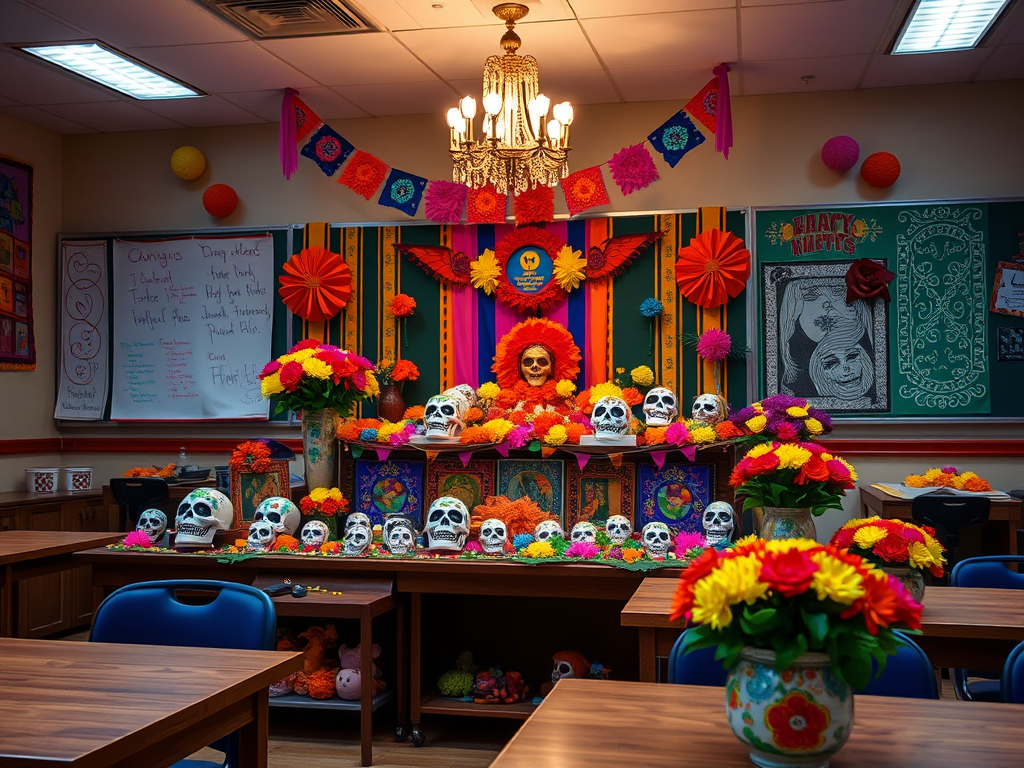
If you’re wanting inspiration, you can find some materials here with MFL Magic, Jose Garcia is has some of the most artistic cultural displays I have seen or you can go full mural as seen at this school on X. There are companies who can produce bespoke murals when given a set of criteria. If you are really stuck for inspiration regarding layout and how it could look then the picture below was created by giving an AI image generator a prompt “classroom dia de los muertos display.” Bear in mind these are highly predictive generating tools and will not be perfect but it might spark some ideas.

Like other approaches this does not detract from classroom time and it makes for a pleasant learning environment. The drawback is again that the display may need refreshing every so often and then you have to balance time invested against the return.

Culture slide approach

This is probably my most recent evolution in culture teaching and the one that I actually feel has done it best.  Dedicating 2 minutes of a lesson to culture after answers to a starter/do now task and before the lesson fully starts.  I prepare a single slide on a topic that includes some pictures and some fun facts.  I talk through it for a minute or two and then we crack on with the lesson.  The benefits of this approach are that there is largely something for everyone.  The students who enjoy history enjoyed learning the history of Spain. The musicians enjoyed learning about singers/songwriters, bands and music.  The students who go on holidays learn a bit more about the places they have been.  The students – for whom a holiday abroad is unlikely – broaden their horizons.  The students who don’t appear to enjoy language lessons often appear to enjoy this part.

Just to unpack what I mean a little bit more by “some pictures and fun facts”…

The Spanish island of El Hierro had a whistling language that was used to communicate between villagers.  William Shakespeare was given a barrel of wine from Tenerife as part of his salary.  Ibiza and Formentera were used as a base by pirates.  Francesco Tarregas’s Gran Vals in A contains a tune known by millions around the world without realising its Spanish origins (seriously, look it up).  The Menorcan city of Mahon is home to Salsa Mahonesa, or – thanks to the French – as we now know it: Mayonaise (an utterly disgusting substance with which people inexplicably ruin sandwiches).

I cannot reproduce the slides as they produced in the context of my work for an academy trust and therefore property of the trust, however, here is a rough guide to what you could do:

Year 7

Term 1Term 2Term 3Term 4Term 5Term 6
Spanish Islands Mallorca Tenerife IbizaMajor players in Spain. King, President, famous peopleSpanish cities Madrid, Valencia, Barcelona, SevillaSpanish speaking countries in South AmericaHistory of Spain Cavemen to present day in 10 lessons. *Customs / Festivals Mealtimes Siestas
Padel Tomatina
San Juan  

*Simon Barton’s History of Spain was quite useful for this for the division of eras into 10 lessons.

Year 8

Term 1Term 2Term 3Term 4Term 5Term 6
Spanish artists.Spanish musiciansCentral American countriesFoods including Paella
Mole Negro
Pique Macho
Idioms from SpainQuirky places to visit in Spain + South America Smurf village Water fights in Bolivia
Colombian festival of Yipao

Culture can make great cover work

Feedback from the cover supervisors in my first school was that they hated covering Spanish/French/German as they didn’t know the answers, students would struggle with not knowing words and most people sending in cover are often too ill to provide much more than “do these grammar exercises.” Whilst a set of sentence builder activities goes a long way towards solving this, a cultural based lesson could work. A set of cultural based activities means students are still learning, they do not pick up or reinforce misconceptions with unchecked exercises and the cover teacher has a significantly easier job.

I have done this two ways in the past:

Spain Live – This was a great textbook teaching pupils about Spain. It works very like a geography textbook with articles and questions to answer. There are also France and Germany versions.

IT room/library – Write out a list of Spanish speaking countries, periods in Spanish history or famous Spanish people. Give each student a different one so that they have to do their own piece of work. Students have to create a poster / powerpoint / document of some description that explains everything they can find using the computers or the library (if your school has one). To avoid copying and pasting, make them write it in a horrible histories style where it has to be accessible for a child aged 8-10.

Conclusion

However you choose to teach it, there is no escaping the fact that culture can broaden horizons, enrich the mind and enthuse our students. The above are some ways I have done it over the past 15 years. You may have others in which case feel free to suggest them in the comments or underneath the social media posts.

GCSE: Teaching the Celebrity Culture topic

For a topic like this, it makes sense to start with three very simple questions:

  • How is this going to be assessed?
  • What vocabulary will they need to do well?
  • What obstacles might I encounter in teaching this?
Exam TypeWays it could appear
ListeningSomeone talking about a celebrity they admire
Interview with a celebrity
SpeakingQuestions about a celebrity you admire
Roleplay discussing a celebrity
Photocard where questions are about a celebrity or opinions on celebrity culture
Reading aloud task about someone famous
ReadingText about a celebrity
Short texts with people giving opinions on celebrity
WritingWrite about a celebrity you like or admire and explain why

Vocabulary

Looking at the exam board vocabulary list, the following words jumped out at me:

well knownbrandfollowborntrick/deceive
alivefashionintroducemarriedcry
deadinfluencerpresentdivorcepromote
behaviourvoteadvertseparaterelate to
interviewrecordmediaestablish/set upto direct/manage

Many of the words on the vocabulary list will naturally come up during the teaching of the module. The ones above were a mixture of “that’s slightly unusual so will need teaching” or “that’s definitely teachable but could be taught equally in another topic and transferred.”

There will also be significant overlap with free time activities particularly if your free time lessons include music, dance, films, TV and the internet.

Obstacles

Potential obstacles in this topic include the following:

  • Your resources could date very very quickly as celebrities fall in and out of public eye.
  • Celebrities can suddenly be “cancelled” or information emerges about them that might be a distraction from the lesson.
  • Exams are less likely to use well-known celebrities so you may need to create or find some resources using people with whom the students are less familiar.

Don’t re-invent the wheel

I have written before about using what we already have for aspects of this new new gcse. Plenty of textbooks have covered celebrities in various guises so far. Those resources (while they may not teach every word on the new spec) will serve you well. For example, our recent AQA Spanish GCSE textbooks had a page on “modelos a seguir” (you can find related resources on TES such as this one). Mira 3 had short biographies on celebrities as a means of revising the preterite. If you have copies of these books lying around and/or gathering dust then use them for this topic. I imagine French and German textbooks will have similar texts that are of use.

Don’t assume students have the vocabulary to talk about these things

You might be thinking that they are surrounded by influencers and instagram/snapchat etc, how would they not know how to talk about it?! Students will be aware of people who are famous, online influencers with thousands of followers but some might not understand the concept of “celebrity culture” itself or have the vocabulary to talk about it in English. For example, discussing the pros and cons of being famous might be a stretch for some. They might not be able to articulate why in a foreign language they do or do not like a particular celebrity beyond “he/she is …” They equally might struggle to articulate this under pressure.

I think a sentence builders approach could work very well here especially for talking about people you admire and also for where famous people have not been good role models. Gianfranco Conti’s post here gives some salient pointers about how to craft a good sentence builder

What opportunities this topic presents (teaching)?

Firstly, opinions and reasons are unavoidable on this topic. A question such as “tell me about someone you admire and why” gives an able student the potential to give a variety of opinion and justification phrases. Secondly, there is a great opportunity for the past tense with some examples “he/she was”, “he/she won”, “he/she recorded/sold/has gone on tour.” Lastly, there is a opportunity to drop in a reference to the future with a simple “I want to meet him/her.” Vincent Everett’s post here gives you an excellent idea of how this could be taught in the classroom.

What opportunities this topic present (cultural capital and making the case for languages)?

Firstly, there is an opportunity to build our students understanding of the target language culture. You may need to do a little bit of research if you are not up-to-date with your Spanish/German/French influencers. The majority of our students are online, on TikTok and Instagram. Give them some good role models to follow from the target language country. Lots of videos are subtitled so students can read the language as well as listening to it.

Secondly, this topic is a good opportunity to remind students that a lot of famous people are bilingual or multilingual and that they learnt it like the students did: in school. Kylian Mbappe – in one interview – mentions he “wasn’t the best in school at Spanish” but he kept learning. In another (the one below) he mentions that sometimes people “still speak too fast”. A good reminder that mastering a language takes time!

This topic would tie in quite well with options too.

Effective Retrieval Practice in A-Level German Lessons

It’s been a long while since I studied A-level German, however I would argue the starters to those lessons constituted some of the most effective and efficient retrieval practice in languages I have ever received. They set me up very well for university and I can still remember the verb conjugations over 20 years on. We had five German lessons a week. This post will explain how four of them began. The other one was a vocabulary test on our “5 a day” from that German student staple: Wort für Wort.

This is a very German-centric post and I can hear Germanists out there saying “es ist an der Zeit” (“it’s about time”). I hope it’s useful and thought provoking. I have tried applying the same in Spanish but I cannot quite get the musicality and rhythm to work, although the processes beyond that stage would probably be applicable to other languages

How it worked:

Our teacher – who I should at this point say was brilliant – would begin the lesson saying “ein paar Verben” (a few verbs). We would suggest a number of verbs ranging from the weird to the actually useful in a sentence. She would add in some that linked with the lesson we were about to do or a lesson that had recently been done and the infinitives would be written down the side of the whiteboard. Weak verbs would be marked with a (w) next to them. Occasionally, where time might have been tight, we were left the verbs from the year above and used those.


We would chant our way through the verbs (working from left to right). There was definitely a rhythm that built up and it even worked with separable ones. I’m aware some teachers prefer to skip the present ones where they don’t change but for the rhythm, I prefer to leave them in.

denkendenktdachtegedacht
esseniβtgegessen
springenspringtspranggesprungen
hörenhörthörtegehört
absagensagt absagte ababgesagt

Next, we would be tested with some quick fire whole class responses on modal verbs.

I can / I want / I must or have to / I like / I should / I’m allowed to

These would also be dropped into the imperfect.

I was able / I wanted / I had to / I liked / I ought to have / I was allowed to

We would then move to “silly sentences” which more often than not included ,weil ,obwohl and other subordinating conjunctions. These sentences often incorporated class members, their interests and quirks. On reflection, I believe this was also used an opportunity to see if recent grammar had stuck such as cases, adjective endings and prepositions.

Quite often the subjunctive (Konjuntiv II) would make an appearance at this point with hätte, wäre and a past participle. Using the verbs above the sentence would likely be “I would have jumped out of the window, if I had thought quicker” or “i would be ill, if i ate the food because it contains gluten.” I can also remember the Konjuntiv I making an appearance to challenge one of the top students in our class (not me) shortly after we had learnt it. Being a skilled teacher, she gave him some reported speech including a genitive and adjective endings.

10-15 minutes of an hours lesson four out of five times a week meant that we did not struggle for verbs or conjugations come the exams. Even if you were not the one cold-called to do a silly sentence, you could be immediately pounced upon if the person doing it had struggled and stopped. You had to be constantly thinking and ready to answer.

EverydayMFL was meant to be a place to share my ideas and there are more of those to come. This post is a tribute to an inspirational teacher that taught me A-level German for two years and probably developed my passion for languages more than most other teachers I have had. She is sadly no longer in teaching but still works with young people as a life/image coach.

5 Things to Try Tomorrow

The whole idea behind these posts is five simple things you can do in your classroom with minimal preparation tomorrow.

Adam Boxer’s Tick Trick (adapted to MFL)

This arose from a post on X by Adam Boxer (you can find his website here). I started using this with my classes for translation tasks. It’s devastatingly simple to add into a lesson: “If you have that bit on your answer, give it a tick on your board.“ You can even convert it into TL with more simplistic language “If you have A, correct. If you have B, correct.” I used it to break sentence translations down into chunks of languages so that students were being rewarded for the bits that they were getting right. The current AQA GCSE does a similar thing where 2/3 chunks correct might equal a mark.

Photo by Photo By: Kaboompics.com on Pexels.com

The power of underlining.

Recently, our department has begun experimenting with sentence builders. I currently share some groups and wanted to check how much of the sentence builder my class actually knew and could reproduce because when you see them every other lesson, it is inevitably harder to track their progress. Being a fully-signed up fan of mini-whiteboards, I chose 5 sentences from the sentence builder for my class to reproduce in Spanish. In this case, the sentence builders described a house. Each sentence was different, used adjectives with the highest surrender value (that is to say applicable across multiple contexts) and students could attempt an extra sentence from the previous sentence builder if they finished quickly. I asked students to turn their sentence builders over and try to produce the sentences from memory. If they peeked, looked up a word or phrase then I asked them to underline that phrase on the sentence builder. It gave me quick intel as to how much each student could remember.

AI seedling image

Seed-planting for GCSE

One of my Year 9 class this week asked a question about GCSE. It was one of those “let’s slow the lesson down by getting the teacher to talk about something” moments. I quickly weighed up the pros and cons and thought let’s take the opportunity to sell GCSE MFL to this mixed ability group. We have not begun our options process yet but they had some thoughts that needed unpacking.

Do I have to take it?

What is foundation / higher?

My sister says it’s ****** hard?

Do i really have to talk for 12 minutes?

What if i don’t want to teach / translate? Is it worth it?

It’s always worth reminding students that they have been preparing for their language GCSE since Y7. The words that they learn then are equally likely to make an appearance and the topics in Key Stage 3 often map to the GCSE ones. When the foundation reading text says “does Ximena enjoy her history lessons?”, they learnt that in Year 7. I sometimes think we are not so different from maths in that our GCSE is the culmination of everything learnt so far.

Photo by Yan Krukau on Pexels.com Grumpy Smurf picture was copyrighted

Grumpy Time

Not my idea at all and full credit goes to Gianfranco Conti for this one. Having seen that my class had used the sentence builder mentioned above to write about where they live (more ideas for this topic here), I asked them to produce me an answer that was entirely grumpy. Having not done this for a few years, none of my students had written a grumpy answer before so we had a brief moment about adding in adverbs of degree (sometimes MFL teachers and resources refer to these as quantifiers). We noted down a few to add in to sound significantly more grumpy. Students then produced some extremely grumpy sentences and seemed to enjoy it rather than the generic “write about where you live.”

Photo by Binyamin Mellish on Pexels.com

Spot the difference with AI

You might notice we have been teaching a fair bit of “in my house” stuff recently from the post above. This idea continues that theme I asked ChatGPT to produce me an image containing two houses and specified what rooms i wanted in each (after a disastrous first go where we had staircases to nowhere). In the end, I ended up using both images! One for a simple writing activity where students wrote “In house A there is but in house B there is not…” The disaster house came in useful as an extension where with a few adjectives given students could write “there is a useless staircase”, “there is a garage upstairs which is stupid.”

A cautionary note on this one. ChatGPT only allows you a certain amount of images per day also since then I have also learnt that AI image generation has a significant water footprint.

Lastly, if you are starting to look for Christmas MFL ideas then…

Here’s 9 ideas

Here’s 9 more ideas

Also a relatively new blog from Beth M is well worth a look. I remember Steve Smith being kind enough to mention mine in the early days which raised my viewing numbers. I hope this will do the same.

Turning Around Challenging Classes: Strategies for Success

My current school uses mixed ability groups so the scenarios below are from previous years in teaching groups largely set by ability but I thought this might give some hope to those teachers that are struggling.

8×6 – Year 8 Set 6

SOURCE: YARN

I had battled with this class up until Christmas and January needed something new, something different to avoid seven months more of students not learning as much as they could. This class was extremely boy heavy and whilst more recently books such as “Boys don’t try” have advocated avoiding competition, we leaned into it. Bill Rogers “Cracking the Hard Class” played a major part in this one and much of what follows is based on the advice found therein.

My classroom at this point was set up with square tables much like a primary school with four students to a table. The overly rectangular shape of the room suited it and lent itself to this. Rows ended up very long and a horseshoe wasn’t possible with student lockers and cupboards etc. This did however mean that whiteboards and rubbers could be left in a tray in the middle of the desk and all that needed to be given out was pens.

Students were in teams of four. Students had a say in the teams. They could nominate one person they thought they would work well with and 2 people they would rather avoid. This meant that certain combinations did not end up together. Ultimately, I didn’t satisfy everyone but the buy-in increased slightly. The rules and what they could score points for was clearly explained.

Our teams were Bolivia, Paraguay, Peru, Chile, Argentina and Panama. Points were awarded for completion of work, good work, using the target language in class, positive behaviours such as helping others and completion of homeworks. I occasionally had a TA in this group and they were allowed to award points too. Points were counted in two places a small whiteboard on the wall (which normally held learning objectives) and on a mini-whiteboard when I was mobile so they didn’t get forgotten. We would finish lessons ever so slightly earlier to give time to add up the points for each team. These would be displayed on a PowerPoint slide before students left the room, as well as at the start of lessons. As I taught this class Friday period 6 then this was declared the double points lesson. This meant that friday period 6 was actually quite a nice end to the week. At the end of each half-term we rewarded the top two teams and reset the scores to zero. Certain behaviours would mean points being wiped off. We limited this to rudeness and anything you might deem physically aggressive. The school policy remained in place for other infractions.

The mix of positive reinforcement, short term rewards combined with the team accountability that grew turned this class around. The TA and I actually ended up quite enjoying this class and were both disappointed when they got restructured for Year 9.

8×5 – Year 8 Set 5

Tenor Gifs

I hesitate to include this one but I’m going to and the reasons will become clear later on. This class looked great on paper. There was only 12 of them. How difficult could it be? Our first lesson went actually well, expectations were set, books were neat and students did what they were asked. I went home thinking “job well done lad.” Then came the second lesson. One student decides to run over the tables throwing various items at other students. Another hides under the table refusing to come out. One claims they don’t have a pen. The pen magically appeared flying through the air towards me when i asked them to leave after they had delivered a number of x-rated outbursts at other students. Three others refused to work as they didn’t believe there was anything wrong with the verbal outbursts from the other one. One walked out because they didn’t want to do the work “it was too hard” and that was just copying the date and title. Their book showed they did it perfectly the previous lesson. Another walked out because I asked them to open their book and make a start.

I said the reasons for including this would become clear later on. Being completely honest, I don’t think I ever fully turned around this class but some of their lessons did get better. There is a model of bringing change to organisations that i think works with classrooms and is relevant here. I have paraphrased it below:

  • Stage 1: “Early Adopters” – Approx 10-20% of a group – Some people will just join in straight from the off. They will go with you.
  • Stage 2: “Ok, i’ll join” – Approx 20-30% of a group – Some people will join with you after a short while when they have had time to size you up.
  • Stage 3: “Don’t want to get left behind” – Approx 40-50% of a group – Some people will realise the tide is turning and join you.
  • Stage 4: “Critical mass” – Approx 55-70% of a group – At this point more people are with you than against you. Some people will not join you as they have decided they don’t like you, or your ideas.

It was clear with this class that we needed to get to critical mass. Here are some of the steps we took:

  • Removing 1 key player from the group and moving them to another group with a teacher they had had the previous year. They were more comfortable with her.
  • Getting SEN department involved to assist students under their remit. One was extracted for extra literacy as with a reading age equivalent to that of approximately 5 years old, accessing Spanish was extremely hard.
  • Getting our behaviour specialist to work with another key player or two. One particularly tricky student was removed for a period of 2 weeks while they worked with him. They then accompanied him to his next two lessons as a means of re-integrating him. The three of us had a conversation prior to his return. It allowed the class to settle a bit and then we carried on. The other we met with in a PPA to try and sort out some of the issues they were having. They highlighted some issues that we could deal with. There was a mixture of the content and the nature of the group.
  • Having a talk with one of the more challenging students outside the room that went something along the lines of “I’m never going to stop believing that you can do well in my lessons”. After that chat, I had to live up to this every single lesson. Some lessons they did well, some they didn’t but there was a definite increase where we had more good days than bad.
  • Once it was realised that this group were an issue, someone from SLT would drop in occasionally to see how the class were working and positively reinforce any good behaviours. Simultaneously, they would also look out for, and be quicker to any calls made to remove pupils. It took time and following rules and policies for at least a term or two to get to this point. Once the data of the time out room started showing that these students were an issue across the school and that MFL was over-represented in its two lessons a week (compared to the subejcts with one lesson) then the question became “what needs to happen for the students in that room to be successful?” rather than “what on earth is happening to the students in that room and why aren’t they being successful?”
  • Talking to their tutors and asking what information they had beyond the stuff that was available from SEN that could help me understand them or use to build a better relationship with them.
  • Having a starter task on paper, on the desk on arrival and making sure it could not be failed. It could be argued this was a massive lowering of expectations and to an extent it was. Once we had good behaviour and a good start to the lesson, we could get on with the learning.
  • Listening activities were largely done by me rather than the recordings. It was about giving the students confidence. Some struggled with processing so I would take the transcripts and slow them down or amend the language in them slightly, removing distractors and increasing the cognates.
  • Battleships and other games became a common feature of lessons and were always done with a model first so that students could “defeat Sir” and practise the language before doing it with their partners.
  • Writing was very much “write a short bit from memory to answer this question and then look up something to add.” Students had vocab lists. I had stamps where I could praise or give simple feedback. Stamp stacks from this supplier worked quite well.
  • We sought support from parents via phone-calls and posted occasional reward postcards home. Some parents were more supportive than others but again it helped in reaching that critical mass.
  • One teacher who was on a PPA would occasionally come and do their work in the classroom and help out here and there. They didn’t have to, they realised it was a battle and just wanted to help out.

I did wonder about posting the above and indeed writing this whole post as it doesn’t make me look like the world’s greatest teacher. I was my own worst critic in that I would go home thinking: “you’ve done this for 7-8 years now, how is this group of 10 giving you such a hard time.” I didn’t realise at the time but I wasn’t alone; other teachers struggled with these students but the timetable didn’t put all 10 together in one room apart from in MFL and ICT!

If you are that teacher going through that class at the moment or looking at taking on a new class that makes you think “aaaaaaahhhh” then know that there are steps you can take. Don’t be afraid to talk to line managers, SENCOs, pastoral staff and SLT. If things are really really bad, then there is support out there: https://www.educationsupport.org.uk/ is one such source. Union reps can also help. I would also recommend subject Facebook groups. You can post anonymously if you are just out of ideas and don’t want to be identified.

If you love teaching, love your subject, are passionate about your pupils and want them to do well then don’t let that one class change that.

9x Something – We’re not doing this next year

This next one is an amalgamation of a couple of classes. What do you do when they are not taking it next year?

Class 1 had very much decided this from about September 3rd. I used the setup from 8×6 above, as it had worked well the previous year and went for it. The group contained mostly different kids and in the end, a few were convinced to take Spanish.

Class 2 were a re-structured group post-option confirmation. They had had the options lesson and even despite our best efforts as a department, they had all opted for other things. All those that were studying it were moved into another group: my group. Continuing with the textbook chapter was a non-starter. So we went practical with the idea: If you were dropped in Spain, what would you need? These lessons were all resourced via old textbooks, bbc clips, resources online or lessons from TES.

The rough order was as follows:

Lesson 1: Shop names including this classic

Lesson 2: Directions (how to get to shop)

Lesson 3: Buying things (in the shop you just got to) recap of larger numbers and prices

Lesson 4: Buying ice-cream (if you can ask for ice-creams you can pretty much buy anything)

Lesson 5: Ordering food in restaurants

Lesson 6: Complaining about food

Lesson 7: Hotel vocab

Lesson 8: Checking in and out

Lesson 9: Transport by train/bus

Lesson 10-11: Body parts, illness and injury

Lesson 12: Getting what you need in the chemist

Most students will buy in to the fact that you are teaching them something useful and that in itself can be a big help. Inevitably, there are some who will not but more ideas can be found in this post

Ultimately, my hope in writing this is to give some hope and pathways forward to the teacher who is dreading “that class” tomorrow. If this post achieves that, then it’s worth it. Don’t stay silent and do lean on the support that is out there.

Everyday Mini-whiteboards

Quite why Mini-whiteboards tend to divide opinion is a bit of a mystery to me. A colleague once observed my lesson with a well-regarded speaker who often leads CPD around the country. My colleague informed me later that this speaker had said that the best way to improve my lesson would be to “bin” the mini-whiteboards. Had I not used them at that point then I wouldn’t have an accurate idea of what they learnt that lesson and indeed if they had mastered the verb conjugations I was trying to teach. Conversely, another senior leader (and now successful Headteacher) would not teach science without having them to hand.

Adam Boxer writes an excellent blog about Ratio (a concept from Lemov’s Teach like a Champion). I believe mini-whiteboards to be one of the best ways of increasing ratio in the classroom. I have a few principles when it comes to using them.

Principles:

– Everyone writes

– Everyone tries

– Everyone hides their answer until it is asked for

Logistics

I don’t have a classroom and teach in wide range of different rooms. I carry around a box with everything I need to teach. Here is how I manage:

  • Stock up on a box of 10 new pens at the start of – and halfway through – each half-term. No-one throws away a pen without my say so. “If I can read it from the front, it works.”
  • Hand out the whiteboards while students are doing the starter task. Do not hand out pens until you plan to use them.
  • Give out and/or get students to give out pens and rubbers. Rubbers are 1 between 2. It saves time and also means they are less likely to lose them as the other person needs it too! Some students prefer the blazer sleeve cleaning method.
  • Always insist on trying a pen that a student claims “is not working”. Often this is a misconception and what they are really trying to say is that it’s not a perfect jet black.
  • Always give a clear instruction of what you want to see on the board. Challenge any non-compliance such as doodling etc.
  • Always count down giving long enough for those students that need it. Sometimes it can help to have a particular student in mind as a guide and start the countdown when they are closer to finished.
  • No-one shows an answer until countdown is over and everyone shows their answer.

Whiteboard Activities

Obviously, you can use a whiteboard to translate both ways and practise verb conjugations. You can use them to draft sentences for work. I often like to have them on the desks so when students ask for words I can simply write them down. With the new new GCSE, you can use them to practise for the dictation activities. I would imagine these are regular occurrences for the pro mini-whiteboard MFL teacher.

Wikipedia Commons

Environmentally friendly time-saving battleships.

To save paper, printing and copying out time. Draw a 5×5 grid on the mini-whiteboard. Shade in the top row and first column. Have students add boats in a non-shaded area. Put your battleships game on PowerPoint slide. Explain that the top row and first column match the shaded ones. A quick model on the board where some students attempt to destroy the ships you have obviously put in there and they will be well away.

Noughts and Crosses translation practice.

Wikimedia Commons

Both students in a pair divide both their boards into a 3×3 grid. Have a corresponding grid on the screen with some translations. Students play noughts and crosses. They have to translate correctly to get the X or O. If there is any dispute then they look it up in vocab lists/knowledge organisers etc. The second board is for the inevitable rematch.

Starts and Ends

I tend to use this activity when teaching opinions with reasons. Students get the start or end of a sentence. They have to finish it however they can. It’s quite good for seeing what they can spontaneously produce, what has stuck and what they can do under pressure.

  • Me gusta ir al cine … (I like going to the cinema)
  • Me encantan las matemáticas (i love maths)
  • porque es mi asignatura favorita (because it’s my favourite subject)
  • aunque me da miedo (although it scares me)

Occasionally, with this activity, I tell students I will give them a score of 1,2,3 depending on how impressed I am with the sentence. This generally has the effect of them suddenly showing they know even more. If they get a score over 10 (keeping track on their boards) they may get a positive point.

Sharks + Icebergs

This is good for practising lots of small chunks. I’ll be honest, I came up with this activity at some point in the past 6-7 years. Soon after trying it with a class, I realised it owes a lot to Language Gym’s rather superb Rock Climbing. Where it differs is that you are not making one long sentence, merely practising short chunks and you don’t have the blood-curdling “aaaaaaaaaaaaaaaaargggghhh” when the man falls off the wall. You do however find some kids rather gleefully removing limbs from the stick man (should I be worried about them?)

Setup:

Students: The board needs to be portrait. Divide the board into a 7 x 3 grid. 7 rows, 3 columns. Students shade a map from one end to the other (see diagram). One shaded box per line. On the back of the board they draw a stick man.

Teacher: On your board/projector screen you will need a set of 21 short sentences using language the students have been learning.

Front of board (facing student):

  ///////////////////////////////////////// 
 /////////////////////////////////////////  
  ///////////////////////////////////////// 
   /////////////////////////////////////////
  ///////////////////////////////////////// 
   /////////////////////////////////////////
  ///////////////////////////////////////// 

Back of board (facing away from student):

Wikimedia commons

Students try to guess their partner’s path across the icebergs (shaded bit) avoiding the sharks (unshaded). Each time they guess wrong, their partner removes a limb from stick man. The winner comes when either someone has made it across the icebergs, or their partner has neither body or head. You can still win if you make it to the other side like the Black Knight in Monty Python. As long as something is left, you are in the game.

Wikimedia Commons. It is surely a crime that Dara never got to properly participate in “Scenes we’d like to see”

Future Tense Scenes We’d like to see.

Copied from the popular game show mock the week, this works best with the future tense. Pick carefully the class you use it with. Students tend to overcomplicate here, restrict them to the language they have been learning.

Things that Mr /Mrs … will never do..

Things that His Majesty will never do

Things I am not going to do at the weekend

Unexpected things that … is going to do this evening

Environmentally friendly strip bingo

Early in my MFL career I was introduced to strip bingo. I admit I tend not to use it too much however it is very simple to hold a whiteboard portrait, write down 5 phrases and rather than tearing off the strips, students simply cross off the phrase that is at the top or bottom of the list. Lots of paper and time saved. Mini-whiteboards can also work well for any form of bingo game to break up a lesson.

Evolution of Starters

Over the time I have taught, the role and types of starter activity have varied massively. When I first started teaching, a starter was a quick activity to get the lesson off to a speedy start, ensure that every pupil was “doing something” and allow the teacher to deal with any admin (forgotten books, registers etc). The best starters were differentiated or had challenge tasks (with added chillis. If you don’t know what I mean by chillis, you’re probably better for it). This post is charting the journey of where I started to where I am now. As I researched for this post, I stumbled across MFLClassroomMagic who has a list of principles we should consider when planning starter tasks. I wish I had this list in the early days.

The Early Years

Match ups, gap fills, anagrams, spot the errors and two way translations were the name of the game in these days.

The Pros:

  • Quick to produce.
  • Environmentally friendly (no paper needed).
  • Accessible for most learners.
  • Easy to differentiate

The Cons

  • Were these cognitively demanding enough.
  • Would these have been better after introduction of vocabulary.
  • Students had to recall single words not chunks.

The Paper Based Ones

I went through a phase of paper based starters. I got to a point where I was quite quick at condensing them on to a page of 4 to a page (without needing a class set of magnifying glasses. These involved simple puzzles, gap fills or occasional Tarsia puzzles. For those unfamiliar with Tarsia, a tarsia puzzle is a shape divided into smaller shapes with clues along the inside lines that match. If you match them perfectly, you will create the shape.

Example from Mrbartonmaths.com. Whilst not language-specific, you will see the principle.

The Pros:

  • Quick to produce is using websites such as Discovery Education Puzzlemaker
  • Every student has something in front of them with little excuse for not doing it.
  • Students do enjoy puzzles or working things out.
  • Fallen phrase, double puzzles and letter tiles were my go-to puzzles.  Never wordsearches.

The Cons

  • Were these cognitively demanding enough?
  • Have enough glue-sticks to glue in the tarsia puzzles. Avoid tarsia puzzles during pollen season.
  • Sometimes took too long for some students and you would find them completing it in the lesson when they were meant to be on other things.
  • Again single words more likely so lost opportunity for longer chunks of transferable language.

The Vocabulary Test

I went through a phase in one school of vocabulary test starters based on learning homeworks. All students had vocabulary booklets and were allocated a section each week. 5 were Tl to English and 5 were English to TL.

The Pros:

  • Students had the resources, they just had to learn the phrases.
  • Rewards the diligent.
  • Workload light in terms of administering the test.  Tests could be marked by partner.
  • Easy to differentiate to ability groups

The Cons

  • Working out what to do with those who don’t revise or process things slowly.
  • Regular repeated failure for students can be quite demoralising.
  • Harder to make work in mixed groups. 
  • Some kids with dyslexic tendencies admitted they did not enjoy this part of the lesson.

I moved schools in 2018 and learning resources cannot be shared outside of the Trust so examples of the following cannot be given, even on request, sorry. As the Steve Smith style starters and “return of the vocabulary test” are no longer departmental or trust current practice (at least as starters, some of the activities may inevitably feature at other points in a lesson), then I will share them. The final one titled “The Hybrid” (sounds like a sci-fi film) is still in development and refinement. It may make an appearance on this blog one day.

The Steve Smith Style starters

I would characterise the next phase of my evolution as the “Steve Smith style starter.” This is not because they are solely Steve Smith creations (although they may indeed be) but mainly because they (and variations thereof) all appear in this nifty list on his website! One starter task that I cannot locate the author of (wondered if it might have been Kayleigh Merrick via Twitter. If you are reading this and it is you, and you’re not Kayleigh, then please let me know and I will happily link to your blog/Twitter feed), was “Find 4”. This could have been 4 ways to start a sentence, 4 items of vocabulary on a particular theme, 4 connecting words. One would assume that with such an activity marks would be awarded for creativity and originality.

The Pros:

  • Start/End the sentences.  I always referred to it as “starts and ends.”  Students enjoyed the freedom with this activity to finish the sentence.  Your most creative students will enjoy finishing some of these, particularly anything that involves their classmates.  Sentences such as “at the weekend … is going to” or this weekend (insert past tense activity here) said The Prime Minister (or any celeb, other teacher etc)
  • Activities like “change one thing” work really well.  You can also colour some words so that half of the room change one thing and half of the room change another thing. 
  • Convert the sentence from present to future was always challenging but I found worked better if an infinitive was given in brackets 

The Cons

  • Keeping the creativity going with these is ever so slightly trickier.
  • Odd one out was a good activity and students would enjoy it but it helps to have some phrases so students can explain their decision in TL otherwise you risk going into English for too long.  Phrases such as the ones below, allow for a bit more TL use.
    • I think the odd one out is … because of the spelling / length /meaning / type of word
    • I’ll be honest, it was a guess

Return of the Vocabulary Test

Our school moved to silent starts of lessons for the first 10minutes for all subjects and all lessons. This meant we had to be creative in what we did with our first 10mins that did not involve talking. In that time, students would have 10 phrases to change from English to TL. They were tested on the same phrases for 3-4 lessons in a row so that they got better at them.

The Pros:

  • Allowed testing of chunks and single words chosen by the teacher.
  • A positive marking scheme of “2 points for perfect 1 for close” rewarded effort.
  • Questions could get progressively tougher.
  • Students repeatedly tested on the same chunks.
  • Worked well in remote learning.

The Cons

  • Bit repetitive.
  • Hard to stop students checking previous page in book for answers.
  • Always had to go through answers, some students would copy down during this and maybe not think enough during the test.

The Hybrid

Where we are now, is a place I’m quite happy about. It takes some of the better elements of all the above. It ticks most of the boxes on MFL Classroom Magic’s list. It is not perfect (few things in education are perfect) but the direction of travel seems right There are two tasks to complete in our first ten minutes, with the suggestion they apportion their time appropriately. Elaborating on this will have to wait for another day.

Final Words

Hopefully this post stirs you to thought. Maybe that thought is “I’m really glad my school does … and not what I have just read.” Sometimes it’s quite nice to be reminded we are doing the right thing. Maybe that thought is “I can’t believe Everydaymfl is not doing this awesome thing which we do, he absolutely should know about this awesome thing!” If that is your thought then please drop it straight in the comments.

However, that thought might be “I should really look at our department starters ahead of the new term.” If the ideas above have not hit the spot then I would whole-heartedly recommend this list from MFLClassroom Magic for 25+ more ideas (with added templates). If you’re stuck after that then ask your team, they might just have a brilliant idea.

Keeping Year 9 going…

New_Chums_beach_Whangapoua_Waikato.jpg

It’s that time of year again.  Year 11 have gone.  Year 10 are thinking about work experience. Year 9s become that little bit more difficult to teach.

I got lucky this year.  I got a rather nice year 9 group.  They are a group with a mixture of middle and top set characters with a handful of lower ones thrown in.  The words mixed ability make the range of abilities sound wider than it is.

Over the past 5 years I have not been so lucky.  This post is an exploration of the variety of strategies I’ve tried.  The following picture does not represent a strategy but is definitely reflective of how it has felt at times:

OLYMPUS DIGITAL CAMERA

9×4 teaching aid.

Prepare a presentation/poster

Sometimes we do not get enough time to cover the extensive culture and history that surround the languages we teach.  Students prepare a presentation in groups of two or three to be delivered to their class.

How to vary it:

  • Give students a choice of delivery styles: interview, powerpoint and speech, podcast recorded using apps like spreaker , giant A2/A3 poster for corridor complete with text and pictures.  If you are a school with ipads then a whole world of possibilities are probably open to you (leave suggestions in the comments section).
  • To use TL or not to use TL.  With groups where most carry on til GCSE then insist on some TL, otherwise make the activity about presentation skills (perhaps colloaborate with English).
  • Horrible Histories.  Having met Terry Deary, the man is on to something.  The more gory or wacky it is; the more kids  will read about it.  Perhaps get your kids to go after the lesser known facts.
  • Ban certain websites.  Wikipedia is not always correct.  At university when I looked up the Spanish Civil War it turned out it was Manchester United’s sub goalkeeper!  Encourage use of reputable sources.
History Culture Geography
Guerra de independencia Don Quixote Espana
Islamic Conquest of Spain Gabriel Garcia Marquez Bolivia
The Inquistion Cataluna Peru
Colombus Castilla y Leon Paraguay
Spanish Civil War El País Vasco Chile
Franco Flamenco Ecuador
Juan Carlos de Borbon Tango Honduras
Zapatero Bullfighting Costa Rica
Ernesto Che Guevara Galicia Puerto Rico
Simon Bolivar Bunuel Venezuela
Al Andalus La tomatina Colombia
Eva Peron San Fermin Los Andes
Evo Morales Pedro Almodovar El salar de uyuni
Diego Maradona Las islas canarias Patagonia

Spanish survival kit

Everything needed for the casual tourist.  What does a holidaying student need?

WEEK THEME
1 Introductions

Name ¿Cómo te llamas? Me llamo …,

How are you + opinions¿Qué tal? ¿ Cómo estás?

Numbers 1 – 20, Age ¿Cuántos años tienes?

Alphabet,

2 Personal information

Where live ¿Dónde vives? Vivo en …

Holiday dates, times

3 Food and drink

Basic vocabulary

Ordering in a restaurant/bar/café

Complaining – this is not what I ordered etc

Money and shopping

Currency

Asking how much

Understanding larger numbers and prices

I would like Quisiera …

I like/don’t like Me gusta…/ No me gusta …

5 Directions

Asking where places are in a town ¿Dónde está …? Esta … ¿Hay … par aquí?

Understanding directions

6 Revision

There are obvious benefits to this approach.  It gives students some revision of the basics and prepares them for holidays.  The downside is that it is too simplistic for some.

Start GCSE

This is this year’s idea.  As a department we looked at the new specs and decided there was some stuff we have never taught.  So we decided to give it a go.  The results have been surprising.  Most students seem to have taken to it as they appreciate it is necessary for their classmates.  Other groups with slightly lower numbers of GCSE students have found it a bit tougher.  They do however appreciate the more advanced themes (global understanding) and focus on being able to make up stuff on the spot.  Rachel Hawkes writes that students judge their TL abilities based on what they can say and she is right.

A Film

“But SLT would never allow it!!” I hear you scream.  You may be right but at the same time there is a lot to be gained, if it is handled well.

Things to consider:

  • Get permission from parents, HoD and SLT if needed.
  • Make sure it is already on your scheme of work!  History show films regularly, why not mfl?
  • Create a worksheet with questions to provoke thought.
  • Give pupils a selection of words to find and switch the subtitles on.
  • Give pupils a synopsis to translate sections of before starting.
  • Give the pupils some character bios to translate before starting.
  • Give the pupils some character bios to fill in during the film with multiple choice options.  Eg: Ramón es descapacitado / paralisado / activo
  • You could show them the trailer to give an overall picture.
  • You could give them a series of pictures from the film to put in order afterwards .(perhaps with a short Spanish explanation underneath.
  • You could write some true/false sentences for the students to work out.
  • You could make a multiple choice quiz based on the film using Kahoot to gauge their understanding of the film.

One of the most difficult GCSE groups I ever taught was spellbound watching el mar adentro.  17 boys, 2 girls and they were transfixed.  It also fed quite nicely into their Philosophy, Theology, Ethics lessons at the time.

Grammar Revision

If you have a group doing GCSE then take them on a grammar crashcourse.  I believe grammar teaching is important and it can be fun (post on quirky ways to teach grammar is coming soon).

Expo and Mira tend to cover something grammatical and then assume it is mastered at the end of that particular page.  The next time it is revisited, it will be similar but with something new added.  If you are following one of these schemes then you may find students are not quite as adept with the grammar as you would like.  Graham Nuthall (The Hidden Lives of Learners) suggests students need three exposures to new concepts before they start to embed them.  If you are using the above textbooks, it is entirely possible that students will only have had one exposure to some concepts.

The Euros, world cup, Olympics, Women’s World Cup, Wimbledon

Use it as an opportunity to teach opinions and the future tense in the third person.  You could also use it to revise past tense, weather and a variety of vocabulary.  More ideas on Wimbledon can be found here with this shameless self-promotion link.

I think that … is going to win

In my opinion England will win etc.

Perhaps you do something different entirely, leave it in the comments section below!

Outstanding MFL everyday.

For some reason, despite lessons being no longer graded, people are still searching for outstanding MFL activities.  Please bear in mind that this post was written in 2016 and reflective of the current prevailing educational landscape of the time

‘Hypothetical’ conversation overheard in staffroom:

Experienced teacher 1: “I delivered a number of outstanding lessons today”

Experienced teacher 2 “Ha! Your definition of an outstanding lesson is you putting your feet up while the kids are standing outside!”

Experienced teacher 1: “you saw them then!”

I’ve seen a lot of requests on TES forums, Twitter and Facebook for outstanding activities or an outstanding lesson on (insert topic here).  I’ve probably wished for a few myself in the past.  There’s nothing wrong with asking for something that works when you’re low on time and your desk is covered by paper and looks like a scale model of the himalayas. What makes an outstanding lesson is highly subjective and is based largely on the observations of the person watching.  I think even OFSTED realised this recently.  OFSTED say they will no longer grade individual lessons or learning walks.  This is good news, although they have to deliver a judgement on quality of teaching and learning across the school so some form of grading still has to take place (in their heads one assumes). Teaching and learning still has to be judged as outstanding/good/requires improvement/inadequate.

This is not a post on “how to play the OFSTED game” as the only OFSTED game to be played is simply high quality teaching and learning.  It is a post about the key ingredients for an outstanding lesson and how we might apply those in MFL teaching everyday.

Before we look at the ingredients.  Let’s hear it from the horses mouth:

Inspectors will use a considerable amount of first-hand evidence gained from observing pupils in lessons, talking to them about their work, scrutinising their work and assessing how well leaders are securing continual improvements in teaching. Direct observations in lessons will be supplemented by a range of other evidence to enable inspectors to evaluate the impact that teachers and support assistants have on pupils’ progress. Inspectors will not grade the quality of teaching, learning and assessment in individual lessons or learning walks.

Inspectors will consider:

  • how information at transition points between schools is used effectively so that teachers plan to meet pupils’ needs in all lessons from the outset – this is particularly important between the early years and Key Stage 1 and between Key Stages 2 and 3
  • whether work in all year groups, particularly in Key Stage 3, is demanding enough for all pupils
  • pupils’ views about the work they have undertaken, what they have learned from it and their experience of teaching and learning over time
  • information from discussions about teaching, learning and assessment with teachers, teaching assistants and other staff
  • parents’ views about the quality of teaching, whether they feel their children are challenged sufficiently and how quickly leaders tackle poor teaching
  • scrutiny of pupils’ work, with particular attention to:
  • pupils’ effort and success in completing their work, both in and outside lessons, so that they can progress and enjoy learning across the curriculum
  • how pupils’ knowledge, understanding and skills have developed and improved
  • the level of challenge and whether pupils have to grapple appropriately with content, not necessarily ‘getting it right’ first time, which could be evidence that the work is too easy
  • how well teachers’ feedback, written and oral, is used by pupils to improve their knowledge, understanding and skills. 

Source text here P44.

Outstanding (1)

  • Teachers demonstrate deep knowledge and understanding of the subjects they teach. They use questioning highly effectively and demonstrate understanding of the ways pupils think about subject content. They identify pupils’ common misconceptions and act to ensure they are corrected.
  • Teachers plan lessons very effectively, making maximum use of lesson time and coordinating lesson resources well. They manage pupils’ behaviour highly effectively with clear rules that are consistently enforced.
  • Teachers provide adequate time for practice to embed the pupils’ knowledge, understanding and skills securely. They introduce subject content progressively and constantly demand more of pupils. Teachers identify and support any pupil who is falling behind, and enable almost all to catch up.
  • Teachers check pupils’ understanding systematically and effectively in lessons, offering clearly directed and timely support.
  • Teachers provide pupils with incisive feedback, in line with the school’s assessment policy, about what pupils can do to improve their knowledge, understanding and skills. The pupils use this feedback effectively.
  • Teachers set challenging homework, in line with the school’s policy and as appropriate for the age and stage of pupils, that consolidates learning, deepens understanding and prepares pupils very well for work to come.
  • Teachers embed reading, writing and communication and, where appropriate, mathematics exceptionally well across the curriculum, equipping all pupils with the necessary skills to make progress. For younger children in particular, phonics teaching is highly effective in enabling them to tackle unfamiliar words.
  • Teachers are determined that pupils achieve well. They encourage pupils to try hard, recognise their efforts and ensure that pupils take pride in all aspects of their work. Teachers have consistently high expectations of all pupils’ attitudes to learning.
  • Pupils love the challenge of learning and are resilient to failure. They are curious, interested learners who seek out and use new information to develop, consolidate and deepen their knowledge, understanding and skills. They thrive in lessons and also regularly take up opportunities to learn through extra-curricular activities.
  • Pupils are eager to know how to improve their learning. They capitalise on opportunities to use feedback, written or oral, to improve.
  • Parents are provided with clear and timely information on how well their child is progressing and how well their child is doing in relation to the standards expected. Parents are given guidance about how to support their child to improve.
  • Teachers are quick to challenge stereotypes and the use of derogatory language in lessons and around the school. Resources and teaching strategies reflect and value the diversity of pupils’ experiences and provide pupils with a comprehensive understanding of people and communities beyond their immediate experience.

So let’s have a look at those key ingredients and what they mean for us in the classroom:

Key Ingredient: What it means for MFL teachers:
Transition information We need a knowledge of where the children are coming from.  We need some idea of how much language tuition the children have had, what language and how effectively it was taught.  This is more applicable to year 7.  As far as year 8s and 9s are concerned, you will need an idea of where they finished at the end of year 7.
Challenge Is your work demanding enough?  I don’t mean simply sticking an extension task on a starter or a reading activity.  Are you sufficiently challenging that little lass who finishes the task seconds after you have explained it?  Should she have finished that quickly?  Are your tasks differentiated enough to keep all students challenged and engaged?  Could you give different students a different task?  How could you reward risk-taking with the language?
Pupils views ARGH?!   What would they say about your lessons?
Parents views Informed by the above as few parents have likely seen your superb lesson on the future tense!
Scrutiny of work From this I understand the following:1)      Pupils must be seen to be making an effort and doing well and this should be seen through their exercise books.

2)      There must be some evidence that their abilities have improved.  You can do this through various ways.  Some staff will use charts with “can do” statements or it could simply be that there are less corrections in the book later in the year.

3)      There must be some work that is not “too easy” for them where they struggle.  Struggle is part of learning so that is not a bad thing.  If it is all ticked and correct then it could be interpreted as too easy.

4)      Feedback should inform and foster improvements in knowledge, understanding and skills.  For more on feedback see here

Subject Knowledge Must be evident along with questioning.  Questioning varies depending on subjects.  I think certain subjects have it easier than MFL but students could deduce a grammar rule if given sufficient examples and then go on to some structured practice of that rule.  If you are thinking of ways to develop your subject knowledge then look no further:  Keeping your languages up!
Effective Planning No time wasted and all resources readily available and accessible.  They may not want to see a lesson plan per se but would expect to see a well planned MFL lesson.  This is probably the best thing I have read on planning an MFL lesson.
Behaviour Management Clear rules and consistently enforced.  I would argue that there is nothing wrong with removing a student whose behaviour is detrimental to the progress of the rest of the class, even in an observation.
Adequate practice time Pupils must be allowed enough time to practice and embed what they are learning.  There must then be a definite increase in demand and evident progression in difficulty of the material covered in the lesson.  Practice in MFL will obvious take place through different skills but it is worth considering: how do they link to your overall objectives in that lesson?
Checking understanding Understanding must be checked and any misconceptions identified.  You can probably tell who will struggle so maybe set the class a short activity that they can use to demonstrate their learning, while you go and help those who need it.
Challenging h/wk Homework could consolidate, extend or prepare the students for future work.  It should do all of these.  More on homework here
Literacy and Numeracy Whilst numeracy is harder to shoehorn into MFL, literacy is very much the bedrock of what we do.  Start using grammatical terms and do not shy away from them.  You’re a language teacher and probably a fan of the odd reflexive verb, subordinating conjunction or relative clause.
Pupils know how to improve Pupils have to know how they can make their French/Spanish/German better.  What does their book tell them and what does your classroom wall tell them?
Challenging stereotypes As MFL teachers we are in an ideal place to do this and hopefully avoid situations like the recent awful match of the day video where the presenters butcher the French language.  I’m not giving you a link, as a football fan I find it embarrassing.

OFSTED’s descriptions miss out one major feature of teaching that I believe is key to delivering outstanding lessons and that is relationships.  Admittedly you can produce an outstanding lesson that meets all of the above boxes but there is likely to be one question in the observer’s mind that also needs answering: “would I be happy for this person to teach my kids?”  Your relationships with your students will answer that.  John Tomsett says: ‘Fundamentally students need to feel loved and I really don’t care what anyone might think of that, to be honest, because if I know anything about teaching, I know that is true.’

What could I do now? 5 things to try this term.

If you’re English then make a cup of tea before contemplating the following:

  1. Build those relationships.  Grab your seating plans or markbook and find 3 students per class who you are going to develop your relationship with.  How are you going to do that?  Will you be teaching those kids next year?  Who knows?  Do it anyway.
  2. Key Ingredients.  Pick one of the key ingredients that you need to work on.  In your planning for next week incorporate it into every lesson.  Yep, that’s every single one.  It’s all very well reading a blog post but you have to act on it.  My Headteacher likes the phrase purposeful practice.  To paraphrase Aristotle, “we are what we repeatedly do.  Excellence therefore is a habit not an act.”
  3. Share.  Share the OFSTED descriptors or key ingredients above with your department.  What ones do you want to work on over the coming weeks?  What do you need to put into place for next year?
  4. Gained time.  Can you devote some of it to CPD?  Who in your department is good at challenge, differentiation, target language use?  Who could you learn from?
  5. Power of praise.  I used to do termly phone-calls home to a parent to give some positive feedback on a student.  I’ve slipped on this and may well do a few in the coming half-term.  Shaun Allison writes about them here.  You could also do an email although make sure you personalise it.  One simple phone-call has massive potential in terms of relationship with the pupil, their parents and the parents of other students.
  6. Consider September.  Yep, right now!  September is where we set the tone, set the patterns and culture in our departments, what would you like an observer to see if they entered your classroom?  What needs to be part of your practice?
  7. Iron sharpening iron.  “As iron sharpens iron, so one person sharpens another” (biblical proverb).  I love this proverb as it applies to most areas of life. Another person can always be guaranteed to sharpen you and smooth out the rough edges.  Most NQTs have a mentor and most PGCE trainees do too.  Once we exit that process, we are on our own.  Who could you work with to improve your own teaching?  Can you get them to pop in and watch?  No notes, no agenda, no judgments and no threat, but just someone there simply to develop your practice.

Further Reading

Indicators of Outstanding – a blog post by education adviser Mary Myatt.

Great Lessons – a series of blogs by Tom Sherrington (Headteacher) on what makes for great lessons.

An Outstanding Teacher – short blog post by Shaun Allison

Six Steps to Outstanding – I read this when I was starting as an NQT and found it useful.

Everyday Literary Texts

After a couple of blogs titled getting ready for the new GCSE and getting ready for the new GCSE: the sequel  (clearly I’m great at naming things).  I thought it was about time I made some headway with the various elements required in listening and reading.  Literary texts are making an appearance in the new GCSE.  Regardless of whether you think it is a good idea, they are coming and this means an opportunity to make the best of it.  The government state the following:

“Pupils should be taught to read literary texts in the language [such as stories, songs, poems and letters], to stimulate ideas, develop creative expression and expand understanding of the language and culture”National Curriculum for Languages

Before going overboard on new resources, budget allocations and looking at every single website for a satisfactory literary text, we need some perspective.  It is highly likely that this element of the new GCSE will only be tested in the reading paper.

This blog will look at how we can incorporate the demands from the DfE into our normal teaching practice.  Readers of this blog should be advised that my main languages are Spanish and German so French teachers may be slightly disappointed but I would encourage them to head to the excellent Frenchteacher website.

Texts

24263264079_8c5258bf22_m

Our textbooks are technically full of literary texts:

  • Listos 2 p 92 – biographical text on footballing legend Diego Maradona.
  • Mira 2 p101 Barcelona Te Quiero – song about Barcelona.  One of my former colleagues convinced the kids that this song won Eurovision!  To be fair, it is probably better than some Eurovision entries.
  • Expo 2 Red p93 La Marseillaise – The song that most people know the first bit of!
  • Klasse 3 – every chapter has a “Lesepause”, what more could you need?!

If your school is on a bit of a “move away from the textbook” crusade then I would encourage you to make use of the texts that are in those books.  There is no shame in using a book!  You are also doing your bit to promote literacy so on this occasion your use of a textbook is entirely justified.  You can also guarantee they have been through proof-reads and revisions, which lessens the time you may spend correcting the errors on a power-point found on a resources website.

Stories

25049713836_4a78c2a372_m

It is likely the story will be only a short excerpt.  I would be amazed if they could fit a whole story into an exam paper!  To access stories your students will need the following:

There are many ways you can incorporate a story into your lesson plan.  Here are some

  • Teaching Past Tense:  How many past tense verbs can you find in …?  I do this with an excerpt from Harry Potter.  It tells you if they have internalised the verb endings.
  • Teaching Present Tense: A day in the life of …
  • Teaching House & Home: A short text about where someone lives.  I normally use Papa Francisco as he could have lived in the Vatican but chose a small modest flat instead.
  • Teaching Future Tense: pick an unfinished story and get students to write sentences about what will happen next.
  • Teaching School: A day in the life of …  Pick a student in your class with a good sense of humour and write as if you are them.
  • Teaching holiday experiences: write a tripadvisor review or borrow a real one.  Could the students then create their own?  Could they take your one and make it better?

Songs/Poems

26095594965_60e41a48d6_m

If a song is catchy or cheesy it will probably stick with the students.  Here are some sources:

  • Lexibexi – German versions of English songs.
  • Wiseguys – German songs with some English ones rewritten.
  • Gypsy kings – Spanish songs in Spanish but very clear pronunciation most of the time.
  • Lyrics Training – gap fill of pop songs.  You may need to censor the videos!
  • Navidad – Christmas is a great time for using songs.

What can you do with a song?

  • Gap fill lyrics.
  • Multiple choice questions – which word did they hear?
  • Make them learn it.
  • Get them to perform it.
  • Use it to internalise pronunciation rules
  • Write another verse.
  • Predict the vocabulary used in the song – listening bingo
  • Rearrange verses

Remember we are talking about songs in the context of literary texts so at some point the students will need to encounter the lyrics.

Letters

4694715707_df500626dd_m.jpg

My assumption is that these will be letters of complaint, emails about holiday experiences and emails asking for information about a job.  I think we would do well do let these topics arise as they normally do on our scheme of work.

What I would recommend is giving students a crash-course in letter writing.  This can be as simple as teaching phrases like “dear”, “yours faithfully” and various similar phrases. Some weaker students might struggle with “un saludo cordial” as cordial in their minds is something you drink.  I really do not think we are treading any new territory here in terms of reading.  However, given that the curriculum also mentions registers then students may well need to write a letter using formal or informal modes of address.

Other literary texts

Literary texts may not be encompassed solely by the above so here are some other options you could incorporate:

  • Newspaper articles eg: Cholita Fashion (clothing unit), Quinoa (healthy eating) or Messi.  You could also Prepare your own.  After Rosaespanolas superb murder mystery lesson my trainee produced a newpaper article for the students to use so they could write their own.
  • Websites – one of my ICT-minded colleagues made a brilliant lesson where students were given a budget on an excel spreadsheet and had to buy an outfit for a particular occasion using Galeria.
  • Signs, adverts and notices:


Everyday Feedback & Marking

Update: Government publish results of review into marking.  It’s worth a read and the three principles of “meaningful, manageable and motivating” are sound.  

Feedback and marking conjure up a variety of responses.  Some teachers secretly enjoy it. Some would like to drop their marking pile in a woodchipping machine.  If you are reading this because you want to improve your feedback then hopefully you find something new to try.  If you are snowed under then I would point you in this direction.

We know from research by people such as John Hattie that feedback can be incredibly important.  Two videos that demonstrate the importance of feedback and how it can be used well are below.   The first: Austin’s Butterfly, has done the rounds on Twitter, Facebook and in schools.  Watch for the kid at about the 45-50second mark with his encyclopaedic knowledge of butterflies…

The second video shows that over time with a diet of quality instruction and effective feedback people generally improve at whatever they are doing.  Pay attention to his control, his reactions and his speed.  It is one way I get the kids to “buy in” to my marking and then the subsequent reflection time.


Feedback or Feedforward?

I know, “feedforward” is not a word but this came from a discussion with some colleagues the other day.  Most students do not care about the work they have done once it is over.   They care about the next piece.  So whilst our feedback is reactionary and responds to what they have done, they are already looking at the next thing.  One colleague said that he gets students to copy the target from the previous piece of written work at the top of the next piece of written work they are set, so that it is in their mind while they are producing it.  If you are following Mira 2 then you maybe approaching a module on clothes.  Here is how you could apply this:

Homework 1: Produce a 75 words on things you wear at different times

Student completes piece of work with the following 2 targets

  1. Try to use a greater variety of vocabulary
  2. Add reasons to opinions given

Homework 2: write 75 words about a party you went to and what you wore

Student writes at top of work

  • TARGET: Use greater variety of vocabulary.
  • HOW: no repeated nouns or adjectives where possible.

Suddenly we have a situation where the feedback informs the next piece of work.  This means the next piece of work is not only a response to the marking but it is also driving the learning forward.

Do you use coloured pens?

Schools vary on this.  Here are some of the ones out there I have heard about:

  • The purple pen of progress.  This is for improvements to work or redrafting of work.
  • The pink pen of pride.  This is for work a teacher wishes to highlight as particularly good or because of how well the task has been met by what has been written
  • The green pen of growth.  This incorporates targets to improve.
  • The green pen of peer assessment.  It’s for peer assessment, the clue is in the name.  It is quite a good way of visually defining who did the marking (more for observer than the kid)
  • The red pen of teacher marking.
  • The turquoise pen of…you’re just making it up now!

I have seen coloured pens used really effectively in one of our feeder primary schools.  The presentation of their work is stunning too particularly given a very tough catchment area.  Something goes wrong between the Summer of year 6 and the Autumn of year 7, cynics might suggest it’s adolescence…

Highlighters

My new favourite.  This came originally from a colleague in Bristol and a colleague currently on maternity leave.  Underlining an entire piece of work in different highlighters.

  • Green = good leave it as it is
  • Yellow = something needs correcting

You could add some codes such as  (G) = grammar  (W.O) = word order  (S) = Spelling    to aid understanding where needed or just let the yellow stand for itself and force the burden of correction and thought back on to the pupil.  Some may disagree but I find this visually powerful for the kids.  Weaker ability kids who receive a piece of work that is largely green with one or two hints of yellow get a massive morale boost from this.  Even the ones that get more yellow than green benefit as they still appreciate knowing that at least some of it was right!

Stamps

Ross Mcgill who runs the Teacher Toolkit website has a post about verbal feedback stamps. I see no point in repeating him.  However many stamps can save time and I have benefited from the stamp stacks supplied by a website out there.  The stamps contain things such as:

  • “please give nouns a capital”
  • “please take more care over presentation”
  • “please watch your verb endings”
  • “great work, keep it up!”

DIRT

I mentioned DIRT mats in this post.  There are a number of things you can do to maximise DIRT time.  Firstly, make it really clear what you want students to do with the time and how you want them to do it.  Secondly, refuse to take any questions apart from ones concerning your handwriting for the first 5 minutes.  Lastly in that first 5 minutes, focus on the ones who need your attention most.

Prove to me beyond all reasonable doubt

My Head of Department posed a difficult question last week: “early on in year 7 when you have an able kid getting everything right, what feedback do you give that drives their learning forward?” I happen to have just such a year 7 so here is what I tried.  When we have done grammatical exercises, her DIRT task has been to “prove beyond all reasonable doubt that you can apply the grammar points from the previous lesson using pages … of Mira 1,2,3”.  She then gets on with exercises that challenge, extend, consolidate and deepen her learning.  Sometimes the grammar book used is not the regular one (e.g: listos rather than Mira or the GCSE foundation book if I was feeling really mean).  She has responded really well.

Patricia’s problems page.

Patricia is a student I teach who struggled with a new language: German.  We decided that at the back of her book we should have a problems page.  Initially, I did not mark much of her work to keep her confidence levels high but we had an ongoing dialogue on the problem page.  It was not triple impact marking or deep marking or excessive dialogue.  It was just an honest conversation where she could ask the questions she did not want to ask in class.

  • “I get that the verb goes second, what if you have two or three verbs?”
  • “How do you form questions?”
  • “Why can’t German be easier?”
  • “What is the difference between denn and weil?

Feedback sheets

TES is full of these.  Rather than writing the comments then they can be on a sheet.  This can be very effective but again the sheet has to be meaningful and linked to your assessment criteria.  I remember marking an oral exam with another teacher and they suggested I listen to the amount of subjunctives and connectives the student was using.  The problem is that the Edexcel Speaking mark scheme does not really mention either.  If you are going to produce a sheet like these then make it a good one.  The question the sheet needs to answer is not only “what do I need to work on?” but also “how am I going to go about it?”

Formative Comments

For a while we ran with comment only marking and to an extent we still do in that pieces of work are not graded.  It can be very easy to get into a rut of formative comments.  The following are based on the new GCSE Writing mark scheme (AQA is the only accredited one I am aware of).

Content Quality of Language Accuracy Language Specific
Stick more closely to the
question
Include greater variety of tenses Check genders Spanish accents only go one direction: /
What else could you say about? Use a greater variety of opinion phrases Check spelling Please give nouns a capital
How could you make … clearer? Find more interesting adjectives than “aburrido”
and “interesante”
Check verb/adjective endings Check direction of accents
Aim for longer, more detailed sentences Include more complex clauses and structures Check accents Check use of avoir/etre

If making comments then they should be demanding a response.  Mary Myatt has some points to make on this here.

Subtle comments.

The exercise book is a way of communicating with your students.  Do not underestimate the power of a well-placed positive comment.  Matt Walsh’s blog has a brilliant post worth reading called “to the quiet boring girl in the class“.  Sometimes they just need a little encouragement.  One of the most talented students I have ever worked with once said to me “why must it always be “to improve”, why can’t I just be good for a few seconds?” Here’s the challenge: pick the quiet kid that doesn’t contribute much in lessons.  Look through their book, find a piece of work, single out the positives and finish with a comment about how much you valued the effort and thought that went into it.  If you need convincing of the effect you can have then read this.

“I thrived on the quiet praise I was given” – Emma Thomas

Everydaymfl’s Marking & Feedback

I’ve outlined a lot of different stuff here.  I’m sure you have lots of other idea.  If you saw Everydaymfl’s books, what would he hope you would see?

  1. Underlined date, title and label as to class or homework
  2. Legible work.
  3. Pieces of work marked with highlighters.
  4. Codes where absolutely necessary but very few to force the student to examine their work.
  5. 2-3 targets at the end of work with how to improve.
  6. DIRT task for the student to work on (using purple pen).
  7. Some elaborate positive comments – not just “well done” but “this is great because.”
  8. Challenging and redrafting of poor quality or poorly presented work.
  9. Regular marking (half-termly)
  10. A comment somewhere to make the quiet kid feel ten feet tall.

5 Things to try tomorrow

5 Things to Try Tomorrow

Image by Cool Text: Logo and Button GeneratorCreate Your Own Logo

I’m snowed under with marking, reports and grades at the moment.  So here’s 5 ideas which helped me procrastinate, which you may like to try tomorrow…

Target Language Answers

How do your pupils respond at the end of starters, reading activities, listening activities?  I’ve started getting my classes to use the following:

  • creo que es …A,B,C etc
  • pienso que es
  • podría ser …
  • Estoy seguro que es …

It’s a simple way of drilling in key phrases and it keeps the lesson in the target language. I thought it might slow things down but it hasn’t.  Even better is that students are using them and they are appearing in their work.

Dice

Such a simple thing but so versatile.  Get a set of 6 sided or 10/12 sided dice.  Try any of the following:

1    me gustaría trabajar                                 con animales

2   mi amigo le gustaría trabajar                 en una oficina

3   mi profesor debería trabajar                   como domador de leones

4   no me gustaría trabajar                            al aire libre

5    mi mama debería trabajar                      con la gente

6   mi papa debería trabajar                          como profesor estresado

Or 

1    Give an opinion about … using ich denke, dass

2   Give an opinion about .. using gefallen

3    Give an opinion about … and add a weil clause

4   Give an opinion about … using gern

5   Give an opinion about …. that adds a sentence in another tense

6   Give an opinion about  … using meiner Meinung nach

Or vocabulary revision

1/2  Partner names 5 words on topic of …

3/4 Partner gives 5 adjectives on topic of …

5/6 Partner gives 5 verb phrases on topic of…

or create your own…

“Hide your whiteboards.”

The credit for this one goes entirely to a trainee teacher who gets better and better with every lesson.  She insists that students keep mini-whiteboards under their chins once they have written and then they raise them on her instruction.    Copying other people is one of my pet hates and this eliminates it and also forces the “less motivated” (bone idle) to work harder and produce something or it’s really obvious.

 DIRT mats.

cooltext170479354004015

Our school has introduced DIRT time.  One pupil suggested it be called “time for improvement, reflection and development” but then realised that “TIRD” had a slightly unappealing ring to it.  During that time, my focus needs to be on the students with genuine questions about how to improve their work.  The rest need to get on.  These mats are editable and really easy to adapt.  Despite the fact they are aimed at KS1 and KS2 they can be adapted and used with all years.  My experience so far is that the younger years like the Pixar one and my 10s & 11s feel that the force is strong with the Star Wars versions.


Hands up listening

This came courtesy of Nick Mair on a course.  It is incredibly versatile and quite effective in terms of assessing the skill of listening.  It also shows you who your best listeners are.

The teacher talks in the target language.  Students have 3 options: left hand , right hand, both hands.  You assign something to each hand.  Maybe it is “opinion”, “reason”, “two tenses used”.  Or “sensible”, “idiotic”, “mixed”.

Here are two examples using Mira 1, which would lead to students putting both hands up.

  • “En mi casa hay un salón, un comedor y una cocina.  Había un baño en el jardín.”
  • “En mi casa hay un salón, un comedor, una cocina y un baño.  Arriba hay un dormitorio, el dormitorio de mis padres y el dormitorio de mi tortuga.”


Credit to www.cooltext.com for the cool text effects.


Getting ready for the new GCSE: the sequel

“There is an immutable conflict at work in life and in business, a constant battle between peace and chaos. Neither can be mastered, but both can be influenced. How you go about that is the key to success.”  Phil Knight

I’m not actually sure who Phil Knight is, but I like the quote and it has relevance to this situation with the new GCSE.  We will not master the new system in its first few years but we can influence the outcome by preparing our students well.  The last post on this topic looked primarily at preparing pupils for the new speaking tasks and a previous one examined the return of the roleplay.  This one will focus on the writing element of the new GCSE.  I have previously blogged before on writing but this is specifically aiming at the new GCSE.  Whilst I aim to be unbiased, three exam boards are submitting 3rd and 4th drafts. This post therefore will be written with the AQA specs in mind.  Today’s post is an amalgamation of my own thoughts and ALL South West’s conference in Bristol yesterday.

Here is a summary of what candidates have to do based on the AQA spec.

Foundation Writing Marks Available Higher Writing Marks Available
4 Sentences in TL based on picture 8 90 word task in TL
Instructions in TL
16
40 word paragraph in TL.
Instructions in TL
16 150 word task based on 2 bullet points
Instructions and bullet points in TL
32
Translation of sentences into TL 10 Translation of paragraph into TL 12
90 word task in TL
Instructions in TL
16

The question inevitably is: how do we prepare our pupils for this?  A quick look at the mark scheme provides us with two themes to be aware of:

Foundation students will need to focus on content and quality of language. 

Higher students will need to focus on content and range of language.  

From what I can see, it appears the higher students will need to do more, with more.  We are looking at breadth and depth, which is great. Teachers of foundation students might this allows more time for reinforcement and repetition of material, once you have worked out how to teach all the topics in 2 years but that is another blog post.  Given that we now have 6-7 lessons per CA back then we have to maximise the time on language learning.

Whatever you choose to do the focus will be on preparing students to use the language in a situation where they have no help other than some TL prompts, a picture and what they remember.  Some of the ideas below were gleaned from yesterday’s conference and credit has been given below where appropriate.

Folded tests (thanks to Greg Horton)

Greg suggested this idea yesterday.  I might have modified it as I couldn’t remember it all. Students have an A4 sheet of absolutely key phrases that they should know (creo que, es, son, pensaba que, pienso que, voy a, espero, me gustaría etc).  English is down one side and Spanish down the other.  You hold the sheet portrait and fold it in half.  The students then test each other:  Sherice says the English and Chardonnay aims to recall the Spanish working down the list.  They then swap but Chardonnay starts at the bottom of the list and works up.  They then check their scores and see who wins.  The test reinforces and tests spontaneous production of key phrases.  Greg then suggested a penalty shootout between the two highest scorers at the front of the class.  This would ensure that the students know quality language and it places value on knowing these phrases.  You could also develop the range and breadth of language with higher sets by changing the test papers after a term.  A homework task could be to make sentences involving the words.

TL Instructions for all written work

Photo Credit: mgjosefsen via Compfight cc

Photo Credit: mgjosefsen via Compfight cc

The new exam is going to be largely in TL.  Some exam boards may supply “probable rubrics” but why not start now?  The more students are used to it; the less scary the exam will be. As MFL teachers we are used to acting and a lot of gesture and mime can probably help to ingrain the key phrases in the minds of our learners.  Failing that then you can teach it to them or have your most frequent utterances displayed on walls or learning mats.

Learning walls

Displays of posters might need to become a thing of the past (perhaps save them for the corridors).  What can students learn from your wall?  At the moment, I will be honest, they cannot learn enough from my walls.   A fantastic idea I saw at Bradley Stoke Community School was a teacher who had pouches on the walls of short summaries of how to do each tense or how to form negatives in French.  What do your walls contain that improve written work?  Foundation students will need this kind of support. Otherwise they will become too dependent on dictionaries they are no longer allowed to use  If I had my way the walls in my room would act like the ones in Minority Report, but we’re not there, yet!

Photo Credit: youflavio via Compfight cc

Equipment checks

One of the curses of controlled assessments is that students memorise entire paragraphs about their work experience but cannot form sentences in a foreign language or hold a basic conversation.  Eva Lamb spoke yesterday about engineering situations such as an equipment check and repeating TL that can be used in other situations:

Photo Credit: Nene La Beet via Compfight cc

Photo Credit: Nene La Beet via Compfight cc

Eva:Hast du ein Heft?

Boris: Ja ich habe ein Heft?

Eva: Hast du dein Heft?

Vladmir: Ich habe kein Heft

Eva: Hast du dein Heft verloren

Vladmir: Ja Ich habe mein Heft verloren

Eva: detention!

Ok…so she didn’t say the last line…but it is a very simple way to recycle language and one I am itching to try.  She suggested doing it with year 7 from the very first lesson.  It forces every student to speak and the haben verb paradigm is instantly being absorbed.  From then, change it to homework, who won the Manchester United Arsenal match (sorry Arsenal fans) etc.  It is also not much of a stretch from knowing “ich habe, some personal pronouns and some past participles to being able to use them in written work.

More Grammar practice; less nouns.

Students can find the nouns for homework on Wordreference.  Textbooks are massively guilty of presenting nouns, nouns and more nouns.  Students need verbs.  Every sentence on this blog contains a verb, some might even have more than one.  Verbs are going to be key.  Foundation students will need a stock of them that they can deploy at any point. Higher students will likely need a greater range of them but know what they can do with them.  For example: knowing that adding é ía to a Spanish infinitive will change the meaning and equally removing the last two letters and replacing with o or é will also change the meaning.  Irregular verbs will likely need to be learnt.  This could be done for homework.

Core language

Two of my colleagues from English recently tried testing their bottom set 3 times on the same vocabulary.  They took in the marks from the third time.  They also made the students then write some sentences using the vocabulary.  Unsurprisingly the scores increased each time, even for the weakest.

MFL departments need to nail down a core of language that students should know at the end of years 7,8 and 9.  If you work with primary schools then you can do even more of this.  Every student should be able to produce certain structures.  Why is it that last year’s year 11 bottom set could also remember juego al fútbol (pronounced “joo way go al fut-ball”)?  Yet a simple pienso que, debería, tengo que or other verbs was beyond them.  They need a core and they need testing on it regularly to give it value.  They also need testing on their ability to apply it.

Some phrases need to be procedural in the same way that students are taught a procedure to approaching a simultaneous equation, expanding brackets or a quadratic formula.  We do this with ,weil clauses but do we do it with other structures?

Transferable structure plenaries

Most of our lessons contain some nouns but it is the grammatical structure that is important.  Take for example the Expo 1 lesson on “dans ma ville”.  The structure that the book is teaching is a very simple “il y a” and “il n’y a pas de”.  Quite often students will remember this in the context of “dans ma ville il y a” but the question is can they apply the il y a elsewhere?

Photo Credit: eldeeem via Compfight cc

Photo Credit: eldeeem via Compfight cc

This photo could be shown at the end of the lesson.  Qu’est-ce qu’il y a dans le photo?  Suddenly the students have to apply their knowledge of the structure along with the previous topic of house and home.  Get them to produce the sentences on mini-whiteboards. This way you can measure their spontaneous production of the TL (thus managing the first task of the foundation paper) and also check their understanding of the structure.  Then try it with another photo (maybe the one below).  Qu’est-ce qu’il y a dans le photo?

Say more

Photo Credit: zenobia_joy via Compfight cc

Photo Credit: zenobia_joy via Compfight cc

Greg Horton had a slide which simply had question words on it.  One of his class would sit at the front and be given a simple sentence to read or you could give them a picture.  The students ask questions to elicit more detail from the person sat at the front. Continuing on from the previous idea, the starting sentence could be: “Hay un perro”  Pupil could then ask:

¿Cuántos? ¿Dónde? ¿De qué color es?

More advanced students could ask:

¿Por qué?  ¿Qué hace?  ¿qué opinas tú de los perros?

Again it is about spontaneous production.  Students could note down the answers on whiteboards to test their listening.  They could change the verb forms to practice grammar.  They could even do a tabloid version on mini-whiteboards where they exaggerate every claim that is made or completely misrepresent what the student says:

Student: en la foto hay un perrito tierno.

Students: en la foto hay un perro agresivo y violente.

Everyday Homework

Leading headteacher Tom Sherington writes on his blog “great teachers set great homework”.  In fact, he dedicates an entire blogpost to it.  I thought I would do the same but with an MFL slant.  I’m sure I have set some good homeworks and some bad ones in my time.  Below is a buffet of homeworks.  It will allow you to add to your plate the ideas you like, whilst avoiding those that you don’t.

One of the best bits of the blog mentioned above is this:

“The research by Hattie et al shows that homes make more difference to learning than schools. So, take away homework and what do we have? Essentially, homes with the greatest cultural capital, typically more affluent and middle class, will just fill the gap with their own family-education as they always have. They’ll be fine. Meanwhile, children from families where home-learning is scarce or simply doesn’t happen are left without structure or resources to fall back on. The same inequalities that give children such different learning orientations from pre-school persist. I’d argue that homework for all is a basic element of an educational entitlement; it is a leveller – provided that schools offer support for ‘homework’ to be done anytime, any place.” – Tom Sherrington September 2nd 2012

So, how can Everyday MFL teachers such as you and I make sure that learning continues outside the classroom?  Just as feedback and marking should drive learning forward; homework should do the same!

Vocabulary learning

Photo Credit: <a href="https://www.flickr.com/photos/10332960@N03/24239940353/">sardinista</a> via <a href="http://compfight.com">Compfight</a> <a href="https://creativecommons.org/licenses/by-nc-nd/2.0/">cc</a>

Photo Credit: sardinista via Compfight cc

Well that was obvious wasn’t it!  As MFL teachers, we know the value of vocabulary learning but how can you ensure that they have actually learnt it.  One method I have used in the past particularly with lower ability learners or year 7s is the look, cover, write, check sheet.  You can find an example on the TES here.  There is also one that I would recommend with your weakest students at this link.

Sites such as Languages Online, The Language Gym, Linguascope, Memrise, Duolingo, Pons Vocabulary Trainer all have their place and role to play.  The Language Gym focuses quite heavily on conjugation.  This excellent with the advent of the new GCSE and the greater focus on being able to manipulate language.  Memrise I  like as it forces the students to type the vocabulary and produce it, rather than simply reading.  I’m a big fan of the phrase “reading is not revision” so this site is right up my street!  Languagesonline is also excellent.  The only issue I have with these sites is you cannot see which students have done the work!  I believe Vocabulary Express does allow such things but have yet to try it.

Rachel Hawkes suggests that students should achieve a certain amount of points from a selection of activities to prove they have done their homework, using a variety of different techniques.  Too many students will simply stare at the words and assume that some osmosis will occur unless they are given specific tasks to do.

I tend to teach the students as much as possible about how to learn vocabulary early on.  Look, cover, say, write, check can be very effective.  Flashcards and mindmaps equally so.  By testing it, you will give it value.  By sanctioning unacceptable performance, you will find students are more likely to do it.  I’m not going to give a minimum acceptable level as sometimes that can vary depending on the student.

A couple of colleagues in another department have recently experimented setting the same vocabulary for 2-3 weeks with lower ability classes.  They have tested them each week but only taken in the marks on the third time.  Looking at the books, they have found that the students improved and their confidence was boosted by this process.  I would argue the amount of reinforcement also helped.  You could do this with some high-frequency language for your weaker groups.  It is an experiment I would certainly like to repeat.

The multi-skill homework.

Currently my favourite!  Why set homeworks that test only one skill??!  This epiphany came to me at some point in the middle of a lesson!  It has only taken 5 years to have it.

Slow German, Audio Lingua, Conjuguemos and the websites previously mentioned might allow you to set a variety of different tasks.  My current year 10 were set the following last week:

  1. Listen to this podcast on audio-lingua
  2. Complete following exercises on languagesonline and samlearning
  3. Produce dialogue for … situation

I’m allowed to set up to 50 minutes worth of work so I might as well go for it!  I was not exactly popular when I did this.  Once the rationale was explained, most students went for it.

Exam boards also have past papers on their websites, that would easily allow multiple skills.  Again the specimen papers for the new GCSE could be used in this way.  Admittedly speaking would be out of the question but listening, reading and writing would all be possible.

The worksheet

Photo Credit: <a href="https://www.flickr.com/photos/28629285@N02/7076490675/">t2ll2t</a> via <a href="http://compfight.com">Compfight</a> <a href="https://creativecommons.org/licenses/by-nc/2.0/">cc</a>

Photo Credit: t2ll2t via Compfight cc

There are some brilliant worksheets out there on websites such as TES and the excellent Frenchteacher.  Having said that, you might have a low photocopying budget so I would encourage you to create your own or borrow bits from other people and condense it on to a single page.  The big question with the sheet is: does it make the students work hard?  Does it take them from a level where they might follow a model to get the answer to being able to apply the grammar rule?  With the appearance of translation in the new GCSE, this could be a place to include it?


The paragraph

Produce a paragraph on … Produce two paragraphs on …  These can often be effective as it gives the student time to work on something using what they have learnt.  However, beware the evils of googletranslate.  This website, long the bane of the Everydaymfl teacher, is getting.  Students shouldn’t need to recourse to it if they have been taught how to use wordreference.com correctly, or if they have sufficient resources on your VLE, in their book or on paper.

Have you considered a point scoring paragraph?  Higher point scores generally indicate better work…

5 10 20 25
Simple connecting words More complex connecting words More complex structures
um…zu
ohne..zu
ausser…zu
ni…ni
bien que…
The amazing mindblowing structures
to really impress examinersKonjunktiv II
Konjunktiv I
Si hubiera pensado…
French subjunctive
Simple time phrases More complex opinion phrases More of the above More of the above
Simple adverbs Less common adverbs Less common adverbs More of the above

Another idea would be to ask students for an ASL calcuation.  Average Sentence Length.  They need to divide the amount of words by the amount of sentences.  Scores of 7+ indicate they are probably using opinions.  Scores of 12+ indicate they are justifying those opinions.  Scores of anything higher and they might need to consider the occasional full stop!

Have you considered banning certain words from their paragraphs?  Some of the below would be top of my list!

French German Spanish
ennuyeux langweilig aburrido
interessant interesant interesante
amusant lustig divertido

The example sentences

Regularly I will set my learners a task to produce some examples using a grammar point we have worked on.  This is mainly because I want to see if they can do it outside the classroom without me and also to reinforce the material at a later date.  The Ebbinghaus Forgetting Curve suggests they will have lost some of it after the lesson so this is my attempt to fight the curve!  Perhaps suggest a theme for their example sentences:

Future tense: “what Homer Simpson will do at the weekend”

Past Tense: what”insert celebrity” did last week


The Culture Homework

Photo Credit: Arttesano via Compfight cc

Photo Credit: Arttesano via Compfight cc

I tend to set one of these once a half-term (homework is weekly).  Students are naturally curious and like to learn about the country.  I remember, when I was in school years ago, a couple of homeworks from my language teacher: “find out what you can about who won the election in Germany?”  Gerhard Schröder was the answer, which seems like a long time ago now, probably because it was!  Students  like to know about the place, not just the language.  However, we are language teachers and so the homework should be proportional to what we do.  I would also counsel that you tell them to avoid the blindingly obvious and go for a more horrible histories style in their research.  “Madrid is a city in Spain” is the kind of thing you can open yourself up for if not careful!

I have highlighted my favourite one in orange.  Google it, you will see why it is such a cool festival!

French German Spanish
What is “la marseillaise” actually about? What is Karnival? What happens at “la tomatina”?
Find out 10 facts about the French Revolution Find 10 facts about the fall of the Berlin wall Produce a poster showing what happens at “las fallas”
What is Bastille day? Who is Angela Merkel? What is Yipao and why is it celebrated in Colombia?
What is Mardi Gras? Produce a timeline of major events in
German history starting from 1800
What is día de los muertos all about?
How do the French celebrate Christmas? 10 Facts about any German city Produce a short biography of Franco or another famous  figure from Spanish history
Who was Marie Curie? Who was Hans Riegel from Bonn? Who is the current King of Spain?
Find out 10 facts about a city that is not Paris. Find out 10 facts about a city that is not
Berlin or Munich
Find out 10 facts about a city that is not
Madrid or Barcelona

Flipped Learning

I’m a bit of a skeptic at the moment when it comes to this.  John Hattie claims that along with effective feedback; clarity of explanation is crucial in our teaching.  Most youtube videos teach a grammar rule and then explain EVERY exception known to man.  If you are not confused by the end then it is because you got up to make a cuppa 2-3minutes in.  I think there is a place for it, but video selection needs to be carefully done.  Then the students need to do something with the knowledge to reinforce it, otherwise it is just another video.  The questions the teacher needs to ask are as follows:

  • Is this better than explaining the concept in class with worked examples?
  • Is the person on the video easy to listen to?
  • What will I do about students who do not watch the video?
  • Should I use the video to introduce or consolidate?
  • Is the video clear, too fast, too slow?


If you have read this far then well done but don’t forget it’s half-term.  Enjoy yourself, rest, have some fun, have some more fun and be ready to go again on Monday.


Getting ready for the new GCSE

It’s almost here.  Regardless of the fact that 3 out of 4 exam boards are yet to have their specifications approved by OFQUAL, we have to begin teaching towards it in September. I’ve been thinking about how to prepare my year 9 learners for what is coming, in terms of topics and skills.  Here are some things I have tried out:

Modalverben – regular drilling.

German teachers will be familiar with modal verbs.  They are 6 most common verbs and are combined with an infinitive  The same can be done in Spanish but there will just be more of them and they take different forms.  I want my students to be completely proficient with these most common verbs so that they can use them spontaneously with infinitives.  If you had 10 minutes to prepare for an exam, having a mental arsenal that contains

I have to / I like / I should / I want to / I can etc along with some infinitives, should be useful to them.  We have been having regular sentence making drills on mini-whiteboards.  Over time I have added in some opinion and reason phrases.  If you are in doubt about whether drilling is effective then the video below is

Roleplays

8528350250_b7ba0774b6_m

I found the old roleplay cards and we will be using them in the coming weeks.  If you don’t have them then there are some specimen papers on the exam-board websites. Those can be used and adapted.  Rather than writing a section, I will refer you to a previous blog.  A recent post on Frenchteacher also is worth a read.  Do your students know enough multi-purpose transactional vocabulary?

Spontaneous Speech

Students are going to have to be a lot better at generating language spontaneously.  Yes they can be drilled in rubric, roleplays and discussion but there is a greater emphasis on producing the language unaided.  With TL rubrics in the speaking elements, this could be even harder.  Rachel Hawkes has some worthwhile suggestions here.  She also has a Phd so I will leave it in her capable hands.

Speaking from pictures.

Rachel Hawkes illustrated this brilliantly on a recent course I went on.  It is about encouraging learners to use what they have learnt.  It does not matter if they cannot say what they want to say.  The question is what can they say?

What might a year 7/8/9 be able to do with the following picture?

  • Es una fiesta.   Hay un elefante.  Me gustan las fiestas.
  • Creo que es una celebración porque hay mucha gente.

Photo Credit: <a href="https://www.flickr.com/photos/25802865@N08/12471761553/">chooyutshing</a> via <a href="http://compfight.com">Compfight</a> <a href="https://creativecommons.org/licenses/by-nc-sa/2.0/">cc</a>

Photo Credit: chooyutshing via Compfight cc

Equally with this you can get the students to predict the questions that might be asked.

New Topics

I’m borrowing from AQA here.

  • Marriage/partnerships
  • Social media
  • Mobile technology
  • Customs and festivals in TL speaking countries
  • Charity/voluntary work
  • Poverty/homelessness

This looks more interesting than “self, family and friends”.  The hard bit is working out how these might be examined.  How can we teach them and make them accessible? See the table below:

NEW GCSE
Topic from AQA How it could be examined Implications for teaching practice
Marriage/partnerships Speaking – discussion or picture
Listening
Reading
Writing – essay or translation question
Students need to be able to give
their opinions on this topic.
Discuss with RE department to 
ascertain prior knowledge, stumbling blocks and
stereotypes.
Social Media Speaking – do you think it is a good thing?
Listening – text about someone who uses
Reading – text about social media
Writing – essay or translation question
Need to teach a variety of multipurpose
vocabulary as the range is so wide.  Students
need to be able to give opinions on it, use
frequency adverbs and explain why it is a good
or bad thing.
Customs and Festivals Speaking – is celebrating things important?
Listening – report about an event
Reading – text about an event
Writing – less likely, possible translation
Teach major festivals at various points of the year.
Day of the dead, san fermin, la tomatina, las fallas.
Students will need a cursory knowledge of the well-
-known festivals
Charity/volunteer work Speaking – should young people do it?
Listening – account of someone’s job
Reading – account of someone’s job, charity
website?
Writing – should young people do it?
Teach students phrases to structure arguments and
create extended responses.
Poverty/homelessness Listening
Reading – text on developing world
Echo 3 and Mira 3 do a bit of this.  Discuss with
geography, is there a case-study or unit of work that
you can link this too.


5 Things to try tomorrow

Happy New Year to you all.  With the term imminent I thought I would offer the following 5 things to try tomorrow.

Shake up the seating

Photo Credit: Flowers For Clarence via Compfight cc

College classroom — Image by © H. Armstrong Roberts/CORBIS

Most teachers change the seating plan when the class is not working how they would like.  It happens when they realise that little Brendan and little Alex are a positively toxic combination, or when you realise that little Chardonnay has fallen out with little Sinead.  However, maybe there is a sound pedagogical reason for changing the seating.  This post by David Didau has really caused me to think and I might well experiment with my classes.  I have 8 tables of 4.  What if I rotate them half-termly?  It means the pairings stay the same but the location changes.

Didau writes…

“A few years ago I became aware of a very strange and as far as I know, unresearched phenomena. If I taught a lesson where students knew something in that chair, they would not necessarily know it in this chair. Simply asking students to move seats in the middle of a lesson was enough to disrupt their ability to recall and transfer.”

So give it a go.  Didau himself goes on to say:

“So I started experimenting with moving students about and giving them a greater variety of sight lines and thus a greater and more unstable range of visual cues….And guess what? Their ability to transfer what they’d learned within the classroom improved. Now, I would, of course, hesitate to make a mountain out of this molehill, but it does seem worthy of further investigation.”

As they say on BBC News, more on that story later…

Tarsia

Photo Credit: <a href="https://www.flickr.com/photos/11187240@N08/4497817101/">mickeyono2005</a> via <a href="http://compfight.com">Compfight</a> <a href="https://www.flickr.com/help/general/#147">cc</a>

Photo Credit: mickeyono2005 via Compfight cc

This is one of my favourite plenary activities.  It works particularly well if you are the kind of person who has objectives in the “know”, “understand” and “be able to” format.  You need to download their generator here.  You can then create puzzles like a triangle of triangles.  The aim is to get the English and Spanish words to match up with no text around the outside edge.  Other shapes are possible.  You could equally do sentence halves etc.  Make sure that the format is set to “text” otherwise it will squish (yes that is a word) all your words together.  Allow 5 mins for an able group and 10mins for a less able group.  I might suggest also printing the “solution” tab, or copying it into word to be printed as it will save you massively on photocopying!

Word Association

Simple but great for seeing what vocabulary students can recall over time.  Give them a starting word and see how long they can go for.

Gallery Critique

Photo Credit: <a href="https://www.flickr.com/photos/18658153@N06/3567964617/">Hairlover</a> via <a href="http://compfight.com">Compfight</a> <a href="https://www.flickr.com/help/general/#147">cc</a>

Photo Credit: Hairlover via Compfight cc

I wrote a post on peer-assessment ages ago.  I have always thought that for language teaching peer-assessment is extremely hard to do effectively.  The statistic mentioned by Shaun Allison rings in my head every time someone mentions it.  Even if pupils are trained well, I feel it is risky and potentially detrimental to weaker learners.  One student once wrote “excellent use of connectives”, which was not a bad comment but there were none! MFL is not like English where one can suggest additions to their argument.  And it is not like history or geography where you can examine how closely someone has answered the question.  With gallery critique it is my understanding that Student 1 produces work.  Students 2,3 & 4 comment on it and then student 1 reviews the feedback using it to develop their work.  The same process will be happening with students 2,3 &4.  Hopefully there will be some kind of triangulation that leads to more accurate peer-assessment.  After all, 8 out of 10 cats did prefer Whiskas…

Starters to make them think more.

Photo Credit: <a href="https://www.flickr.com/photos/36157171@N05/4411648645/">sebastianmarcel</a> via <a href="http://compfight.com">Compfight</a> <a href="https://www.flickr.com/help/general/#147">cc</a>

Photo Credit: sebastianmarcel via Compfight cc

I’m a big fan of gap-fills, anagrams, matchups, odd ones out etc but they do get stale after a while.  My new favourite is giving pupils sentences that they have to alter in some way to make their own.

Dans ma ville il y a une gare.  – transform this into a sentence with 10 words.  

No me gusta el inglés porque es aburrido – say something nice

En mi familia hay cinco personas – say it in a different way

No hay una piscina en mi casa – Change this while keeping the sentence on the same topic.   You may not use any words from the original apart from “casa” and “piscina”.


9 ideas para Noel/Navidad/Weihnachten

Christmas is approaching. I’m fairly certain most MFL teachers have done the following over the past few years:

  1. Make a Christmas card
  2. Christmas Wordsearch
  3. Christmas crossword/sudoku etc
  4. Break out the DVDs…if SLT are reading, I didn’t suggest this…

Here’s some ideas that go beyond the minimal with years in brackets as a guide.

Cluedo: who killed Santa? (yr 7,8,9,10,11)

Prepare three columns of phrases on whiteboard.

  • People (Santa, Herod etc)
  • Places (santa’s workshop, lapland)
  • Murder weapons (tinsel, christmas trees, presents, satsumas). You will need to pick one of each in your head. Students then give you their opinion on who killed Santa, where, and what weapon. You tell them only how many they get right or wrong. Brilliant game for teaching deduction and reinforcing opinion phrases such as “a mon avis” or “pienso que”.

Euroclub schools (yr7,8,9)

Take them to an ICT room and complete any of the pdf quiz worksheets on http://www.euroclubschools.org.uk/page2.htm. French, Spanish and Italian are on offer here. Whilst not huge on the TL; it is brilliant for their knowledge of culture. Some exam boards are looking at increasing the cultural side of the new GCSE so it cannot hurt.

La pesadilla antes de la navidad

Video here

Lyrics are in the description, exploit to your hearts content

Gap fills, multiple choice, missing sounds or letters, translate bits. Over to you… Lamentably, months on, all your students will remember are the words ¿qué es? ∏ë

Letter to Santa (Yr 7,8,9,10,11)

The new GCSEs have writing tasks that involve “write a letter to” (at least one of the sample assessments does). Why not introduce this with a letter to Santa. It is also a great opportunity to revise tenses.

El año pasado recibí … aunque quería …

Este año quiero/me gustaría …

Lots of potential and easily transferable between year groups.

Food-tasting

5829330676_ea38ec69d0_m

Some students will never get to try turrón or stollen, why not bring some in? If finances are stretc
hed then you could ask for a voluntary contribution…or hand the receipts to your HoD to claim back under “vital lesson resources”. Serious point: check for nut allergies otherwise a great lesson and experience for the children will end up in the headteacher’s office, putting a downer on any festive season cheer.

Real Christmas (yr 9,10,11)

Animated cartoon telling the story of the nativity.

Madagascar Penguins (7,8,9,10,11)

3025125260_20ae058f42_m

This has been my stock Christmas lesson for a couple of years created by sanferminuk on the TES website who has a number of excellent resources

Link to Madagascar Penguins

I know, I know, I made a comment about DVDs but this is an entire lesson planned around understanding a 20 min video in the target language. Surely that’s a different thing, right?! The video clip can be found on Youtube.

Origami santa (Yr 7,8,9,10,11)

For the grammar-lovers out there some revision of imperatives might be in order…

There are plenty of others out there but this might help get you started. Practice makes perfect so get practising!

The Great British sing off (yr7,8)

With names like that I should clearly get a job naming things… Anyway, team up with a couple of colleagues who teach at the same time as you. Each group learns a song and then a sing off is had with an impartial judge. Plenty of carols and songs can be found on youtube.

5 things to try tomorrow

5 things I’ve tried this week.  You could try them tomorrow…

Picture Starters

15084098476_37728bee91_m

Photo Credit: Macro-roni via Compfight cc

Mira 1 gets students describing their teachers.  I wanted to see how much my year 7s  could remember so I demanded between 3 and 5 sentences based on a picture I showed them.  Initially I typed in angry teacher into google and used one of them before using an image of Robin Williams from Dead Poets Society.  I was pleasantly surprised what they were able to generate.

Me gusta el inglés porque el profesor es interesante

En mi clase hay un profesor interesante

Odio el inglés pero el profesor es interesante 

This one came from Greg Horton.  You can learn more about the work he does here, the big O seem keen on him.

Hands up listening

In an era of no hands up being in vogue this one goes against the grain.  The teacher can prepare the listening phrases and it is really good in seeing who in your class has the best auditory processing skills and is an effective listener.  It may well surprise you.

Mano derecha Opinión positiva
Mano izquierda Opinión negativa
Dos manos no hay opinión

You read out a sentence and depending on the content, the students put a right hand, left hand or both hands up.  This idea came from Nick Mair and I’ve tried it a few times since.  It also can be massively adapted with tenses, negatives, comparisons, conditionals etc

Forms and Functions

An idea from the effervescent Rachel Hawkes.

1) Past A) Future plans
2) Present B) Uniform
3) Future C) School rules
4) Negative D) description of school
5) Comparison E) Teachers
6) Conditional F) Other students
7) Sentence with two tenses G) Homework
8) Sentence linked with subordinating conjunction h) Stress

The students could do this with mini0whiteboards or a series of exercises could be set on the board and students work quietly through them.  The teacher demands a 1A sentence from the students.  This might mean that the student has to write about future plans whilst incorporating a past tense in there somewhere.  5E might be easier as students would simply compare two teachers.  It is great getting them to think about content, meaning and including the right things in their work.

Literary texts

My year 8s are reading Peter Pan together.  I picked it up for 75 centavos.  I’ve taught them about reading around both sides of an unfamiliar word (deducing meaning from context).

Deducing meaning from what has gone before

Bob entered the kitchen and saw his son doing the dishes.  His son threw a ______ at him.

The most obvious suggestions the students generate are dishcloth and sponge, along with some other, rather imaginative ones…

Deducing meaning from what has gone after.

Bob entered the kitchen and saw his son doing the dishes.  His son threw a ______ at him, which hit Bob and shattered into pieces.

Why do it?  It is mainly to stop them getting hung up on the one word they do not know.

We have also done a fair bit of work on infinitives and knowing the little words such as “de” “el/la/los/las”  “un/una”  etc.  Someone reads out loud before we look at what is going on.

Authentic Texts

The hotel boca juniors powerpoint on the TES was good for getting students working with some authentic material.  Here are some I am looking to try out:

Quinoa – bit of reading for healthy living and food topics

Farting cows – animal/environment topic maybe?  Might need simplifying…

2579250519_c17e814ca2_m

Photo Credit: blackcatcara via Compfight cc


Unsung Heroines: TAs & MFL Lessons

I have to admit I do quite like the Guardian column: “the secret teacher”.  It doesn’t possess the same power to surprise and entertain as The Secret Footballer (another column in the same paper) but that’s probably because I’m a teacher and I know how the world of teaching works.  I did however read one article this week on Teaching Assistants and was appalled at this statement: “the majority of the time, TAs add nothing to my lessons.”  The author prefaced it with some positive comments but it’s sadly just a rant at an ineffective TA they work with masquerading as journalism.

I’ve worked with some great TAs over the years.  Here is how TAs can add value to your MFL lessons, as they have done to mine…

Resource them

Photo Credit: Jellaluna via Compfight cc

Photo Credit: Jellaluna via Compfight cc

Give them a copy of the scheme of work, textbook, vocabulary and if they have computer access then let them access what you will be covering so they can plan ahead.  Every TA that I have done this for has been thankful and more effective as a result.  It might be your TA has no language qualifications and hated languages in school.  I’ve found that type of TA is great as they can feedback on things that you do that maybe do not help the understanding of some of your less able students.  If you can discuss the lesson in advance with them then do it.  Some of the TAs I have worked with have even started using apps like Duolingo and Memrise to build their language skills outside of lessons.

Direct them

Photo Credit: `James Wheeler via Compfight cc

Photo Credit: `James Wheeler via Compfight cc

If they are attached to an individual then discuss that child with them.  Decide how much you want them to pay attention to that child.  Decide whether you want them to step back at certain points or stages of a lesson.  You might want to let the child struggle a little bit in the practice stage before stepping in.  Equally you might want them to be silent in the presentation stage.  Shaun Allison writes about an interesting experiment his school are conducting with Teaching Assistants and how they are focusing less on the tricky kids and leaving them to the teacher.  It’s something I want to try with my bottom set year 8s.

Encourage their creativity

Photo Credit: Skley via Compfight cc

Photo Credit: Skley via Compfight cc

I had one TA who took aside a small group of kids to teach them how to tell the time in English before we covered it in Spanish.  That same TA made paper clocks with movable hands.  Another printed off flashcards for her student with a statement.  A third one suggested a food-tasting so we did it as the group had been particularly good.  They were instrumental in making sure it ran smoothly on the day.  They are also great at displays.  I’m a man and I’m useless at such things.  When you let their creativity run wild you get some fantastic results and great comments from senior staff about your displays.  At which point you credit your TA of course…

Build a great working relationship with your TA

TAs normally have a good amount of experience or they are very young and only 2-3 years older than year 11s.  The former respond really well to the question “what do you think about…?”  The latter respond well to “I would like to do this, shall we give it a go”.  Students need to see that you and your TA are like Batman and Robin, Jack Bauer* and Chloe O’Brian, Morecambe and Wise etc.  Any hint of that not being the case and students will start playing you against each other.  Students need to know that any slight on your TA is a slight on you, and has no place within your classroom walls.

*Please do not model your teaching style on Jack Bauer in terms of approach or working hours.

Give them feedback

Most TAs are observed at some point in the year.  For some, they will rarely get any feedback otherwise.  Most are conscientious people and want to do their jobs well. Feedback needs to be kind, specific and helpful just as you would do with any student.  “I noticed you spending a bit of time with Brendan, which was great.  Jenny is also struggling quite a bit so next lesson I would like you to work with her and see if you can build her confidence.”

Let them feedback to you

TAs will notice things that you don’t.  Although the kids might believe you to be an omniscient, omnipotent, omnipresent teaching machine, you are not.  Stop dreaming.  Occasionally, your TA will spot bullying, name calling.  Merely being sat lower down next to someone they will notice more than you will. Others might spot a student doing something other than the work you wanted from them.  I have had one TA criticise me quietly for being too harsh on a student.  She was right. It takes a lot to swallow your pride in moments like that.  She did it in exactly the right way, and for the right reasons.  Both student and teacher were better off for that quiet post-lesson conversation.  If it’s appropriate, then create a climate where mutual feedback is professional and constructive, as I found out, everyone wins.

Get some simple CPD from them with one question.

Photo Credit: Mykl Roventine via Compfight cc

Photo Credit: Mykl Roventine via Compfight cc

If a TA is attached to a class and has been at the school for a few years this question can tell you where to go for some good observation based CPD: “which teacher would you want your kids to be taught by?”  If they say you then demand someone else but be secretly pleased inside.  That’s secretly pleased; not openly smug!  That person has seen at least 10 different teachers a week, possibly more and those practitioners will change yearly or termly.   There’s a reason they picked that one so go and find out what it is!

Thank them

Every lesson I make a point of saying “thanks for your help Miss”.  It’s a small gesture but goes down well.  Since we’re approaching that time of year, Christmas cards are also good.  If you have one who you work with frequently, then something red or white and in a bottle goes a long way in terms of gesture but may not go a long way that evening!

TAs do a lot of great unseen and under-appreciated work.  

Hopefully some see this post.  

Share it, if you have a great TA.

5 things to try this week

Half-term – where did that go?!

Anyway, here are 5 simple things to try this week…

Mini-whiteboard Vocab Scrabble

c1e648cf1e7507505599af8fc9c88d48

You need some large tables, mini-whiteboards and pens.  Start by writing a word across the middle (a long one).  Students score points for the following:

  • Point per letter
  • Point per letter of word they create and the word it bisects
  • Double points if the word links to the topic from the previous half term (another way of making it stick).

Alternatively you can use paper but mini-whiteboards are more environmentally friendly 🙂  If you’re feeling nostalgic you can do it with a whole class and an OHP.


Odd-one-out remix.

Photo Credit: david.nikonvscanon via Compfight cc

Photo Credit: david.nikonvscanon via Compfight cc

Give students a line of 4 vocabulary items on the same topic and a big capital letter at the end.  They have to invent the odd one out.  Again you could demand that they recycle knowledge from a previous topic.


livre    cahier   professeur  etudiant           M


Find 5

Great way to build vocabulary.  If you have access to dictionaries, picture dictionaries or Usborne’s first thousand words.  Get students to find 5 of something so they broaden their vocabulary.  Try to avoid them getting hung up on finding the duck!

Taboo

Talk or write about a topic without using certain words.  In the cases of one or two students, I’m going to declare war on the next individual who uses interesante, aburrido, bueno, malo, emocionante.    

Mark – Plan – Teach

I’ve been reading a little too much on the Teacher Toolkit website but I like this one.  It should be the way we approach marking.  I have just marked a set of year 8 assessments and whilst most did what was asked of them, there are a number of errors that I want to sort out.

  • It would appear most of them have great command of possessive apostrophes in English but these do not exist in Spanish yet nowhere in Mira 1,2, or 3 does it cover this.
  • Me gusta + Me encanta are often followed by conjugated verbs so that needs sorting.
  • ie and ei keep getting confused so some phonics drilling is probably in order.