Some gems from ISMLA

View image on Twitter

I was recently invited to lead a seminar titled “Blogging for Languages” at the ISMLA conference in Cambridge.  I had a great time, met some great professionals and learnt a lot over the course of the day.  The following are some gems that I picked up from Jocelyn Wyburd, Wendy Ayres-Bennett and Jess Lund from the Michaela School

Jocelyn Wyburd (@jwyburd) 

Jocelyn was the first speaker at the conference.  She is the Director of Languages Centre at the University of Cambridge.  She spoke about how the landscape in the United Kingdom currently looks for languages and language learning.  There are some points from her talk that are particularly relevant and encouraging for us as MFL teachers.

Jocelyn mentioned referred to an article in the Washington Post, shared on the Transparent Language Blog that stated most important qualities required to work at Google were being a “good coach, listening, empathy, problem solver, communicating well, insights into others and critical thinker.”  STEM came last on this list.  Jocelyn’s view was that a language develops all of those qualities that Google look for.

The British Academy wrote in 2017 that half of global leaders have a arts/hums/social science degree, along with 58% of FTSE 100 CEOs and 62% of UK election candidates.  This goes against what might be expected given the current push for STEM subjects.  Jocelyn then referred to research into languages that the UK needs post-Brexit.  A summary of that research can be found here courtesy of the British Council.   There is also a report on Languages for the Future which was cited in Jocelyn’s talk.

Jocelyn’s spoke strongly about how the UK needs more MFL to remain globally competitive, how the CBI (confederation of British industry sees languages as a “valuable asset to businesses” and how the Financial Times when reviewing the book Languages after Brexit spoke of a need for greater “cultural agility”.  Again this cultural agility is something MFL teachers are developing in our lessons, departments, displays and trips.

Lastly, she mentioned 300 different languages are spoken in London.  I would imagine this situation is slightly reduced but similar in other large cities.  The MET benefit greatly from police officers with language skills.  She also highlighted the MOD, GCHQ and armed forces as recruiters who see the value of languages.

I have always been of the view that languages are important and develop a variety of skills.  Jocelyn’s talk has reminded me of how much unseen development occurs in our students, the value of languages to employers and given me some really up-to-date stats, facts and information to share with my year 9s.

Wendy  Ayres-Bennett – Multilingualism: Empowering Individuals, Transforming Societies

Wendy spoke about the MEITs programme (Multilingualism: Empowering Individuals, Transforming Societies).  Here are some nuggets of information taken from her seminar:

1 in 5 UK school children have a language other than English as their home language.

90% of UK primaries do French but transition is variable and often poor in state sector.

Cognitive Benefits of learning a language were demonstrated in a study in Canada.  The study involved 230 dementia patients.  50% were bilingual.  The bilinguals developed dementia 4 years later.  This study was then replicated in India in 2016.  Another study showed that bilinguals recovered twice as well from strokes.  Greater detail can be found in Wendy’s blog here.

Jess Lund – The Michaela Way

The Michaela School has divided opinion.  The Guardian called it Britain’s Strictest School”, Tom Bennett writes “I left, as I have before, impressed. The kids are happy, and totally loyal to the school. Parents for the most part love it.”  From what I have seen, they have a strong belief in their approach and a desire for their students to be the very best they can be.

Jess’ presentation was delivered at the kind of pace that makes speed cameras flash.  It was informative, humourous and engaging.  What came across was her love of language teaching, her passion for her pupils and her belief in the Michaela Way.

The biggest take-away for me personally was the acronym: “PROFS” (past, reasons, opinions, future, subjunctive).  How had I not come across this before?!  I introduced my year 9s to it on the Monday after the conference and they are getting the idea that PROFS = better work and higher marks.

Other ideas I took were:

  • Dotting silent letters in French to improve security with pronunciation.  Unfortunately, my French class did tests in the lesson before half-term so I have not had an opportunity to try it out!
  • Constant phonics and over-pronunciation.  I do fairly regular lessons on phonics but perhaps something more systematic and targeted would help my students even more.
  • Teaching high frequency structures earlier on.  This is something I had been trying with my year 8s but not in quite the same way.  Jess’ sets of “awesome top 10s” definitely go further than I have.  They are something I am starting to look at.

Jess’ presentation made me question a few things about language teaching:

  • Should we be teaching high frequency structures in year 7 as student enthusiasm is higher?  Also teaching the language that makes the biggest impact earlier could lead to greater long-term retention.
  • They attempt to have “no wasted time” in their lessons.  This got me thinking, out of the 50 minutes I teach, how many might have been lost?

5 things to try tomorrow

Image result for five

Here are 5 things that worked for me this week.

Voki.com

I had forgotten about this website until one of my pupils said “I know the words I just don’t know how to pronounce them when I’m practising at home”.  My internal, unvocalised reaction to this comment – a comment  innocently dropped after 4.5 years of Spanish – is probably best summarised by the picture below:

Image result for anger

In hindsight, my internal monologue should have focused on the positive “when practising at home”.  However, it was at this point that Voki came to mind.  Whilst not perfect, it does offer text to speech conversion.  It also can help occasionally with individual Spanish words.  Once you have set the voice to Spanish and the accent to a relatively clear one (our preference was for Javier).  Just remind the pupils they don’t need to sign up to use it, and also not to get distracted on creating avatars.

Imemorize 

For learning answers to questions, this is a particular favourite.  The address is as follows:

http://imemorize.org/download.html

It allows students to learn sentences and hide words to check their recall.  The activities are scaffolded quite well.  It would depend on the student who uses it as to how effective it is.

Students used to find this helpful in the days of controlled assessment.  One has also thanked me for “saving” their GCSE drama coursework.

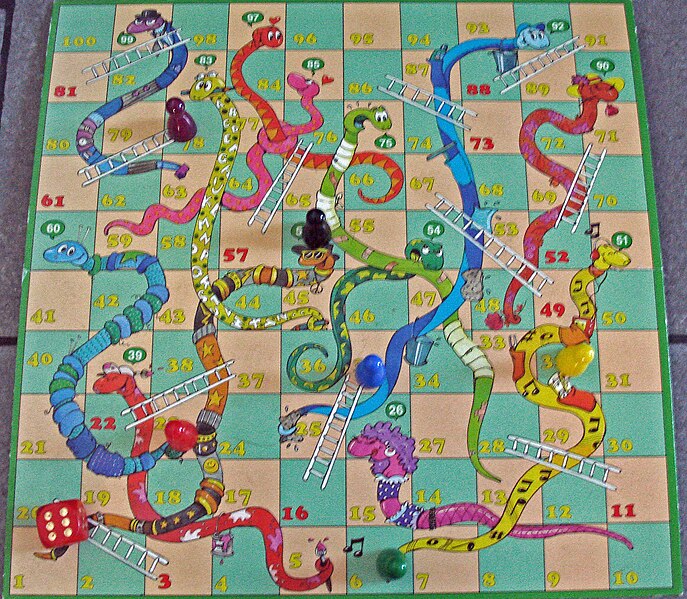
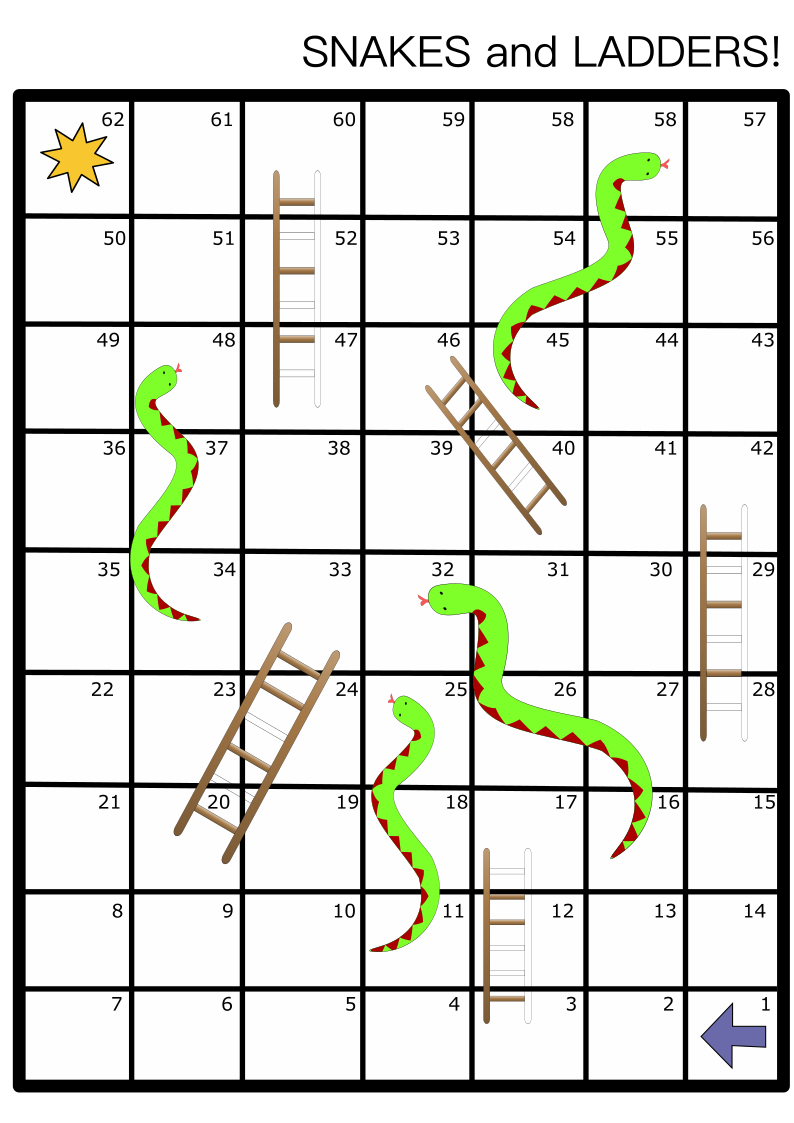
No snakes, no ladders (Idea from Gianfranco Conti / Dylan Viñales)

Image result for snakes and ladders

Secondary MFL facebook groups such as: Secondary MFL Matters, Secondary MFL in Wales, New GCSE 9-1 resources, Global Innovative Language Teachers and others) have taken over my news-feed.  They allow some superb sharing of resources and ideas.  However, lots of activities appear briefly and then disappear: balloon towers, one pen&one dice.  This is one I want to keep.  It involves speaking, listening, reading and translation.  Students play in threes – 2 players and a referee. This is a refreshing change to the majority of MFL games, which seem to require a partner.  Full instructions for No Snakes, No Ladders can be found here.

Treasure Hunt

Treasure chest

This is a slight variation on the MFL standard of battleships.  Gives students a slightly larger grid (6×6) and tell them to hide some treasure somewhere in the grid.  This variation worked in 98% of the pairs in my class.  Sadly there was a kid who guessed it first time! 36 different squares!  What were the chances?!  I made sure that they had a rematch.

Quick Speaking Feedback

This next suggestion is a little bit embryonic.  It is something I have tried with two classes and am still considering how it might work best.

There is a huge focus in UK schools on feedback, DIRT and responding to marking.  The vast majority of DIRT I have seen on Facebook Groups and the TES relates purely to written work.  I’ve written about that here.

I started to consider how I may give short quick feedback on speaking, a skill I believe to be substantially more important than writing.  With two year 8 classes, I went around asking them to read a longer paragraph from a textbook page (Mira 2 or Listos 2).  Whilst they were reading out loud, I scribbled one quick sentence in their book regarding their pronunciation.  Some of the notes looked like this:

Speaking Feedback

  • Check “ci/ce” in middle of words – should sound like “th”  eg: “vacaciones”, “francia”
  • Remember ll = y
  • Superb today, nothing to correct!
  • Remember silent h when starting a word, otherwise fine.

To save time and workload, I wrote one sentence per student.  It did not take long to go through the class.

For those of you wanting students to respond to it then there were two ways I tried to engender this.  Firstly, I modelled the sentence and then they repeated it back to me.  This helped some to understand how it should sound.  Secondly, I wrote a list of 4-5 words in their book that I wanted them to say containing the same sound.  Lastly, in light of everything I had heard, I planned a lesson around J and G in Spanish.  This youtube clip was helpful in that lesson.  It took the focus off of me and gave them plenty of examples.  In that lesson I read out a list of words and students corrected me if I made a mistake.  We had races of words involving Js and Gs along with trying a few tongue twisters corporately and individually.

What I noticed from this was that some students got a substantial confidence boost.  Their ability to pronounce words was better than they perceived it to be.  Others appreciated the quick feedback.  Some appreciated being able to respond to the feedback without a lengthy redraft of a piece of work.  They also appreciated the lesson working on the J and G.

I’m still mulling over where to take this and what to do to refine the process but it was well received by the students and did appear to have a positive effect.


GCSE: Global Issues & Environment

Image result for environment

This was an ambitious one.  Trying to make the topics of environment and global issues interesting was not the easiest task I have ever set myself.  I’m admit that I am not entirely sure if I have succeeded on this one.  Hopefully there is something for every reader.  Maybe it is an activity, or an idea below reminds you of a great resource or activity you have not used for a while.

Before I start, the reader should be aware of the following:

  • AQA refers to “global issues” and refers to “the environment”, “poverty/homelessness”
  • Edexcel/Pearson refers to “international and global dimension” with subheadings of “environmental issues, being green, access to natural resources”
  • WJEC simply refers to “global sustainability”.

I have done my best to put ideas that can be applied to all boards.  There will be a lean towards one in terms of the language used as that is what I am currently teaching.  There is certainly no intent to promote one above the other.

This post will look at a mix of the environment and global issues.  Poverty was covered here as I thought it went well with charity and volunteering.

What can I do with these themes?

Environment is a great opportunity to recycle or introduce previously learnt language.  In the past I have taught “you must” and similar phrases.  It has been used to revise the future (“will” or “going to”).  I have also used it as a means of teaching the conditional (“i could…”).  Lastly, it was a good means of introducing students to the subjunctive with impersonal statements such as “es necesario que”.  They were then introduced to the subjunctive properly with the global issues.  Global issues also became a good way to revise comparatives and superlatives.

Will my students be interested?

I think this is all about the “buy-in” from students.  Some will have an interest in the environment and being environmentally friendly.  They will go along with you on this topic.  I can picture that with other groups, and you know the ones I mean, it might be a tough ask.  I think in this case, any “buy-in” comes from the possibility that this topic could confront them on a roleplay card or photocard and they need to be ready for it.  Some may not engage at all.   I found the global issues topic engaged a mixed ability group, particularly the debate mentioned below.

Match up L2 & L2

Having seen this on a past paper example, I have started to use it more with my GCSE students.  There is a reasonably detailed reading text about a topic.  Opposite the text are 4 text messages from supposed young people that relate to points made in the text.

This infographic from día mundial del medio ambiente would serve just such a purpose.  students would have to write a number based on the alleged text messages sent by 4 supposed teenagers.

I have put links to two French ones below and two German ones as examples, you may be able to find better ones.

French infographic 1

French Infographic 2

German Infographic 1

German Infographic 2

These are simple ways to include some literary texts in your lessons without having to produce too much.  There are other ways to include literary texts in your lessons but that is another blogpost.

You can also create your own infographics if you were looking for a different reading text for recycling vocabulary.  Easel.ly  and Infogram were two I came across on a brief search.  If you know of a great one, put it in the comments section and claim the title of “First Commenter of 2018”.

Fake Whatsapp

I discovered this whatsapp generator.  The disadvantage in using it is that it does mean a bit of work in terms of resource preparation.  However, it will stop the normal glazing over that occurs when students see the textbook displaying a Nokia 3210 with buttons and a green screen (also known as the good old days).  The advantage is that you can produce the language and recycle plenty of vocabulary that you have covered in class.

How does this relate to global issues?  Very simple.  Create a fake group-chat using fakeWhatsapp.  Person 1 in the chat suggests they have a project where they have to ask people what they do to help the environment.  Persons 2,3,4,5 simply answer with what they do.  You could set some comprehension questions.  You could read out some statements that they then match to the people in the conversation.  Students could produce their own groupchat mimicking your one.  Plenty of options here.

How environmentally-friendly are you?

Some textbooks will have these.  However, if you are good with the language then translating this one will not take long.  You can probably find others on the TES website.  Quizzes are a great way to recycle and repeat language, along with revising time adverbs. Partners take turns reading the question and answering them.  If answers are linked to points then students could grade how environmentally friendly they are.

Do you turn out the lights on leaving the house?

  • A. I always turn out the lights on leaving the house
  • B. I often turn out the lights on leaving the house
  • C. I sometimes turn out the lights on leaving the house
  • D. Never.  I’m scared of the dark

The advantage of preparing your own is the recycling of previously learnt language.

38598851432_131216a7f8_m

9 Lives

Using the quiz above.  Students pre-select an answer for each question.  Their partner then has to get from the start of the quiz to the end of the quiz.  Each time they are wrong, they lose a life.

Person 1 pre-selects answers

Person 1 reads question “Do you turn out the lights on leaving the house?”

Person 2 tries to guess pre-selected answer. “I always turn out the lights on leaving the house”

Person 1: “non/nein/no”

Person 2: now down to 8 lives, tries to guess pre-selected answer  “I sometimes turn out the lights on leaving the house”

Person 1: “oui/ja/si” reads next question “How often do you have a shower?”

and so it goes on…


povAntarctica, Ice, Caps, Mountains, Penguin, Ice Bergs

7 pictures 7 sentences

This was adapted from a commercially produced textbook.  It involved 7 sentences, each was divided in two.  There was also a picture.  The first task was to match the sentence halves and then match the sentences to the pictures underneath.  It would not take much to create your own version of this.

Moving on from the activity above, you could use these as a start of a photo-card discussion.  You could also simply get the pupils to generate sentences relating to the picture.


20150802_212412

Recycling container seen in San Sebastian.

Containers Card Sort

Again an adaptation of a commercially produced textbook (the same one in fact).  It was a great way to acquire and use a variety of vocabulary in a meaningful context.  Give students a series of headings in books (such as recycling containers) and a set of vocabulary (that can go in the containers).  You could adapt this to different levels

Easy: put vocabulary in correct container

Medium: Scaffolded sentences explaining where you would put each item

Hard: Use of conditional + direct object.  I would put it in … because


35971775343_7c807e015c_m

Debate in progress             Photo Credit: Conselho Nacional de Justiça – CNJ Flickr via Compfight cc

Superlative/Comparative Debate

This was an activity that happened after a few lessons, in which we had covered opinion phrases, superlatives, subjunctive and global issues vocabulary.

A few years ago, there were a number of teachers talking about “Grouptalk”.  One of the ideas I saw was the idea of a cyclical discussion.  Students would start a discussion on a table of four and try to keep it going as long as possible.  I tried this last year with a mixed ability year 10 group on the “biggest problem facing the world”.  The conversation was heavily scaffolded with vocabulary help and some prompts on paper.  I have rendered the potential conversation below in English.  Names have been altered.

Ross: “In my opinion, the biggest problem in the world is poverty  What do you think Phoebe?”

Phoebe: “For me, the biggest problem in the world is terrorism.  Joey, in your opinion, between racism and terrorism, which is worse?”

Joey: “I believe that world leaders are the biggest problem.”

Rachel (interrupting) : “Joey you’re completely wrong, it’s global warming.”

Joey: “I disagree.  Ross, what do you think: global warming or terrorism?”

Students were genuinely surprised that they could take part in a relatively tricky debate entirely in the TL.

Debate Round 2: Bingo cards

Were I to do the debate above again, I would give 5×5 grid bingo cards with phrases to use.  Students that complete a line or a row would receive some form of reward.  Something like this could work…

Questions Subjunctives Opinion phrases Fancy Language
I asked someone an opinion me da miedo que exista Desde mi punto de vista aunque quisiera pensar de otra manera
I asked a question with two options es increíble que haya Opino que el problema que nos enfrenta es
Finished statement with a question no creo que sea A mi modo de ver y por si eso fuera poco

If you do not trust the student who is claiming the reward then you have two options:

  1. Students have to tell you one or two of the ways they used the phrases above
  2. Their partner completes it while they talk
Image result for tarsia

Original Tarsia

Environment Tarsia

Formerly an italian Renaissance design motif, now an educational activity.  The idea of Tarsia puzzles was hotly debated on the GILT Facebook Group a while back.  Some were heavily in favour; others were heavily against.  Arguments for included testing of vocabulary.  Arguments against suggested it was testing of being able to put shapes together.  Both points of view have been put forward by experienced colleagues.  Rather than a simple English-German matchup, I have tried to make them more challenging by doing the following:

  1. Populate it with a mix of seen and unseen vocabulary.
  2. Have the words around the outside edge as well – Maths do this with formulas to great effect.  Students could translate the outside edge vocabulary as an extension task.
  3. Have the tarsia composed entirely of synonyms in TL.
  4. Have the tarsia composed of starts and ends of sentences.
  5. Have the tarsia composed of a mixture of haben/sein verbs in perfect tense or etre/avoir verbs in passé composé.

Tarsia are puzzles I was introduced to by our maths department.  They were used to match up formulas that would give the same result but there are many ways to adapt them for MFL.  A google image search of the word will show you how they look.  How can you make one?  Download the program here.  They are quite heavy on the photocopying and chopping up so you may need your tutor group to do the chopping for you.


Plenty to come from EverydayMFL

Dear all.

It’s the summer holidays so I’m taking a few weeks off.  From September there will hopefully be more regular posts as things got a little sporadic towards the end of last term.

In the meantime you can have a read of the following:

Top post:  Outstanding MFL Everyday

Second most popular post: GCSE Revision

Third most popular post: Feedback and marking.

Least popular posts: 5 Things to try tomorrow and 5 ideas to try this week

One for the NQTs: First Lesson of the year

Posts to come in the new academic year:

  • Making marking work
  • Teaching the new GCSE – reflections at the halfway point.
  • What is going to be different this year (lessons learnt from The Language Gym)

I’m sure there will be others but those are the three I’m working on.

Have a great summer!


5 Things to try tomorrow

Number, Five, 5, Digit

It has been a while since writing one of these (or anything) so here are 5 things to try tomorrow.

Everydaymfl has been a little bit quiet of late but posts in the works include one on questioning and possibly one on the new GCSE – what I learnt teaching it so far.

No writing lessons

Writing is one of the easiest skills to show progress with.

  1. Student writes something
  2. Teacher corrects
  3. Student improves

However, students are used to a lot of this.  It really is quite something for them to have a “no writing” lesson in a subject they will typically associate with writing.  An entire lesson of speaking and listening is not a bad thing as it reminds them how important the skills are.   Some groups will be noticeably more enthused by this idea.  It is quite heavy on the planning and paired activity so you may want a settling activity at some point – perhaps hands up listening.

Group Model Essay

After my year 10 group seemed somewhat intimidated by the 150 word task in the new GCSE, I thought I would approach it gradually.  Here is what we did:

They were given a 150 word task from the AQA textbook.

In groups of 4 they drafted the best response on mini-whiteboards that they could come up with.  After some feedback from me, they improved the draft on mini-whiteboards.  One member of the group put it on to paper.  They handed them in and I typed them up on a word document with significant amounts of space around them.  I annotated the work highlighting tenses, good bits of grammar (comparatives, superlatives, subjunctives) and double ticks for anything that particularly stood out.

This was really well received and sometimes it is helpful to know “what a good one looks like” but also to know that you were involved in producing it.

Micro-listening enhancers

I have read a lot about these on Gianfranco Conti’s website.  I have found myself using them quite a bit recently as my speakers are kaputt.  The pupils did seem to be gaining confidence from them.  In teaching the perfect tense in Spanish, it seemed to have a positive effect on the pronunciation of “he” and “ha” et al later in the lesson.  Well worth a try and something I am looking to do a bit more of earlier on.

Photo Credit: immaculate-photons Flickr via Compfight cc

Photo Credit: immaculate-photons Flickr via Compfight cc

MM Paired Speaking

Possibly one of my favourite activities.  The MM refers to a lady I worked with on my PGCE.  In my mind the activity is named after her for two reasons.  1) I have never seen anyone else do it.  2) I’ve no idea what to call it!

Students divide their page into 3 columns.  If they don’t have a ruler then gentle folds work well.

  • Column 1: days of the week or time phrases in a list going down.  3 lines between each approximately
  • Column 2: draw simple picture representing an activity
  • Column 3: leave blank.
  1. Person A asks question for example: “Qué hiciste el lunes”
  2. Person B responds using time phrase and makes sentence based on picture “el lunes fui de compras”.
  3. Person A notes down in the empty column what their partner did on Monday.

You can add challenge by getting Person A to write in the third person on step 3.  You could differentiate for weaker learners by getting them to write a quick note as to what they heard.

This is a very versatile activity as it can be adapted to different tenses and languages easily.  It is good speaking and listening practice at the same time.  Both students should have that last column filled by the end of the activity.

The Future Tense Three Musketeers 

This came from a teacher I used to work with.  She would teach the future tense telling students that there are three musketeers.

Musketeer number 1 has 6 moves in Spanish.  Musketeer number 2 always does the same thing. Musketeer has different disguises but you can always tell it is him by looking at the ending.  The three can never be separated.  Once the concept has been introduced you may then move on to some mini-whiteboard practice.  Telling students to check musketeer number 1,2 or 3 seems to be quite effective.  It also seems to eradicate “voy a juego” or “voy a hago”

1                       2                                            3

Voy                  a                   ______________AR/ER/IR

Vas

Va

Vamos

Vais

Van


5 Things to try tomorrow

Here are 5 things I have tried this week…

Los Meses Del Año en estilo Macarena.  

The kids loved this!  The trick is getting them to practise the lyrics before doing it with the actions.


Equipment check in TL

This idea was borrowed from an excellent seminar by Eva Lamb earlier this year.  When teaching students the items in the pencil case then get them to do an equipment check and stitch up their friend.

Persona 1: ¿Tienes un lápiz?

Persona 2: Si, tengo un lápiz.

Persona 1: ¿Tienes una calculadora?

Persona 2: no tengo una calculadora

Persona 1: ¡Señor, mi compañero no tiene calculadora!

12 sided dice revision

Teach a topic, such as family.  Then at the end of the topic go through with the students how the new speaking exams will take shape.  There is a general conversation section.  Get a set of 12 sided dice and set a GCSE group 12 questions of which they must ask their partner at least 7.  I found this was a great way of practising, ensuring spontaneity and helping them to learn to deal with unpredictability.  The students then peer assessed their partner using the following guidelines:

  1. Start low, ask yourself: did they do that?  If yes, move up.
  2. When you have reached the highest level.  Ask yourself: how well did they do?
  3. Pick a mark higher or lower depending on answer to Q2

12 sided dice were a great little investment and did not break the bank.

3 Minute KS3 Marking


Photo Credit: Leo Reynolds Flickr via Compfight cc

Photo Credit: Leo Reynolds Flickr via Compfight cc

This is a variation on a strategy suggested by Ross Morrison McGill (known to Twitter people as @TeacherToolkit).  Normally the suggestions from Teacher Toolkit take 5 minutes; this one takes two!!    I cannot find the original link but I believe he suggested only 2 minutes per book.  I have been trying it this week with some success and no perceptible dip in quality.  If you can manage 2 minutes then even better.  Here’s the Math…

2mins x class of 34 = 68mins

3mins x class of 34 = 102mins

Now if you’re like me a class of 34 is a massive amount all at once but the principle really helps.  You can still highlight errors, write a positive comment and set 2-3 targets in this time.

My Favourite Spanish Alphabet Song

https://www.youtube.com/watch?v=Xyn8ZDiqcyU

I have used this as a way of recapping the phonics we did in the first lesson (see Rachel Hawkes for Powerpoints on this).  The lesson consists of introducing the alphabet sounds and getting a handle on those.  Then I use it as a vehicle to remind the students of the sound and spelling links.  We then look at a verse from a song (without telling them what it is) going through how each word should be said.  If they know the rules, they can do most of the words, before concerning themselves with what song it is.  We use the first verse of this one below…


Keeping Year 9 going…

New_Chums_beach_Whangapoua_Waikato.jpg

It’s that time of year again.  Year 11 have gone.  Year 10 are thinking about work experience. Year 9s become that little bit more difficult to teach.

I got lucky this year.  I got a rather nice year 9 group.  They are a group with a mixture of middle and top set characters with a handful of lower ones thrown in.  The words mixed ability make the range of abilities sound wider than it is.

Over the past 5 years I have not been so lucky.  This post is an exploration of the variety of strategies I’ve tried.  The following picture does not represent a strategy but is definitely reflective of how it has felt at times:

OLYMPUS DIGITAL CAMERA

9×4 teaching aid.

Prepare a presentation/poster

Sometimes we do not get enough time to cover the extensive culture and history that surround the languages we teach.  Students prepare a presentation in groups of two or three to be delivered to their class.

How to vary it:

  • Give students a choice of delivery styles: interview, powerpoint and speech, podcast recorded using apps like spreaker , giant A2/A3 poster for corridor complete with text and pictures.  If you are a school with ipads then a whole world of possibilities are probably open to you (leave suggestions in the comments section).
  • To use TL or not to use TL.  With groups where most carry on til GCSE then insist on some TL, otherwise make the activity about presentation skills (perhaps colloaborate with English).
  • Horrible Histories.  Having met Terry Deary, the man is on to something.  The more gory or wacky it is; the more kids  will read about it.  Perhaps get your kids to go after the lesser known facts.
  • Ban certain websites.  Wikipedia is not always correct.  At university when I looked up the Spanish Civil War it turned out it was Manchester United’s sub goalkeeper!  Encourage use of reputable sources.
History Culture Geography
Guerra de independencia Don Quixote Espana
Islamic Conquest of Spain Gabriel Garcia Marquez Bolivia
The Inquistion Cataluna Peru
Colombus Castilla y Leon Paraguay
Spanish Civil War El País Vasco Chile
Franco Flamenco Ecuador
Juan Carlos de Borbon Tango Honduras
Zapatero Bullfighting Costa Rica
Ernesto Che Guevara Galicia Puerto Rico
Simon Bolivar Bunuel Venezuela
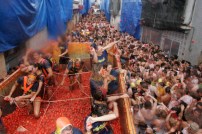
Al Andalus La tomatina Colombia
Eva Peron San Fermin Los Andes
Evo Morales Pedro Almodovar El salar de uyuni
Diego Maradona Las islas canarias Patagonia

Spanish survival kit

Everything needed for the casual tourist.  What does a holidaying student need?

WEEK THEME
1 Introductions

Name ¿Cómo te llamas? Me llamo …,

How are you + opinions¿Qué tal? ¿ Cómo estás?

Numbers 1 – 20, Age ¿Cuántos años tienes?

Alphabet,

2 Personal information

Where live ¿Dónde vives? Vivo en …

Holiday dates, times

3 Food and drink

Basic vocabulary

Ordering in a restaurant/bar/café

Complaining – this is not what I ordered etc

Money and shopping

Currency

Asking how much

Understanding larger numbers and prices

I would like Quisiera …

I like/don’t like Me gusta…/ No me gusta …

5 Directions

Asking where places are in a town ¿Dónde está …? Esta … ¿Hay … par aquí?

Understanding directions

6 Revision

There are obvious benefits to this approach.  It gives students some revision of the basics and prepares them for holidays.  The downside is that it is too simplistic for some.

Start GCSE

This is this year’s idea.  As a department we looked at the new specs and decided there was some stuff we have never taught.  So we decided to give it a go.  The results have been surprising.  Most students seem to have taken to it as they appreciate it is necessary for their classmates.  Other groups with slightly lower numbers of GCSE students have found it a bit tougher.  They do however appreciate the more advanced themes (global understanding) and focus on being able to make up stuff on the spot.  Rachel Hawkes writes that students judge their TL abilities based on what they can say and she is right.

A Film

“But SLT would never allow it!!” I hear you scream.  You may be right but at the same time there is a lot to be gained, if it is handled well.

Things to consider:

  • Get permission from parents, HoD and SLT if needed.
  • Make sure it is already on your scheme of work!  History show films regularly, why not mfl?
  • Create a worksheet with questions to provoke thought.
  • Give pupils a selection of words to find and switch the subtitles on.
  • Give pupils a synopsis to translate sections of before starting.
  • Give the pupils some character bios to translate before starting.
  • Give the pupils some character bios to fill in during the film with multiple choice options.  Eg: Ramón es descapacitado / paralisado / activo
  • You could show them the trailer to give an overall picture.
  • You could give them a series of pictures from the film to put in order afterwards .(perhaps with a short Spanish explanation underneath.
  • You could write some true/false sentences for the students to work out.
  • You could make a multiple choice quiz based on the film using Kahoot to gauge their understanding of the film.

One of the most difficult GCSE groups I ever taught was spellbound watching el mar adentro.  17 boys, 2 girls and they were transfixed.  It also fed quite nicely into their Philosophy, Theology, Ethics lessons at the time.

Grammar Revision

If you have a group doing GCSE then take them on a grammar crashcourse.  I believe grammar teaching is important and it can be fun (post on quirky ways to teach grammar is coming soon).

Expo and Mira tend to cover something grammatical and then assume it is mastered at the end of that particular page.  The next time it is revisited, it will be similar but with something new added.  If you are following one of these schemes then you may find students are not quite as adept with the grammar as you would like.  Graham Nuthall (The Hidden Lives of Learners) suggests students need three exposures to new concepts before they start to embed them.  If you are using the above textbooks, it is entirely possible that students will only have had one exposure to some concepts.

The Euros, world cup, Olympics, Women’s World Cup, Wimbledon

Use it as an opportunity to teach opinions and the future tense in the third person.  You could also use it to revise past tense, weather and a variety of vocabulary.  More ideas on Wimbledon can be found here with this shameless self-promotion link.

I think that … is going to win

In my opinion England will win etc.

Perhaps you do something different entirely, leave it in the comments section below!

Outstanding MFL everyday.

For some reason, despite lessons being no longer graded, people are still searching for outstanding MFL activities.  Please bear in mind that this post was written in 2016 and reflective of the current prevailing educational landscape of the time

‘Hypothetical’ conversation overheard in staffroom:

Experienced teacher 1: “I delivered a number of outstanding lessons today”

Experienced teacher 2 “Ha! Your definition of an outstanding lesson is you putting your feet up while the kids are standing outside!”

Experienced teacher 1: “you saw them then!”

I’ve seen a lot of requests on TES forums, Twitter and Facebook for outstanding activities or an outstanding lesson on (insert topic here).  I’ve probably wished for a few myself in the past.  There’s nothing wrong with asking for something that works when you’re low on time and your desk is covered by paper and looks like a scale model of the himalayas. What makes an outstanding lesson is highly subjective and is based largely on the observations of the person watching.  I think even OFSTED realised this recently.  OFSTED say they will no longer grade individual lessons or learning walks.  This is good news, although they have to deliver a judgement on quality of teaching and learning across the school so some form of grading still has to take place (in their heads one assumes). Teaching and learning still has to be judged as outstanding/good/requires improvement/inadequate.

This is not a post on “how to play the OFSTED game” as the only OFSTED game to be played is simply high quality teaching and learning.  It is a post about the key ingredients for an outstanding lesson and how we might apply those in MFL teaching everyday.

Before we look at the ingredients.  Let’s hear it from the horses mouth:

Inspectors will use a considerable amount of first-hand evidence gained from observing pupils in lessons, talking to them about their work, scrutinising their work and assessing how well leaders are securing continual improvements in teaching. Direct observations in lessons will be supplemented by a range of other evidence to enable inspectors to evaluate the impact that teachers and support assistants have on pupils’ progress. Inspectors will not grade the quality of teaching, learning and assessment in individual lessons or learning walks.

Inspectors will consider:

  • how information at transition points between schools is used effectively so that teachers plan to meet pupils’ needs in all lessons from the outset – this is particularly important between the early years and Key Stage 1 and between Key Stages 2 and 3
  • whether work in all year groups, particularly in Key Stage 3, is demanding enough for all pupils
  • pupils’ views about the work they have undertaken, what they have learned from it and their experience of teaching and learning over time
  • information from discussions about teaching, learning and assessment with teachers, teaching assistants and other staff
  • parents’ views about the quality of teaching, whether they feel their children are challenged sufficiently and how quickly leaders tackle poor teaching
  • scrutiny of pupils’ work, with particular attention to:
  • pupils’ effort and success in completing their work, both in and outside lessons, so that they can progress and enjoy learning across the curriculum
  • how pupils’ knowledge, understanding and skills have developed and improved
  • the level of challenge and whether pupils have to grapple appropriately with content, not necessarily ‘getting it right’ first time, which could be evidence that the work is too easy
  • how well teachers’ feedback, written and oral, is used by pupils to improve their knowledge, understanding and skills. 

Source text here P44.

Outstanding (1)

  • Teachers demonstrate deep knowledge and understanding of the subjects they teach. They use questioning highly effectively and demonstrate understanding of the ways pupils think about subject content. They identify pupils’ common misconceptions and act to ensure they are corrected.
  • Teachers plan lessons very effectively, making maximum use of lesson time and coordinating lesson resources well. They manage pupils’ behaviour highly effectively with clear rules that are consistently enforced.
  • Teachers provide adequate time for practice to embed the pupils’ knowledge, understanding and skills securely. They introduce subject content progressively and constantly demand more of pupils. Teachers identify and support any pupil who is falling behind, and enable almost all to catch up.
  • Teachers check pupils’ understanding systematically and effectively in lessons, offering clearly directed and timely support.
  • Teachers provide pupils with incisive feedback, in line with the school’s assessment policy, about what pupils can do to improve their knowledge, understanding and skills. The pupils use this feedback effectively.
  • Teachers set challenging homework, in line with the school’s policy and as appropriate for the age and stage of pupils, that consolidates learning, deepens understanding and prepares pupils very well for work to come.
  • Teachers embed reading, writing and communication and, where appropriate, mathematics exceptionally well across the curriculum, equipping all pupils with the necessary skills to make progress. For younger children in particular, phonics teaching is highly effective in enabling them to tackle unfamiliar words.
  • Teachers are determined that pupils achieve well. They encourage pupils to try hard, recognise their efforts and ensure that pupils take pride in all aspects of their work. Teachers have consistently high expectations of all pupils’ attitudes to learning.
  • Pupils love the challenge of learning and are resilient to failure. They are curious, interested learners who seek out and use new information to develop, consolidate and deepen their knowledge, understanding and skills. They thrive in lessons and also regularly take up opportunities to learn through extra-curricular activities.
  • Pupils are eager to know how to improve their learning. They capitalise on opportunities to use feedback, written or oral, to improve.
  • Parents are provided with clear and timely information on how well their child is progressing and how well their child is doing in relation to the standards expected. Parents are given guidance about how to support their child to improve.
  • Teachers are quick to challenge stereotypes and the use of derogatory language in lessons and around the school. Resources and teaching strategies reflect and value the diversity of pupils’ experiences and provide pupils with a comprehensive understanding of people and communities beyond their immediate experience.

So let’s have a look at those key ingredients and what they mean for us in the classroom:

Key Ingredient: What it means for MFL teachers:
Transition information We need a knowledge of where the children are coming from.  We need some idea of how much language tuition the children have had, what language and how effectively it was taught.  This is more applicable to year 7.  As far as year 8s and 9s are concerned, you will need an idea of where they finished at the end of year 7.
Challenge Is your work demanding enough?  I don’t mean simply sticking an extension task on a starter or a reading activity.  Are you sufficiently challenging that little lass who finishes the task seconds after you have explained it?  Should she have finished that quickly?  Are your tasks differentiated enough to keep all students challenged and engaged?  Could you give different students a different task?  How could you reward risk-taking with the language?
Pupils views ARGH?!   What would they say about your lessons?
Parents views Informed by the above as few parents have likely seen your superb lesson on the future tense!
Scrutiny of work From this I understand the following:1)      Pupils must be seen to be making an effort and doing well and this should be seen through their exercise books.

2)      There must be some evidence that their abilities have improved.  You can do this through various ways.  Some staff will use charts with “can do” statements or it could simply be that there are less corrections in the book later in the year.

3)      There must be some work that is not “too easy” for them where they struggle.  Struggle is part of learning so that is not a bad thing.  If it is all ticked and correct then it could be interpreted as too easy.

4)      Feedback should inform and foster improvements in knowledge, understanding and skills.  For more on feedback see here

Subject Knowledge Must be evident along with questioning.  Questioning varies depending on subjects.  I think certain subjects have it easier than MFL but students could deduce a grammar rule if given sufficient examples and then go on to some structured practice of that rule.  If you are thinking of ways to develop your subject knowledge then look no further:  Keeping your languages up!
Effective Planning No time wasted and all resources readily available and accessible.  They may not want to see a lesson plan per se but would expect to see a well planned MFL lesson.  This is probably the best thing I have read on planning an MFL lesson.
Behaviour Management Clear rules and consistently enforced.  I would argue that there is nothing wrong with removing a student whose behaviour is detrimental to the progress of the rest of the class, even in an observation.
Adequate practice time Pupils must be allowed enough time to practice and embed what they are learning.  There must then be a definite increase in demand and evident progression in difficulty of the material covered in the lesson.  Practice in MFL will obvious take place through different skills but it is worth considering: how do they link to your overall objectives in that lesson?
Checking understanding Understanding must be checked and any misconceptions identified.  You can probably tell who will struggle so maybe set the class a short activity that they can use to demonstrate their learning, while you go and help those who need it.
Challenging h/wk Homework could consolidate, extend or prepare the students for future work.  It should do all of these.  More on homework here
Literacy and Numeracy Whilst numeracy is harder to shoehorn into MFL, literacy is very much the bedrock of what we do.  Start using grammatical terms and do not shy away from them.  You’re a language teacher and probably a fan of the odd reflexive verb, subordinating conjunction or relative clause.
Pupils know how to improve Pupils have to know how they can make their French/Spanish/German better.  What does their book tell them and what does your classroom wall tell them?
Challenging stereotypes As MFL teachers we are in an ideal place to do this and hopefully avoid situations like the recent awful match of the day video where the presenters butcher the French language.  I’m not giving you a link, as a football fan I find it embarrassing.

OFSTED’s descriptions miss out one major feature of teaching that I believe is key to delivering outstanding lessons and that is relationships.  Admittedly you can produce an outstanding lesson that meets all of the above boxes but there is likely to be one question in the observer’s mind that also needs answering: “would I be happy for this person to teach my kids?”  Your relationships with your students will answer that.  John Tomsett says: ‘Fundamentally students need to feel loved and I really don’t care what anyone might think of that, to be honest, because if I know anything about teaching, I know that is true.’

What could I do now? 5 things to try this term.

If you’re English then make a cup of tea before contemplating the following:

  1. Build those relationships.  Grab your seating plans or markbook and find 3 students per class who you are going to develop your relationship with.  How are you going to do that?  Will you be teaching those kids next year?  Who knows?  Do it anyway.
  2. Key Ingredients.  Pick one of the key ingredients that you need to work on.  In your planning for next week incorporate it into every lesson.  Yep, that’s every single one.  It’s all very well reading a blog post but you have to act on it.  My Headteacher likes the phrase purposeful practice.  To paraphrase Aristotle, “we are what we repeatedly do.  Excellence therefore is a habit not an act.”
  3. Share.  Share the OFSTED descriptors or key ingredients above with your department.  What ones do you want to work on over the coming weeks?  What do you need to put into place for next year?
  4. Gained time.  Can you devote some of it to CPD?  Who in your department is good at challenge, differentiation, target language use?  Who could you learn from?
  5. Power of praise.  I used to do termly phone-calls home to a parent to give some positive feedback on a student.  I’ve slipped on this and may well do a few in the coming half-term.  Shaun Allison writes about them here.  You could also do an email although make sure you personalise it.  One simple phone-call has massive potential in terms of relationship with the pupil, their parents and the parents of other students.
  6. Consider September.  Yep, right now!  September is where we set the tone, set the patterns and culture in our departments, what would you like an observer to see if they entered your classroom?  What needs to be part of your practice?
  7. Iron sharpening iron.  “As iron sharpens iron, so one person sharpens another” (biblical proverb).  I love this proverb as it applies to most areas of life. Another person can always be guaranteed to sharpen you and smooth out the rough edges.  Most NQTs have a mentor and most PGCE trainees do too.  Once we exit that process, we are on our own.  Who could you work with to improve your own teaching?  Can you get them to pop in and watch?  No notes, no agenda, no judgments and no threat, but just someone there simply to develop your practice.

Further Reading

Indicators of Outstanding – a blog post by education adviser Mary Myatt.

Great Lessons – a series of blogs by Tom Sherrington (Headteacher) on what makes for great lessons.

An Outstanding Teacher – short blog post by Shaun Allison

Six Steps to Outstanding – I read this when I was starting as an NQT and found it useful.

Everyday Feedback & Marking

Update: Government publish results of review into marking.  It’s worth a read and the three principles of “meaningful, manageable and motivating” are sound.  

Feedback and marking conjure up a variety of responses.  Some teachers secretly enjoy it. Some would like to drop their marking pile in a woodchipping machine.  If you are reading this because you want to improve your feedback then hopefully you find something new to try.  If you are snowed under then I would point you in this direction.

We know from research by people such as John Hattie that feedback can be incredibly important.  Two videos that demonstrate the importance of feedback and how it can be used well are below.   The first: Austin’s Butterfly, has done the rounds on Twitter, Facebook and in schools.  Watch for the kid at about the 45-50second mark with his encyclopaedic knowledge of butterflies…

The second video shows that over time with a diet of quality instruction and effective feedback people generally improve at whatever they are doing.  Pay attention to his control, his reactions and his speed.  It is one way I get the kids to “buy in” to my marking and then the subsequent reflection time.


Feedback or Feedforward?

I know, “feedforward” is not a word but this came from a discussion with some colleagues the other day.  Most students do not care about the work they have done once it is over.   They care about the next piece.  So whilst our feedback is reactionary and responds to what they have done, they are already looking at the next thing.  One colleague said that he gets students to copy the target from the previous piece of written work at the top of the next piece of written work they are set, so that it is in their mind while they are producing it.  If you are following Mira 2 then you maybe approaching a module on clothes.  Here is how you could apply this:

Homework 1: Produce a 75 words on things you wear at different times

Student completes piece of work with the following 2 targets

  1. Try to use a greater variety of vocabulary
  2. Add reasons to opinions given

Homework 2: write 75 words about a party you went to and what you wore

Student writes at top of work

  • TARGET: Use greater variety of vocabulary.
  • HOW: no repeated nouns or adjectives where possible.

Suddenly we have a situation where the feedback informs the next piece of work.  This means the next piece of work is not only a response to the marking but it is also driving the learning forward.

Do you use coloured pens?

Schools vary on this.  Here are some of the ones out there I have heard about:

  • The purple pen of progress.  This is for improvements to work or redrafting of work.
  • The pink pen of pride.  This is for work a teacher wishes to highlight as particularly good or because of how well the task has been met by what has been written
  • The green pen of growth.  This incorporates targets to improve.
  • The green pen of peer assessment.  It’s for peer assessment, the clue is in the name.  It is quite a good way of visually defining who did the marking (more for observer than the kid)
  • The red pen of teacher marking.
  • The turquoise pen of…you’re just making it up now!

I have seen coloured pens used really effectively in one of our feeder primary schools.  The presentation of their work is stunning too particularly given a very tough catchment area.  Something goes wrong between the Summer of year 6 and the Autumn of year 7, cynics might suggest it’s adolescence…

Highlighters

My new favourite.  This came originally from a colleague in Bristol and a colleague currently on maternity leave.  Underlining an entire piece of work in different highlighters.

  • Green = good leave it as it is
  • Yellow = something needs correcting

You could add some codes such as  (G) = grammar  (W.O) = word order  (S) = Spelling    to aid understanding where needed or just let the yellow stand for itself and force the burden of correction and thought back on to the pupil.  Some may disagree but I find this visually powerful for the kids.  Weaker ability kids who receive a piece of work that is largely green with one or two hints of yellow get a massive morale boost from this.  Even the ones that get more yellow than green benefit as they still appreciate knowing that at least some of it was right!

Stamps

Ross Mcgill who runs the Teacher Toolkit website has a post about verbal feedback stamps. I see no point in repeating him.  However many stamps can save time and I have benefited from the stamp stacks supplied by a website out there.  The stamps contain things such as:

  • “please give nouns a capital”
  • “please take more care over presentation”
  • “please watch your verb endings”
  • “great work, keep it up!”

DIRT

I mentioned DIRT mats in this post.  There are a number of things you can do to maximise DIRT time.  Firstly, make it really clear what you want students to do with the time and how you want them to do it.  Secondly, refuse to take any questions apart from ones concerning your handwriting for the first 5 minutes.  Lastly in that first 5 minutes, focus on the ones who need your attention most.

Prove to me beyond all reasonable doubt

My Head of Department posed a difficult question last week: “early on in year 7 when you have an able kid getting everything right, what feedback do you give that drives their learning forward?” I happen to have just such a year 7 so here is what I tried.  When we have done grammatical exercises, her DIRT task has been to “prove beyond all reasonable doubt that you can apply the grammar points from the previous lesson using pages … of Mira 1,2,3”.  She then gets on with exercises that challenge, extend, consolidate and deepen her learning.  Sometimes the grammar book used is not the regular one (e.g: listos rather than Mira or the GCSE foundation book if I was feeling really mean).  She has responded really well.

Patricia’s problems page.

Patricia is a student I teach who struggled with a new language: German.  We decided that at the back of her book we should have a problems page.  Initially, I did not mark much of her work to keep her confidence levels high but we had an ongoing dialogue on the problem page.  It was not triple impact marking or deep marking or excessive dialogue.  It was just an honest conversation where she could ask the questions she did not want to ask in class.

  • “I get that the verb goes second, what if you have two or three verbs?”
  • “How do you form questions?”
  • “Why can’t German be easier?”
  • “What is the difference between denn and weil?

Feedback sheets

TES is full of these.  Rather than writing the comments then they can be on a sheet.  This can be very effective but again the sheet has to be meaningful and linked to your assessment criteria.  I remember marking an oral exam with another teacher and they suggested I listen to the amount of subjunctives and connectives the student was using.  The problem is that the Edexcel Speaking mark scheme does not really mention either.  If you are going to produce a sheet like these then make it a good one.  The question the sheet needs to answer is not only “what do I need to work on?” but also “how am I going to go about it?”

Formative Comments

For a while we ran with comment only marking and to an extent we still do in that pieces of work are not graded.  It can be very easy to get into a rut of formative comments.  The following are based on the new GCSE Writing mark scheme (AQA is the only accredited one I am aware of).

Content Quality of Language Accuracy Language Specific
Stick more closely to the
question
Include greater variety of tenses Check genders Spanish accents only go one direction: /
What else could you say about? Use a greater variety of opinion phrases Check spelling Please give nouns a capital
How could you make … clearer? Find more interesting adjectives than “aburrido”
and “interesante”
Check verb/adjective endings Check direction of accents
Aim for longer, more detailed sentences Include more complex clauses and structures Check accents Check use of avoir/etre

If making comments then they should be demanding a response.  Mary Myatt has some points to make on this here.

Subtle comments.

The exercise book is a way of communicating with your students.  Do not underestimate the power of a well-placed positive comment.  Matt Walsh’s blog has a brilliant post worth reading called “to the quiet boring girl in the class“.  Sometimes they just need a little encouragement.  One of the most talented students I have ever worked with once said to me “why must it always be “to improve”, why can’t I just be good for a few seconds?” Here’s the challenge: pick the quiet kid that doesn’t contribute much in lessons.  Look through their book, find a piece of work, single out the positives and finish with a comment about how much you valued the effort and thought that went into it.  If you need convincing of the effect you can have then read this.

“I thrived on the quiet praise I was given” – Emma Thomas

Everydaymfl’s Marking & Feedback

I’ve outlined a lot of different stuff here.  I’m sure you have lots of other idea.  If you saw Everydaymfl’s books, what would he hope you would see?

  1. Underlined date, title and label as to class or homework
  2. Legible work.
  3. Pieces of work marked with highlighters.
  4. Codes where absolutely necessary but very few to force the student to examine their work.
  5. 2-3 targets at the end of work with how to improve.
  6. DIRT task for the student to work on (using purple pen).
  7. Some elaborate positive comments – not just “well done” but “this is great because.”
  8. Challenging and redrafting of poor quality or poorly presented work.
  9. Regular marking (half-termly)
  10. A comment somewhere to make the quiet kid feel ten feet tall.

5 Things to try tomorrow

5 Things to Try Tomorrow

Image by Cool Text: Logo and Button GeneratorCreate Your Own Logo

I’m snowed under with marking, reports and grades at the moment.  So here’s 5 ideas which helped me procrastinate, which you may like to try tomorrow…

Target Language Answers

How do your pupils respond at the end of starters, reading activities, listening activities?  I’ve started getting my classes to use the following:

  • creo que es …A,B,C etc
  • pienso que es
  • podría ser …
  • Estoy seguro que es …

It’s a simple way of drilling in key phrases and it keeps the lesson in the target language. I thought it might slow things down but it hasn’t.  Even better is that students are using them and they are appearing in their work.

Dice

Such a simple thing but so versatile.  Get a set of 6 sided or 10/12 sided dice.  Try any of the following:

1    me gustaría trabajar                                 con animales

2   mi amigo le gustaría trabajar                 en una oficina

3   mi profesor debería trabajar                   como domador de leones

4   no me gustaría trabajar                            al aire libre

5    mi mama debería trabajar                      con la gente

6   mi papa debería trabajar                          como profesor estresado

Or 

1    Give an opinion about … using ich denke, dass

2   Give an opinion about .. using gefallen

3    Give an opinion about … and add a weil clause

4   Give an opinion about … using gern

5   Give an opinion about …. that adds a sentence in another tense

6   Give an opinion about  … using meiner Meinung nach

Or vocabulary revision

1/2  Partner names 5 words on topic of …

3/4 Partner gives 5 adjectives on topic of …

5/6 Partner gives 5 verb phrases on topic of…

or create your own…

“Hide your whiteboards.”

The credit for this one goes entirely to a trainee teacher who gets better and better with every lesson.  She insists that students keep mini-whiteboards under their chins once they have written and then they raise them on her instruction.    Copying other people is one of my pet hates and this eliminates it and also forces the “less motivated” (bone idle) to work harder and produce something or it’s really obvious.

 DIRT mats.

cooltext170479354004015

Our school has introduced DIRT time.  One pupil suggested it be called “time for improvement, reflection and development” but then realised that “TIRD” had a slightly unappealing ring to it.  During that time, my focus needs to be on the students with genuine questions about how to improve their work.  The rest need to get on.  These mats are editable and really easy to adapt.  Despite the fact they are aimed at KS1 and KS2 they can be adapted and used with all years.  My experience so far is that the younger years like the Pixar one and my 10s & 11s feel that the force is strong with the Star Wars versions.


Hands up listening

This came courtesy of Nick Mair on a course.  It is incredibly versatile and quite effective in terms of assessing the skill of listening.  It also shows you who your best listeners are.

The teacher talks in the target language.  Students have 3 options: left hand , right hand, both hands.  You assign something to each hand.  Maybe it is “opinion”, “reason”, “two tenses used”.  Or “sensible”, “idiotic”, “mixed”.

Here are two examples using Mira 1, which would lead to students putting both hands up.

  • “En mi casa hay un salón, un comedor y una cocina.  Había un baño en el jardín.”
  • “En mi casa hay un salón, un comedor, una cocina y un baño.  Arriba hay un dormitorio, el dormitorio de mis padres y el dormitorio de mi tortuga.”


Credit to www.cooltext.com for the cool text effects.


Getting ready for the new GCSE: the sequel

“There is an immutable conflict at work in life and in business, a constant battle between peace and chaos. Neither can be mastered, but both can be influenced. How you go about that is the key to success.”  Phil Knight

I’m not actually sure who Phil Knight is, but I like the quote and it has relevance to this situation with the new GCSE.  We will not master the new system in its first few years but we can influence the outcome by preparing our students well.  The last post on this topic looked primarily at preparing pupils for the new speaking tasks and a previous one examined the return of the roleplay.  This one will focus on the writing element of the new GCSE.  I have previously blogged before on writing but this is specifically aiming at the new GCSE.  Whilst I aim to be unbiased, three exam boards are submitting 3rd and 4th drafts. This post therefore will be written with the AQA specs in mind.  Today’s post is an amalgamation of my own thoughts and ALL South West’s conference in Bristol yesterday.

Here is a summary of what candidates have to do based on the AQA spec.

Foundation Writing Marks Available Higher Writing Marks Available
4 Sentences in TL based on picture 8 90 word task in TL
Instructions in TL
16
40 word paragraph in TL.
Instructions in TL
16 150 word task based on 2 bullet points
Instructions and bullet points in TL
32
Translation of sentences into TL 10 Translation of paragraph into TL 12
90 word task in TL
Instructions in TL
16

The question inevitably is: how do we prepare our pupils for this?  A quick look at the mark scheme provides us with two themes to be aware of:

Foundation students will need to focus on content and quality of language. 

Higher students will need to focus on content and range of language.  

From what I can see, it appears the higher students will need to do more, with more.  We are looking at breadth and depth, which is great. Teachers of foundation students might this allows more time for reinforcement and repetition of material, once you have worked out how to teach all the topics in 2 years but that is another blog post.  Given that we now have 6-7 lessons per CA back then we have to maximise the time on language learning.

Whatever you choose to do the focus will be on preparing students to use the language in a situation where they have no help other than some TL prompts, a picture and what they remember.  Some of the ideas below were gleaned from yesterday’s conference and credit has been given below where appropriate.

Folded tests (thanks to Greg Horton)

Greg suggested this idea yesterday.  I might have modified it as I couldn’t remember it all. Students have an A4 sheet of absolutely key phrases that they should know (creo que, es, son, pensaba que, pienso que, voy a, espero, me gustaría etc).  English is down one side and Spanish down the other.  You hold the sheet portrait and fold it in half.  The students then test each other:  Sherice says the English and Chardonnay aims to recall the Spanish working down the list.  They then swap but Chardonnay starts at the bottom of the list and works up.  They then check their scores and see who wins.  The test reinforces and tests spontaneous production of key phrases.  Greg then suggested a penalty shootout between the two highest scorers at the front of the class.  This would ensure that the students know quality language and it places value on knowing these phrases.  You could also develop the range and breadth of language with higher sets by changing the test papers after a term.  A homework task could be to make sentences involving the words.

TL Instructions for all written work

Photo Credit: mgjosefsen via Compfight cc

Photo Credit: mgjosefsen via Compfight cc

The new exam is going to be largely in TL.  Some exam boards may supply “probable rubrics” but why not start now?  The more students are used to it; the less scary the exam will be. As MFL teachers we are used to acting and a lot of gesture and mime can probably help to ingrain the key phrases in the minds of our learners.  Failing that then you can teach it to them or have your most frequent utterances displayed on walls or learning mats.

Learning walls

Displays of posters might need to become a thing of the past (perhaps save them for the corridors).  What can students learn from your wall?  At the moment, I will be honest, they cannot learn enough from my walls.   A fantastic idea I saw at Bradley Stoke Community School was a teacher who had pouches on the walls of short summaries of how to do each tense or how to form negatives in French.  What do your walls contain that improve written work?  Foundation students will need this kind of support. Otherwise they will become too dependent on dictionaries they are no longer allowed to use  If I had my way the walls in my room would act like the ones in Minority Report, but we’re not there, yet!

Photo Credit: youflavio via Compfight cc

Equipment checks

One of the curses of controlled assessments is that students memorise entire paragraphs about their work experience but cannot form sentences in a foreign language or hold a basic conversation.  Eva Lamb spoke yesterday about engineering situations such as an equipment check and repeating TL that can be used in other situations:

Photo Credit: Nene La Beet via Compfight cc

Photo Credit: Nene La Beet via Compfight cc

Eva:Hast du ein Heft?

Boris: Ja ich habe ein Heft?

Eva: Hast du dein Heft?

Vladmir: Ich habe kein Heft

Eva: Hast du dein Heft verloren

Vladmir: Ja Ich habe mein Heft verloren

Eva: detention!

Ok…so she didn’t say the last line…but it is a very simple way to recycle language and one I am itching to try.  She suggested doing it with year 7 from the very first lesson.  It forces every student to speak and the haben verb paradigm is instantly being absorbed.  From then, change it to homework, who won the Manchester United Arsenal match (sorry Arsenal fans) etc.  It is also not much of a stretch from knowing “ich habe, some personal pronouns and some past participles to being able to use them in written work.

More Grammar practice; less nouns.

Students can find the nouns for homework on Wordreference.  Textbooks are massively guilty of presenting nouns, nouns and more nouns.  Students need verbs.  Every sentence on this blog contains a verb, some might even have more than one.  Verbs are going to be key.  Foundation students will need a stock of them that they can deploy at any point. Higher students will likely need a greater range of them but know what they can do with them.  For example: knowing that adding é ía to a Spanish infinitive will change the meaning and equally removing the last two letters and replacing with o or é will also change the meaning.  Irregular verbs will likely need to be learnt.  This could be done for homework.

Core language

Two of my colleagues from English recently tried testing their bottom set 3 times on the same vocabulary.  They took in the marks from the third time.  They also made the students then write some sentences using the vocabulary.  Unsurprisingly the scores increased each time, even for the weakest.

MFL departments need to nail down a core of language that students should know at the end of years 7,8 and 9.  If you work with primary schools then you can do even more of this.  Every student should be able to produce certain structures.  Why is it that last year’s year 11 bottom set could also remember juego al fútbol (pronounced “joo way go al fut-ball”)?  Yet a simple pienso que, debería, tengo que or other verbs was beyond them.  They need a core and they need testing on it regularly to give it value.  They also need testing on their ability to apply it.

Some phrases need to be procedural in the same way that students are taught a procedure to approaching a simultaneous equation, expanding brackets or a quadratic formula.  We do this with ,weil clauses but do we do it with other structures?

Transferable structure plenaries

Most of our lessons contain some nouns but it is the grammatical structure that is important.  Take for example the Expo 1 lesson on “dans ma ville”.  The structure that the book is teaching is a very simple “il y a” and “il n’y a pas de”.  Quite often students will remember this in the context of “dans ma ville il y a” but the question is can they apply the il y a elsewhere?

Photo Credit: eldeeem via Compfight cc

Photo Credit: eldeeem via Compfight cc

This photo could be shown at the end of the lesson.  Qu’est-ce qu’il y a dans le photo?  Suddenly the students have to apply their knowledge of the structure along with the previous topic of house and home.  Get them to produce the sentences on mini-whiteboards. This way you can measure their spontaneous production of the TL (thus managing the first task of the foundation paper) and also check their understanding of the structure.  Then try it with another photo (maybe the one below).  Qu’est-ce qu’il y a dans le photo?

Say more

Photo Credit: zenobia_joy via Compfight cc

Photo Credit: zenobia_joy via Compfight cc

Greg Horton had a slide which simply had question words on it.  One of his class would sit at the front and be given a simple sentence to read or you could give them a picture.  The students ask questions to elicit more detail from the person sat at the front. Continuing on from the previous idea, the starting sentence could be: “Hay un perro”  Pupil could then ask:

¿Cuántos? ¿Dónde? ¿De qué color es?

More advanced students could ask:

¿Por qué?  ¿Qué hace?  ¿qué opinas tú de los perros?

Again it is about spontaneous production.  Students could note down the answers on whiteboards to test their listening.  They could change the verb forms to practice grammar.  They could even do a tabloid version on mini-whiteboards where they exaggerate every claim that is made or completely misrepresent what the student says:

Student: en la foto hay un perrito tierno.

Students: en la foto hay un perro agresivo y violente.

Everyday Homework

Leading headteacher Tom Sherington writes on his blog “great teachers set great homework”.  In fact, he dedicates an entire blogpost to it.  I thought I would do the same but with an MFL slant.  I’m sure I have set some good homeworks and some bad ones in my time.  Below is a buffet of homeworks.  It will allow you to add to your plate the ideas you like, whilst avoiding those that you don’t.

One of the best bits of the blog mentioned above is this:

“The research by Hattie et al shows that homes make more difference to learning than schools. So, take away homework and what do we have? Essentially, homes with the greatest cultural capital, typically more affluent and middle class, will just fill the gap with their own family-education as they always have. They’ll be fine. Meanwhile, children from families where home-learning is scarce or simply doesn’t happen are left without structure or resources to fall back on. The same inequalities that give children such different learning orientations from pre-school persist. I’d argue that homework for all is a basic element of an educational entitlement; it is a leveller – provided that schools offer support for ‘homework’ to be done anytime, any place.” – Tom Sherrington September 2nd 2012

So, how can Everyday MFL teachers such as you and I make sure that learning continues outside the classroom?  Just as feedback and marking should drive learning forward; homework should do the same!

Vocabulary learning

Photo Credit: <a href="https://www.flickr.com/photos/10332960@N03/24239940353/">sardinista</a> via <a href="http://compfight.com">Compfight</a> <a href="https://creativecommons.org/licenses/by-nc-nd/2.0/">cc</a>

Photo Credit: sardinista via Compfight cc

Well that was obvious wasn’t it!  As MFL teachers, we know the value of vocabulary learning but how can you ensure that they have actually learnt it.  One method I have used in the past particularly with lower ability learners or year 7s is the look, cover, write, check sheet.  You can find an example on the TES here.  There is also one that I would recommend with your weakest students at this link.

Sites such as Languages Online, The Language Gym, Linguascope, Memrise, Duolingo, Pons Vocabulary Trainer all have their place and role to play.  The Language Gym focuses quite heavily on conjugation.  This excellent with the advent of the new GCSE and the greater focus on being able to manipulate language.  Memrise I  like as it forces the students to type the vocabulary and produce it, rather than simply reading.  I’m a big fan of the phrase “reading is not revision” so this site is right up my street!  Languagesonline is also excellent.  The only issue I have with these sites is you cannot see which students have done the work!  I believe Vocabulary Express does allow such things but have yet to try it.

Rachel Hawkes suggests that students should achieve a certain amount of points from a selection of activities to prove they have done their homework, using a variety of different techniques.  Too many students will simply stare at the words and assume that some osmosis will occur unless they are given specific tasks to do.

I tend to teach the students as much as possible about how to learn vocabulary early on.  Look, cover, say, write, check can be very effective.  Flashcards and mindmaps equally so.  By testing it, you will give it value.  By sanctioning unacceptable performance, you will find students are more likely to do it.  I’m not going to give a minimum acceptable level as sometimes that can vary depending on the student.

A couple of colleagues in another department have recently experimented setting the same vocabulary for 2-3 weeks with lower ability classes.  They have tested them each week but only taken in the marks on the third time.  Looking at the books, they have found that the students improved and their confidence was boosted by this process.  I would argue the amount of reinforcement also helped.  You could do this with some high-frequency language for your weaker groups.  It is an experiment I would certainly like to repeat.

The multi-skill homework.

Currently my favourite!  Why set homeworks that test only one skill??!  This epiphany came to me at some point in the middle of a lesson!  It has only taken 5 years to have it.

Slow German, Audio Lingua, Conjuguemos and the websites previously mentioned might allow you to set a variety of different tasks.  My current year 10 were set the following last week:

  1. Listen to this podcast on audio-lingua
  2. Complete following exercises on languagesonline and samlearning
  3. Produce dialogue for … situation

I’m allowed to set up to 50 minutes worth of work so I might as well go for it!  I was not exactly popular when I did this.  Once the rationale was explained, most students went for it.

Exam boards also have past papers on their websites, that would easily allow multiple skills.  Again the specimen papers for the new GCSE could be used in this way.  Admittedly speaking would be out of the question but listening, reading and writing would all be possible.

The worksheet

Photo Credit: <a href="https://www.flickr.com/photos/28629285@N02/7076490675/">t2ll2t</a> via <a href="http://compfight.com">Compfight</a> <a href="https://creativecommons.org/licenses/by-nc/2.0/">cc</a>

Photo Credit: t2ll2t via Compfight cc

There are some brilliant worksheets out there on websites such as TES and the excellent Frenchteacher.  Having said that, you might have a low photocopying budget so I would encourage you to create your own or borrow bits from other people and condense it on to a single page.  The big question with the sheet is: does it make the students work hard?  Does it take them from a level where they might follow a model to get the answer to being able to apply the grammar rule?  With the appearance of translation in the new GCSE, this could be a place to include it?


The paragraph

Produce a paragraph on … Produce two paragraphs on …  These can often be effective as it gives the student time to work on something using what they have learnt.  However, beware the evils of googletranslate.  This website, long the bane of the Everydaymfl teacher, is getting.  Students shouldn’t need to recourse to it if they have been taught how to use wordreference.com correctly, or if they have sufficient resources on your VLE, in their book or on paper.

Have you considered a point scoring paragraph?  Higher point scores generally indicate better work…

5 10 20 25
Simple connecting words More complex connecting words More complex structures
um…zu
ohne..zu
ausser…zu
ni…ni
bien que…
The amazing mindblowing structures
to really impress examinersKonjunktiv II
Konjunktiv I
Si hubiera pensado…
French subjunctive
Simple time phrases More complex opinion phrases More of the above More of the above
Simple adverbs Less common adverbs Less common adverbs More of the above

Another idea would be to ask students for an ASL calcuation.  Average Sentence Length.  They need to divide the amount of words by the amount of sentences.  Scores of 7+ indicate they are probably using opinions.  Scores of 12+ indicate they are justifying those opinions.  Scores of anything higher and they might need to consider the occasional full stop!

Have you considered banning certain words from their paragraphs?  Some of the below would be top of my list!

French German Spanish
ennuyeux langweilig aburrido
interessant interesant interesante
amusant lustig divertido

The example sentences

Regularly I will set my learners a task to produce some examples using a grammar point we have worked on.  This is mainly because I want to see if they can do it outside the classroom without me and also to reinforce the material at a later date.  The Ebbinghaus Forgetting Curve suggests they will have lost some of it after the lesson so this is my attempt to fight the curve!  Perhaps suggest a theme for their example sentences:

Future tense: “what Homer Simpson will do at the weekend”

Past Tense: what”insert celebrity” did last week


The Culture Homework

Photo Credit: Arttesano via Compfight cc

Photo Credit: Arttesano via Compfight cc

I tend to set one of these once a half-term (homework is weekly).  Students are naturally curious and like to learn about the country.  I remember, when I was in school years ago, a couple of homeworks from my language teacher: “find out what you can about who won the election in Germany?”  Gerhard Schröder was the answer, which seems like a long time ago now, probably because it was!  Students  like to know about the place, not just the language.  However, we are language teachers and so the homework should be proportional to what we do.  I would also counsel that you tell them to avoid the blindingly obvious and go for a more horrible histories style in their research.  “Madrid is a city in Spain” is the kind of thing you can open yourself up for if not careful!

I have highlighted my favourite one in orange.  Google it, you will see why it is such a cool festival!

French German Spanish
What is “la marseillaise” actually about? What is Karnival? What happens at “la tomatina”?
Find out 10 facts about the French Revolution Find 10 facts about the fall of the Berlin wall Produce a poster showing what happens at “las fallas”
What is Bastille day? Who is Angela Merkel? What is Yipao and why is it celebrated in Colombia?
What is Mardi Gras? Produce a timeline of major events in
German history starting from 1800
What is día de los muertos all about?
How do the French celebrate Christmas? 10 Facts about any German city Produce a short biography of Franco or another famous  figure from Spanish history
Who was Marie Curie? Who was Hans Riegel from Bonn? Who is the current King of Spain?
Find out 10 facts about a city that is not Paris. Find out 10 facts about a city that is not
Berlin or Munich
Find out 10 facts about a city that is not
Madrid or Barcelona

Flipped Learning

I’m a bit of a skeptic at the moment when it comes to this.  John Hattie claims that along with effective feedback; clarity of explanation is crucial in our teaching.  Most youtube videos teach a grammar rule and then explain EVERY exception known to man.  If you are not confused by the end then it is because you got up to make a cuppa 2-3minutes in.  I think there is a place for it, but video selection needs to be carefully done.  Then the students need to do something with the knowledge to reinforce it, otherwise it is just another video.  The questions the teacher needs to ask are as follows:

  • Is this better than explaining the concept in class with worked examples?
  • Is the person on the video easy to listen to?
  • What will I do about students who do not watch the video?
  • Should I use the video to introduce or consolidate?
  • Is the video clear, too fast, too slow?


If you have read this far then well done but don’t forget it’s half-term.  Enjoy yourself, rest, have some fun, have some more fun and be ready to go again on Monday.


Getting ready for the new GCSE

It’s almost here.  Regardless of the fact that 3 out of 4 exam boards are yet to have their specifications approved by OFQUAL, we have to begin teaching towards it in September. I’ve been thinking about how to prepare my year 9 learners for what is coming, in terms of topics and skills.  Here are some things I have tried out:

Modalverben – regular drilling.

German teachers will be familiar with modal verbs.  They are 6 most common verbs and are combined with an infinitive  The same can be done in Spanish but there will just be more of them and they take different forms.  I want my students to be completely proficient with these most common verbs so that they can use them spontaneously with infinitives.  If you had 10 minutes to prepare for an exam, having a mental arsenal that contains

I have to / I like / I should / I want to / I can etc along with some infinitives, should be useful to them.  We have been having regular sentence making drills on mini-whiteboards.  Over time I have added in some opinion and reason phrases.  If you are in doubt about whether drilling is effective then the video below is

Roleplays

8528350250_b7ba0774b6_m

I found the old roleplay cards and we will be using them in the coming weeks.  If you don’t have them then there are some specimen papers on the exam-board websites. Those can be used and adapted.  Rather than writing a section, I will refer you to a previous blog.  A recent post on Frenchteacher also is worth a read.  Do your students know enough multi-purpose transactional vocabulary?

Spontaneous Speech

Students are going to have to be a lot better at generating language spontaneously.  Yes they can be drilled in rubric, roleplays and discussion but there is a greater emphasis on producing the language unaided.  With TL rubrics in the speaking elements, this could be even harder.  Rachel Hawkes has some worthwhile suggestions here.  She also has a Phd so I will leave it in her capable hands.

Speaking from pictures.

Rachel Hawkes illustrated this brilliantly on a recent course I went on.  It is about encouraging learners to use what they have learnt.  It does not matter if they cannot say what they want to say.  The question is what can they say?

What might a year 7/8/9 be able to do with the following picture?

  • Es una fiesta.   Hay un elefante.  Me gustan las fiestas.
  • Creo que es una celebración porque hay mucha gente.
Photo Credit: <a href="https://www.flickr.com/photos/25802865@N08/12471761553/">chooyutshing</a> via <a href="http://compfight.com">Compfight</a> <a href="https://creativecommons.org/licenses/by-nc-sa/2.0/">cc</a>

Photo Credit: chooyutshing via Compfight cc

Equally with this you can get the students to predict the questions that might be asked.

New Topics

I’m borrowing from AQA here.

  • Marriage/partnerships
  • Social media
  • Mobile technology
  • Customs and festivals in TL speaking countries
  • Charity/voluntary work
  • Poverty/homelessness

This looks more interesting than “self, family and friends”.  The hard bit is working out how these might be examined.  How can we teach them and make them accessible? See the table below:

NEW GCSE
Topic from AQA How it could be examined Implications for teaching practice
Marriage/partnerships Speaking – discussion or picture
Listening
Reading
Writing – essay or translation question
Students need to be able to give
their opinions on this topic.
Discuss with RE department to 
ascertain prior knowledge, stumbling blocks and
stereotypes.
Social Media Speaking – do you think it is a good thing?
Listening – text about someone who uses
Reading – text about social media
Writing – essay or translation question
Need to teach a variety of multipurpose
vocabulary as the range is so wide.  Students
need to be able to give opinions on it, use
frequency adverbs and explain why it is a good
or bad thing.
Customs and Festivals Speaking – is celebrating things important?
Listening – report about an event
Reading – text about an event
Writing – less likely, possible translation
Teach major festivals at various points of the year.
Day of the dead, san fermin, la tomatina, las fallas.
Students will need a cursory knowledge of the well-
-known festivals
Charity/volunteer work Speaking – should young people do it?
Listening – account of someone’s job
Reading – account of someone’s job, charity
website?
Writing – should young people do it?
Teach students phrases to structure arguments and
create extended responses.
Poverty/homelessness Listening
Reading – text on developing world
Echo 3 and Mira 3 do a bit of this.  Discuss with
geography, is there a case-study or unit of work that
you can link this too.


5 Things to try tomorrow

Happy New Year to you all.  With the term imminent I thought I would offer the following 5 things to try tomorrow.

Shake up the seating

Photo Credit: Flowers For Clarence via Compfight cc

College classroom — Image by © H. Armstrong Roberts/CORBIS

Most teachers change the seating plan when the class is not working how they would like.  It happens when they realise that little Brendan and little Alex are a positively toxic combination, or when you realise that little Chardonnay has fallen out with little Sinead.  However, maybe there is a sound pedagogical reason for changing the seating.  This post by David Didau has really caused me to think and I might well experiment with my classes.  I have 8 tables of 4.  What if I rotate them half-termly?  It means the pairings stay the same but the location changes.

Didau writes…

“A few years ago I became aware of a very strange and as far as I know, unresearched phenomena. If I taught a lesson where students knew something in that chair, they would not necessarily know it in this chair. Simply asking students to move seats in the middle of a lesson was enough to disrupt their ability to recall and transfer.”

So give it a go.  Didau himself goes on to say:

“So I started experimenting with moving students about and giving them a greater variety of sight lines and thus a greater and more unstable range of visual cues….And guess what? Their ability to transfer what they’d learned within the classroom improved. Now, I would, of course, hesitate to make a mountain out of this molehill, but it does seem worthy of further investigation.”

As they say on BBC News, more on that story later…

Tarsia

Photo Credit: <a href="https://www.flickr.com/photos/11187240@N08/4497817101/">mickeyono2005</a> via <a href="http://compfight.com">Compfight</a> <a href="https://www.flickr.com/help/general/#147">cc</a>

Photo Credit: mickeyono2005 via Compfight cc

This is one of my favourite plenary activities.  It works particularly well if you are the kind of person who has objectives in the “know”, “understand” and “be able to” format.  You need to download their generator here.  You can then create puzzles like a triangle of triangles.  The aim is to get the English and Spanish words to match up with no text around the outside edge.  Other shapes are possible.  You could equally do sentence halves etc.  Make sure that the format is set to “text” otherwise it will squish (yes that is a word) all your words together.  Allow 5 mins for an able group and 10mins for a less able group.  I might suggest also printing the “solution” tab, or copying it into word to be printed as it will save you massively on photocopying!

Word Association

Simple but great for seeing what vocabulary students can recall over time.  Give them a starting word and see how long they can go for.

Gallery Critique

Photo Credit: <a href="https://www.flickr.com/photos/18658153@N06/3567964617/">Hairlover</a> via <a href="http://compfight.com">Compfight</a> <a href="https://www.flickr.com/help/general/#147">cc</a>

Photo Credit: Hairlover via Compfight cc

I wrote a post on peer-assessment ages ago.  I have always thought that for language teaching peer-assessment is extremely hard to do effectively.  The statistic mentioned by Shaun Allison rings in my head every time someone mentions it.  Even if pupils are trained well, I feel it is risky and potentially detrimental to weaker learners.  One student once wrote “excellent use of connectives”, which was not a bad comment but there were none! MFL is not like English where one can suggest additions to their argument.  And it is not like history or geography where you can examine how closely someone has answered the question.  With gallery critique it is my understanding that Student 1 produces work.  Students 2,3 & 4 comment on it and then student 1 reviews the feedback using it to develop their work.  The same process will be happening with students 2,3 &4.  Hopefully there will be some kind of triangulation that leads to more accurate peer-assessment.  After all, 8 out of 10 cats did prefer Whiskas…

Starters to make them think more.

Photo Credit: <a href="https://www.flickr.com/photos/36157171@N05/4411648645/">sebastianmarcel</a> via <a href="http://compfight.com">Compfight</a> <a href="https://www.flickr.com/help/general/#147">cc</a>

Photo Credit: sebastianmarcel via Compfight cc

I’m a big fan of gap-fills, anagrams, matchups, odd ones out etc but they do get stale after a while.  My new favourite is giving pupils sentences that they have to alter in some way to make their own.

Dans ma ville il y a une gare.  – transform this into a sentence with 10 words.  

No me gusta el inglés porque es aburrido – say something nice

En mi familia hay cinco personas – say it in a different way

No hay una piscina en mi casa – Change this while keeping the sentence on the same topic.   You may not use any words from the original apart from “casa” and “piscina”.


Bit of fun part 3

Made it!  Term is over.  Sometimes we all just need some light relief.  So here it is…

Free Rice!

This is a website with some small vocabulary tests featuring a very random word list, however every correct answer gives a grain of rice to a needy family in the developing world.  It’s a nice way to keep kids busy in the ICT room when they have finished everything you want them to do.  The worst bit is having to tell them to stop as you feel like you’re depriving a starving family of food!  The kids will tell you this.

Parole du chat

Plenty of fun for those of you who like French and cats.  Mindfulness is big in UK schools at the moment so you could make a tenuous link there…

Do you speak English?

I like this purely for sheer level of irony involved.

Lauren

I think I’ve taught this kid…

Das Erwachen der Macht

https://www.youtube.com/watch?v=VC18mrZJYao

Doesn’t quite sound the same but I was running out of ideas for the 5 bit of this blog!

5 things to try this week

Half-term – where did that go?!

Anyway, here are 5 simple things to try this week…

Mini-whiteboard Vocab Scrabble

c1e648cf1e7507505599af8fc9c88d48

You need some large tables, mini-whiteboards and pens.  Start by writing a word across the middle (a long one).  Students score points for the following:

  • Point per letter
  • Point per letter of word they create and the word it bisects
  • Double points if the word links to the topic from the previous half term (another way of making it stick).

Alternatively you can use paper but mini-whiteboards are more environmentally friendly 🙂  If you’re feeling nostalgic you can do it with a whole class and an OHP.


Odd-one-out remix.

Photo Credit: david.nikonvscanon via Compfight cc

Photo Credit: david.nikonvscanon via Compfight cc

Give students a line of 4 vocabulary items on the same topic and a big capital letter at the end.  They have to invent the odd one out.  Again you could demand that they recycle knowledge from a previous topic.


livre    cahier   professeur  etudiant           M


Find 5

Great way to build vocabulary.  If you have access to dictionaries, picture dictionaries or Usborne’s first thousand words.  Get students to find 5 of something so they broaden their vocabulary.  Try to avoid them getting hung up on finding the duck!

Taboo

Talk or write about a topic without using certain words.  In the cases of one or two students, I’m going to declare war on the next individual who uses interesante, aburrido, bueno, malo, emocionante.    

Mark – Plan – Teach

I’ve been reading a little too much on the Teacher Toolkit website but I like this one.  It should be the way we approach marking.  I have just marked a set of year 8 assessments and whilst most did what was asked of them, there are a number of errors that I want to sort out.

  • It would appear most of them have great command of possessive apostrophes in English but these do not exist in Spanish yet nowhere in Mira 1,2, or 3 does it cover this.
  • Me gusta + Me encanta are often followed by conjugated verbs so that needs sorting.
  • ie and ei keep getting confused so some phonics drilling is probably in order.

Learning from the best

Some people have a nice little page of links.  I’ll be honest, I have not worked out how to do that, yet!  Here are some of my favourite places to go for ideas!

Sometimes you need to look at things in a different way for ideas.

Photo Credit: VeRoNiK@ GR via Compfight cc

Here are a few places that I’ve picked up ideas from:

Frenchteacher  – Steve Smith, an experienced French teacher has a blog and resources site.  I have picked up a lot from his teacher’s guide and his writing on various MFL related themes.

RachelHawkes – Unsurprisingly written by a lady called Rachel Hawkes.  There is a wealth of information on here, powerpoints regarding the latest developments in MFL and a real focus on generating spontaneous speech (she has a Phd to show for it).  Rachel seems to run a lot of CPD, blogs for the TES and also lectures on PGCE courses.  How does she manage that and teach MFL?!  Answers on a postcard…or if Dr Hawkes herself is reading this then seriously, how?!

Headguruteacher – Tom Sherrington writes a lot of very insightful material relating to all sorts of issues.  He is not an MFL teacher but there is a lot you can take from his writings on teaching and learning.  His series titled pedagogy postcards is worth a look.  The recent post on Maths Mindsets could equally apply to languages.

Gianfranco Conti – is a prolific MFL blogger.  His posts relate research and theory to our classroom practice.  He also has a website for students called the language gym and I’m reliably informed that there are exciting plans for that site, although the name does remind me of: this.  His most recent post  well worth a read, along with his thoughts on resilience in MFL classrooms.  Inspiring and thought-provoking material every few days.

Classteaching – Shaun Allison’s blog with it’s titular play on words is well worth a look.  Shaun’s posts tend mainly to focus on teaching and learning with a view to constantly sharpening our classroom practice.  He also blogs on assessment after levels and other areas of school life.  His diagram “expert teaching requires” sums up his philosophy as far as the classroom is concerned.  There is also a plethora of resources, links and ideas on the site.  This blog is eminently readable and updated weekly.

Morgan MFL – This has not been updated since March but contains some useful material particularly for teaching tenses.  This “Yorkshire lass” also has some good youtube videos on her site.  If enough people click on the link maybe the spike in views will convince her to keep it going!  

Teachertoolkit – If Gianfranco Conti is prolific, then Ross Morrison Mcgill is the blogging equivalent of Duracell.  He just keeps going and going and going…  It’s also high quality stuff.  Again, not a specific MFL blog but regularly updated, very current and relevant material.  His 5 minute resources reduce some of the administrative burden as well as providing food for thought.  His most recent post concerns verbal feedback stamps, which fortunately have not yet darkened the doors of my school.  The first bit is a good-humoured rant, the latter half is particularly applicable to the classroom (see mark-plan-teach).

Dom’s MFL Page – Possibly one of the first MFL blogs I read, mainly by searching MFL blogs via google!  Some good resources for teaching and also includes A2.  Try not to get freaked out if your speakers are on full and the French word of the day blasts out.  His posts contain a great deal of useful ideas and are often peppered with good humour.

Chris Fuller – I came across Chris Fuller on an ALL webinar.  He comes across as a great guy and enthusiastic MFL teacher.  His website has a number of creative ideas including the Shelterbox Challenge, PE in Spanish and teaching year 9s about the legalisation of marijuana in Uruguay.  It’s a far cry from the traditional year 9 topics of “me duele la cabeza” and “para llevar una vida más sana…”  (although I could see those slipping neatly into the marijuana module).

Lastly, for those who like the feel of paper in their hand, or new book smell, I wholeheartedly recommend the following:

The Craft of the Classroom – Michael Marland

Cracking the hard class – Bill Rogers

Why students don’t like school – Daniel Willingham

Fighting the language decline – Answers in your classroom

Shortly after results day the Guardian ran a piece here reporting a continued decline in students taking GCSE languages.  They also ran an analytical piece (crowd sourced from Twitter) investigating reasons for the decline.  Both were interesting reads although I think Jennifer Beattle’s and Sara Davidson’s points were the most pertinent from the point of view of a teacher.  I have endeavoured to summarise the thoughts of a typical student in the table below, as I felt this was slightly overlooked.  There are likely some factors I have missed but I hope it provides a useful summary.

The Student View
Reasons for Reasons Against
Enjoyable lessons Oral exams
Useful skill Memorisation
Good for CV/Uni Fear of speaking in front of others
Mixture of exam and coursework Not feeling competent enough
Cultural interest Too hard and too much writing
Holiday use “Never going to go there”
All-round skill improvement Easier options around
Cognitive challenge Everyone speaks English belief

Table generated at http://www.tablesgenerator.com/html_tables#

Rather than further provide reasons for the decline or talk about how to increase the profile of languages in schools, I think the answer comes from the individual classroom.  Students need a feeling of capability, enjoyment and progress.

Creating a feeling of capability

“Capability” is often seen as a negative word in the teaching profession and understandably so, however our students need to feel that they “can do” something. Students equate their capability in a language with their oral and aural competence. Can they say what they want to say?  Can they understand what is being said? In my experience, reading and writing do not appear to enter into their equation to any great degree. The following are comments I have heard from students, friends, colleagues past and present:

  • “I was no good at languages in school”
  • “I couldn’t do languages”
  • “I’m not good at languages” (uttered by a year 7 September 2014 in his first ever Spanish lesson)
  • “I can’t do languages.”

All of these statements beg one question “compared to who?”  My first memory of using a language in a foreign country was ordering ice-creams in a small village in Germany.  It essentially required remembering the words “ich möchte” and reading off the menu.  We need real-life scenarios in our classrooms where students can try and practise things.  This will lead to a feeling of “can do”.  Our students need interactive episodes that simulate real life or situations that allow them to talk for extended periods.  Here are 3 activities I like to use whenever I can:

Photo Credit: <a href=

Photo Credit: euranet_plus via Compfight cc

Debates (based on group talk) – Watch the video and note how the talking situations are cyclical.  There is not actually an end to the discussion.  You can get students to add in a new question or take the discussion in a different way.  When I have done this kind of activity with students there is an immense feeling of satisfaction in the room that they have spoken French/Spanish/German for 3-4 minutes non-stop.  For example: school subjects – there are enough subjects to keep them going for quite a while!  If not, just add in “defensa contra las artes oscuras”, “transfiguración” and “pociones”.

Photo Credit: <a href=

Photo Credit: Oh-Barcelona.com via Compfight cc

Drama – The hard bit is getting the balance between scriptwriting (which some groups will take ages to do) and practising/performing.  Ideally a lot of pre-teaching, listening and roleplaying will help with this.  Students tend to enjoy it as they feel they have survived a real-life situation.  Restaurants, asking for directions, 112 calls, meeting and greeting can all be done as dramatic episodes.

 Photo Credit: <a href=

Photo Credit: insunlight via Compfight cc

“I can’t help noticing I’m considerably richer than you” – based on the Harry Enfield sketch where a couple boast about being considerably more well off.   Students need to better the previous person’s use of the TL when talking about a topic.  They can add reasons, linking words, other tenses.  The idea is that what is constructed is significantly better than what went before.  Together the students will construct something better while teaching and helping each other in the process.

Engendering a feeling of Enjoyment

Enjoyment is not a synonym for games.  I have seen a variety of games in the past few years but when using them the question has to be: how much TL is this going to involve?  What learning return is the whole class getting from the game?  If students are sat there and their brains are doing very little during a game, is it worth doing or could the time be better spent?  Games that involve collaboration, competition, mystery, intrigue and humour are great.  I was going to list a few but I think I will direct you towards this list and put my favourite below.  I really like the look of “alibi” and “press conference” and will try them in a few weeks time.

Photo Credit: <a href=

Photo Credit: rakanb via Compfight cc

Battleships – probably my favourite in class game.  Minimal prep and maximum TL

Real Progress

I ran out of alliterative titles for the last section but if you think of one put it in the comments section!  Students need to feel that they are progressing in a language.  Sublevels and levels do not appear to have a massive effect on this.  Daniel T. Willingham’s superb book “Why don’t students like school?”  looks to have some thoughts with regards to this but I haven’t finished it yet!  There will be a post when I do, as it has been an excellent and eye-opening read so far.

In the meantime I find the following help to engender a feeling of progress among students:

  1. When a student has improved over time, praise them quietly for it.
  2. Comments in books referring students to their previous work and comparing it with improved work you have seen.  Show them the results of their learning and that they actually have made an improvement.
  3. Parents evening is useful particularly if you met the same parents the previous year eg: “Abigail has really come a long way since we last spoke.  Her work has improved and she is also contributing more frequently in class.  I was particularly pleased with her preparation and result in the recent speaking assessment.  It showed just how far she has come.”
  4. Use your own experiences as we were not all born with the ability to speak a language.  Tell them that it has been hard at times, explain how it feels to “plateau” for a while and then when you noticed the improvements.  Students need to know that the person in front of them has fought the same battles with understanding that they are currently fighting.
  5. Share the nature of learning with them.  The conciousness/capability model was something Louis Van Gaal mentioned in an interview and I think it helps to some degree in understanding the process of learning.  My students seemed to appreciate it.
    1. Unconcious & Incapable (don’t know it – can’t do it)
    2. Concious & Incapable (know it – can’t do it)
    3. Concious & Capable (Know it – can do it)
    4. Unconcious & Capable (Know it – can do it unthinkingly)

Ultimately the goal of any language teaching and learning is to get the students to stage 4.

I guess the point of this rather lengthy, meandering and reflective blog-post is a call to myself and maybe other teachers out there to absolutely go for it from September. There is a decline in languages uptake at GCSE nationwide.  Whilst there is a national battle over the future of language learning; there is a local battle to be won.  I firmly believe that generating a feeling of genuine capability, real enjoyment and visible progress in our own learners is our best bet at winning that battle.  When September starts I will have at least 360 kids enter my room and that is what I’m going for.

5 ideas to try this week

Sorry for the lack of posts, things got busy at work so here is a double whammy.  One of the 5 ideas to try series and the other is a collection of thoughts on GCSE revision.

1) No ICT at all

I think we can become too dependent on computers.  The phrase “death by Powerpoint” is not a new one.  Kids are largely unsurprised by anything we can do with a computer.  So how about turning it off for a lesson (apart from your register of course).  The other day with my French class we had a lesson with no ICT at all.  They did not have to even look at a screen.  It was great!  Everything was old-school.  We had flashcards, card sorts and all manner of activities but nothing involved a computer.

2) Giant scrabble

Great way of stretching pupils thinking skills and knowledge of vocabulary on a particular topic.  Put as many mini-whiteboards together as you can.  Start with a word in the middle.  Pupils get a point per letter for their word and a point per letter from any word it bisects.  You could make it a team effort if you have large classes so two pupils work cooperatively.  My old German teacher used to do this on an OHP, we loved it but the mini-whiteboard version allows everybody to be involved.  I’ve also tried adding challenges such as: include words on the theme of … (double word score), include a particular grammar item (triple word score).  The possibilities are not endless, as that is a cliché, but there are quite a few.

3) Differentiated dice speaking.

I might have posted this one before but it keeps with the no-ICT theme above.  Give pupils dice.  If you can buy some D12s (12-sided dice) then do.  You then have the following options.

  • Put 2 sets of  numbers 1-6 with vocabulary (eg me gusta and school subjects) pupils roll the dice twice, say the phrase and their partner translates
  • Give them a task per number of the dice to revise material covered over the year.
  • Give them a task per number of the 6 sided dice and then a modifying element with the twelve sided (heavyH on prep but great for stretching the kids).

4) 50-50 Hands up/hands down

I’ve seen some classes where the rule is no hands up and others where the rule is hands up all the time.  I’ve been trying a mixture of both recently and it’s working.  It maintains the engagement as both other methods have two distinct problems.  The no hands up rule is great but only if the teacher makes a point of picking on all class members.  It can easily lead to picking on the brighter ones,  further the learning and progress of a class.  The latter has an issue as it allows the quieter members of our class to hide.  I find this one neatly counters both.  It shows you who is keen but allows you to keep all members of the class on their toes.

5) Murder mystery  https://www.tes.co.uk/teaching-resource/murder-mystery-lesson–food-and-drink-6091212

Brilliant resource by the exceptional rosaespanola  on TES revising foods, likes and dislikes.  My only concern is that my bottom set did a better job than my top set.  The language was quite challenging  and the task is not particularly easy.  If you use it then give it the 5* rating it merits.

“Sir! When are we going to the computer room?”

Whilst not a pre-requisite to good teaching or good learning, some ICT room input is useful every now and again.  Students enjoy the occasional trip to the computer room.  I should use it more and my classes often remind me to do so!   Here are my regular ICT room lessons.  If you have a good idea drop one in the comments section below.

Sell your sibling (thanks to a former colleague for this one)

https://www.tes.co.uk/teaching-resource/Sell-your-brother-on-Ebay-6193621

Surprisingly, I have never got into trouble for this and the kids love it.  If they are an only child like the writer of this blog then suggest they sell their teacher.  Currently I am for sale on the wall of my own classroom.  In the event that your pursue the latter course, you may wish to correct any factual inaccuracies that ensue from the pupils description of you (which can often best be described as skewed, misinformed or just wrong).  If you’re wondering, I went for €1500.

WANTED

Great way to reinforce descriptions.  Give the pupils a helpsheet with phrases like “armed and dangerous”, “do not approach”, “reward” and then get them to find a celebrity and go for it.  A good plan is to tell them they are doing this lesson and have them think of someone beforehand, otherwise the normal battle of pictures vs content ensues and content loses out.  Ideally, they should probably avoid doing one of their teachers but if they’re learning and being creative with the language don’t stop them.  Display it in the corridor for maximum effect!

Gap Year

ANIMATEDGLOBE

Students plan a gap year using the future tense.  They need to explain where they are going to go, would like to go, intend to go etc and why.  If you have access to www.youtube.com then “where the hell is matt 2008” could provide some inspiration, although it might have more of an effect on your travel plans this summer.

Students could add more details and description.  The trick is to get them to focus on the language first and the pictures later.

Lebenslauf

Designing a CV.  Great way of teaching a range of vocabulary and revising a variety of topics.  Microsoft word has some good templates for this that can be customised.  You could set homework prior to this lesson so the pupils find the vocabulary they need and then produce the CV, or equally do it the other way around and teach them how to use http://www.wordreference.com properly.

Audio guide using audacity

Students produce a radio advert to encourage people to visit their town.  This can be done using the program audacity (free to download – or it used to be).  The difficulty is recording it.  Most students will happily do it but in an ICT room it does mean there is a lot of background noise.  Maybe suggest they do it at home or if your school allows then use http://www.spreaker.com/

Past listening exam papers

If you have a mixed ability group the ICT room is a great place for these.  Give the pupils the papers and put the listening tracks on the system or intranet where they can access them.  It also allows them to control volume and work through at their own pace.  This is good when you are developing exam technique.  Obviously some in-class or exam hall practice is good but this helps build confidence.  It allows you to cater to higher and foundation students if you have a mixed group.

Google Earth Directions

Why not create some directions that the pupils have to use google-earth to follow.  They could also create directions for their friends.  If they get to the right place then clearly they understood the directions – very easy way to evidence progress. There is a good resource on the TES for this but if you know where you are and where you are going then do your own.  I tried some with Madrid and got pupils going around the main square before being dropped elsewhere in the city and having to find the Bernabeu stadium.

Languagesonline.org.uk and samlearning.com

Both of these are superb websites and are improving all the time.  The former has recently been improved to facilitate use of tablet and smartphone.  The latter is gradually building up its stock of listening practice.  Languages online is free to use and has a lot of good exercises for practising grammar.  It also offers the explanations and hints to remind students of the rules they are practising and links well to Key Stage 3 schemes of work.

Little explorers picture dictionary

Great resource for early years or lower school.  My students have recently found this a great help on the house and home topic.  Whilst they see the title of “little explorers” as patronising, the website is very good.  Useful resource for weaker learners and perhaps getting students to make their own vocabulary lists.

Christmas Webquest 

Worksheets 1 and 2 are great for developing cultural knowledge.  I’ve only just discovered the rest of the site and there looks to be some really good material for French, German and Spanish.